
Last updated April 2026
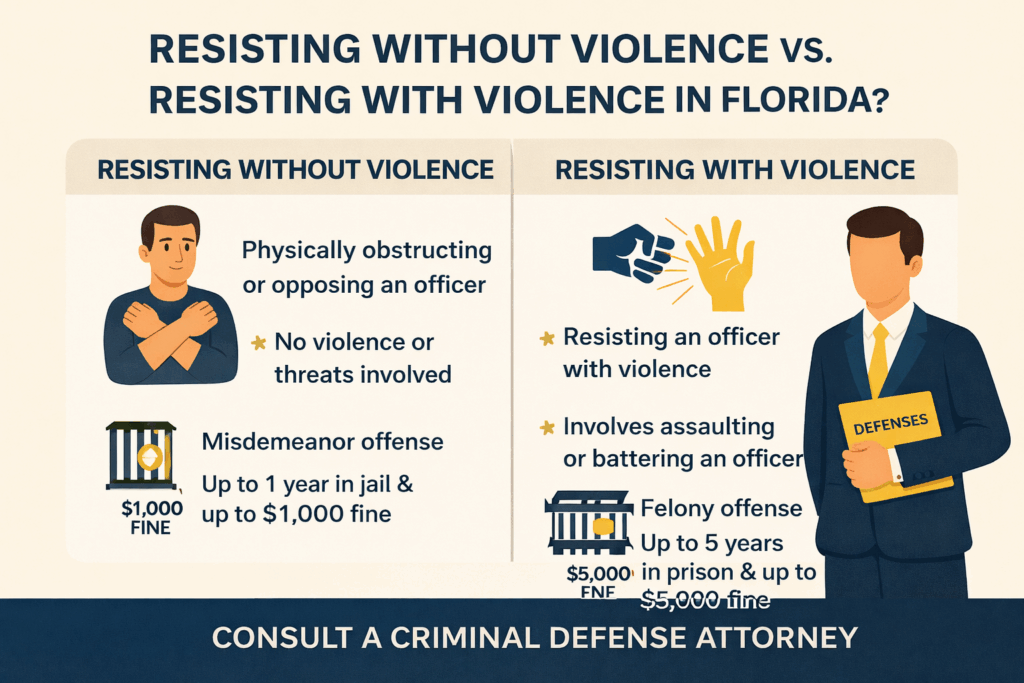
In Florida, resisting arrest can be charged in two very different ways:
-
Resisting Without Violence (RWOV)
-
Resisting With Violence (RWV)
The difference between the two can mean the difference between a misdemeanor and a felony, probation versus prison, and whether force by police becomes legally “justified.”
Unfortunately, these charges are frequently overused and misapplied, especially when arrests escalate quickly or body-worn camera footage tells a different story than the police report.
For a broader overview of how resisting arrest charges arise in Fort Lauderdale, see our guide to Resisting & Obstruction Charges in Florida.
Here’s how Florida law distinguishes the two — and how these cases are defended.
⚖️ Resisting Without Violence (Fla. Stat. § 843.02)
Resisting without violence occurs when a person:
-
Obstructs, resists, or opposes
-
A law enforcement officer
-
Who is engaged in the lawful execution of a legal duty
-
Without using physical force or violence
Common Examples Police Cite
-
Pulling away while being handcuffed
-
Refusing to comply with verbal commands
-
Tensing arms
-
Turning away
-
Giving a false name (see how this is charged in Providing a False Name to Police in Florida)
-
Walking away during questioning
-
Failing to follow instructions
Many of these situations overlap with nonviolent resisting charges. Learn more in Resisting Without Violence in Florida.
Key point:
👉 Verbal opposition alone is not enough unless it actually obstructs a lawful duty.
RWOV is a first-degree misdemeanor, punishable by up to 1 year in jail and probation.
These cases often overlap with investigative stop and unlawful seizure issues.
⚖️ Resisting With Violence (Fla. Stat. § 843.01)
Resisting with violence is far more serious. It occurs when a person:
-
Knowingly and willfully
-
Uses or threatens violence
-
Against a law enforcement officer
-
During the lawful execution of a legal duty
Examples Alleged by Police
-
Pushing or striking an officer
-
Kicking during an arrest
-
Punching, elbowing, or head-butting
-
Grabbing an officer
-
Attempting to flee while using force
RWV is a third-degree felony, punishable by:
-
Up to 5 years in prison
-
Up to 5 years probation
-
$5,000 fine
RWV charges are frequently paired with battery on a law enforcement officer (BAT LEO) allegations.
🔄 Side-by-Side Comparison
| Issue | Without Violence (843.02) | With Violence (843.01) |
|---|---|---|
| Level | Misdemeanor | Felony |
| Force required | No | Yes |
| Jail exposure | Up to 1 year | Up to 5 years |
| Probation | Common | Common |
| Prison | Rare | Possible |
| Often overcharged? | Yes | Very often |
⚠️ When Does Resistance Become “Violence”?
The distinction between resisting with and without violence is not always clear in real-world encounters.
In many cases, the difference depends on how the officer interprets fast-moving physical interactions during an arrest.
Situations that often fall into a gray area include:
- pulling away during handcuffing
- tensing arms or bracing
- reflexive movements during force
- brief or incidental contact with an officer
In these scenarios, what police describe as “violence” may actually be defensive, reflexive, or non-intentional movement. These distinctions are often central to whether a felony charge can be sustained.
🚫 Lawful Execution of a Legal Duty (Critical Element)
Both charges require that the officer was acting lawfully. This requirement applies equally to both misdemeanor and felony resisting charges. If the officer was not acting lawfully, neither charge can stand — regardless of how the conduct is characterized.
If the stop, detention, or arrest was unlawful, you cannot legally be convicted of resisting — with or without violence.
This is where motion to suppress litigation becomes decisive.
Examples:
-
Unlawful detention
-
Arrest without probable cause
If the underlying police action was illegal, the resisting charge often collapses. For a deeper look, see Resisting an Unlawful Arrest in Florida.
🛑 Police Overcharging: How RWOV Becomes RWV
In real cases, RWV is often filed when:
-
The officer loses balance
-
The suspect pulls away reflexively
-
Force is mutual during handcuffing
-
The officer escalates first
-
Bodycam contradicts the report
In practice, these cases often hinge on how quickly the interaction escalated and whether body camera footage supports the officer’s description of events.
Police sometimes label defensive movements as “violence,” even when no strike occurred.
This mirrors the same overcharging pattern seen in BAT LEO and disorderly conduct cases.
🛡️ Defenses to Resisting Charges in Florida
The defenses below apply broadly to resisting arrest cases; felony resisting with violence charges involve additional legal considerations and sentencing exposure that are addressed separately.
At Michael White, P.A., we commonly raise:
✔ Unlawful Stop or Arrest
If the police action was illegal, resisting charges fail.
✔ No Violence
Tensing, pulling away, or reflexive movement ≠ violence.
✔ Self-Defense / Excessive Force
Florida law allows reasonable resistance to excessive or unlawful force.
✔ Body-Worn Camera Contradictions
Video often disproves alleged violence.
✔ Lack of Intent
RWV requires knowing, willful violence — not accidental contact.
✔ Officer Credibility Issues
Inconsistent statements are common and powerful impeachment tools.
🚨 Speak With a Fort Lauderdale Criminal Defense Lawyer Today
Resisting charges often hinge on split-second moments and subjective police narratives.
Early intervention — especially before formal filing — can mean the difference between dismissal, reduction, or a felony conviction.
Contact Michael White, P.A. today to protect your rights.
❓ FAQs — Resisting Arrest in Florida
1. Can I be charged for just arguing with police?
Not by itself. Words alone are usually not enough.
2. Is resisting with violence always a felony?
Yes. It is a third-degree felony.
3. Can resisting charges be dismissed?
Yes — especially if the stop or arrest was unlawful.
4. What if the officer used excessive force first?
You may raise self-defense against unlawful force.
5. Can RWV be reduced to RWOV?
Often yes, especially when video contradicts claims of violence.