
Last updated April 2026
Being arrested does not always mean the arrest was lawful.
In Florida, one of the most important issues in many resisting cases is whether the officer was actually engaged in the lawful execution of a legal duty. If the detention, stop, or arrest was unlawful, that can directly affect whether a resisting charge can stand.
But this area of law is more nuanced than many people realize. Even when police overstep, the question is not always whether a person felt the arrest was unfair. The real issue is whether the officer had legal authority for what occurred, and whether the alleged conduct meets the elements of a resisting offense.
For a broader overview of these charges, see our guide to Resisting Arrest & Obstruction Charges in Florida.
What Makes an Arrest Unlawful in Florida?
An arrest may be unlawful when police act without the legal basis required by Florida law and the Constitution.
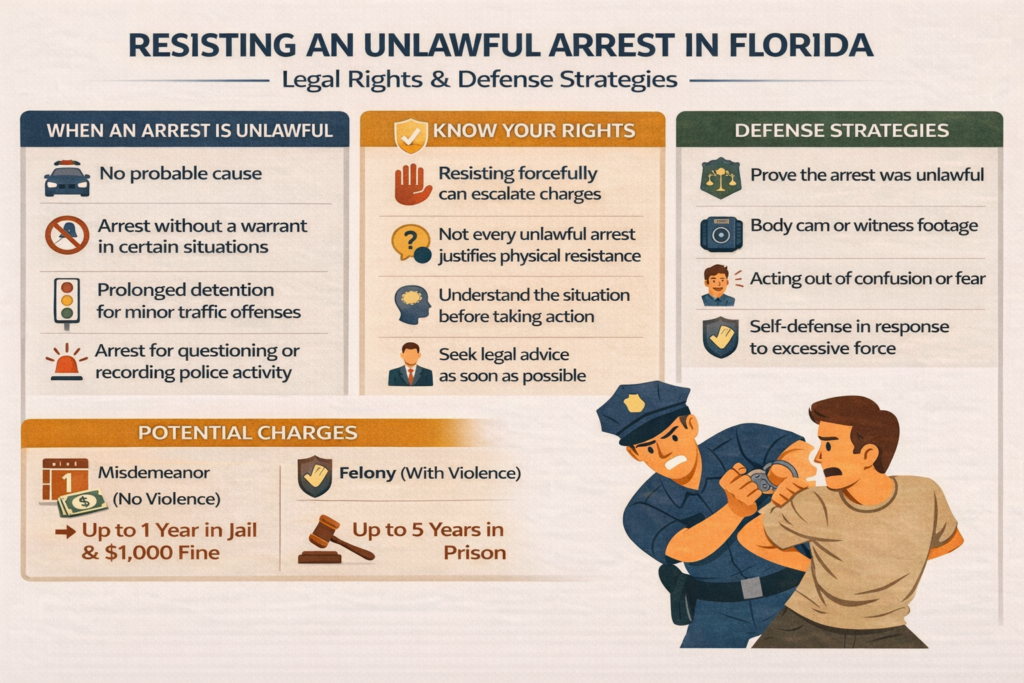
That can happen in situations involving:
- lack of probable cause
- arrest after an unlawful detention
- warrantless arrest where no exception applies
- arrest based on mistaken identity
- arrest following an illegally expanded traffic stop
Not every bad police encounter qualifies as an unlawful arrest, but when officers act without legal authority, that issue can become central to the defense.
Can You Legally Resist an Unlawful Arrest?
This is where many people get tripped up.
Florida law does not give broad permission to physically fight with police simply because the arrest turns out to be unlawful. In many cases, forceful resistance can still lead to serious felony charges, even where the underlying police conduct is later challenged.
At the same time, the legality of the arrest still matters. In resisting cases, the State generally must prove that the officer was engaged in the lawful execution of a legal duty. If that element fails, the resisting charge may fail with it.
That distinction is critical. The issue is usually not whether someone had a practical right to fight the arrest in the moment. The issue is whether the prosecution can prove a lawful arrest or detention as part of the resisting case.
For a more general breakdown of nonviolent resistance charges, see Resisting Arrest Without Violence in Florida.
Why This Issue Matters in Resisting Cases
Many resisting charges are filed quickly and broadly. In practice, officers may add resisting allegations anytime an encounter becomes tense, delayed, or noncompliant.
But resisting charges are not automatic just because an arrest occurred.
If the police lacked probable cause, exceeded the scope of a detention, or attempted an arrest without legal authority, the defense may challenge whether the officer was lawfully performing a duty at all. That can be one of the most important issues in the case.
These are often video-driven cases. Body camera footage, dash camera footage, and civilian recordings may show whether:
- the officer had lawful grounds to act
- commands were clear
- the situation escalated too quickly
- the defendant’s conduct actually interfered with a lawful duty
Common Situations Where Unlawful Arrest Issues Arise
Unlawful arrest arguments often come up in the kinds of encounters that escalate quickly and leave little room for clarification.
Traffic Stops That Go Too Far
A lawful stop can become unlawful if officers prolong it without legal justification or shift into unrelated investigation without proper grounds.
Street Encounters and Stop-and-Identify Disputes
Police do not always have the right to detain someone or demand identification without legal grounds. When that initial contact is unlawful, later resisting allegations may become vulnerable.
Arrests Triggered by Speech or Questioning Authority
Sometimes officers interpret argument, hesitation, or verbal pushback as resistance. But words alone do not always amount to obstruction, especially if the officer lacked a lawful basis for the encounter in the first place.
Encounters Involving Recording Police
Recording law enforcement can raise difficult issues when officers claim the person interfered with the scene. Those cases often turn on distance, commands, timing, and whether the person actually disrupted a lawful investigation.
For that issue, see Recording Police and Obstruction in Florida.
Gray Area: Unlawful Arrest Does Not Automatically Erase Risk
This is one of the most misunderstood parts of the law.
Even where an arrest may ultimately be challenged as unlawful, that does not mean every response in the moment is protected. Physical resistance can still escalate the situation, create separate exposure, and lead to additional allegations.
That is why these cases often require two separate legal questions:
First, was the officer acting lawfully?
Second, did the accused person’s conduct actually satisfy the elements of a resisting charge under Florida law?
Those issues may overlap, but they are not identical.
Defenses in Resisting Cases Involving an Unlawful Arrest
When unlawful arrest issues are present, the defense often focuses on the legal foundation of the encounter itself.
Potential defense arguments may include:
- the officer lacked probable cause to arrest
- the officer unlawfully prolonged the stop or detention
- the officer was not engaged in the lawful execution of a legal duty
- the conduct did not amount to obstruction or resistance under the statute
- the incident involved confusion, fear, or rapid escalation rather than criminal intent
These cases are often stronger than they first appear because the arrest report may flatten a complicated encounter into a simple allegation of noncompliance. Video evidence and careful legal analysis often tell a different story.
Resisting Without Violence vs. Resisting With Violence
Unlawful arrest issues can matter in both misdemeanor and felony resisting cases, but the stakes increase significantly when violence is alleged.
- Resisting without violence is generally charged as a first-degree misdemeanor
- Resisting with violence is typically charged as a felony
If the case involves force allegations, the legal analysis becomes even more important because the penalties increase sharply and the factual disputes are often more intense.
What Happens After a Resisting Charge Based on an Unlawful Arrest?
These cases often move fast at the beginning, but the strongest defenses usually emerge through early review of the evidence.
That can include:
- body camera and dash camera review
- analysis of probable cause
- review of dispatch history and timing
- witness statements
- legal evaluation of whether the officer was performing a lawful duty
In some cases, these issues support dismissal, reduction, suppression arguments, or stronger leverage in negotiations. In others, they reshape the entire theory of the defense.
Charged With Resisting Arrest in Fort Lauderdale?
If you were accused of resisting after an arrest that may have been unlawful, the facts need to be evaluated carefully and early.
These cases often turn on a legal issue hidden underneath the surface allegation: whether the police had lawful authority to do what they did in the first place.
Frequently Asked Questions
Can you resist an unlawful arrest in Florida?
Florida law does not broadly authorize physical resistance just because an arrest may later be shown to be unlawful. But the legality of the arrest can still be central to whether a resisting charge can be proven.
Does an unlawful arrest defeat a resisting charge?
It can. In many resisting cases, the State must prove the officer was engaged in the lawful execution of a legal duty. If that element is missing, the charge may be challenged.
What makes an arrest unlawful in Florida?
Common issues include lack of probable cause, unlawful detention, mistaken identity, and warrantless arrests that do not fit a legal exception.
Is arguing with police the same as resisting arrest?
Not always. Words alone do not automatically amount to resisting or obstruction. The surrounding facts, the officer’s legal authority, and the actual conduct all matter.
Does body camera footage help in unlawful arrest cases?
Often, yes. Video can be critical in showing what the officer knew, what commands were given, whether the detention was lawful, and whether the accused person’s conduct actually interfered with a legal duty.