
Last updated April 2026
Recording police activity is often protected — but that protection is not unlimited.
In Florida, many obstruction and resisting charges arise from situations where someone is filming or questioning law enforcement during an active investigation or arrest. While the First Amendment generally protects the right to record police in public, that right can become legally complicated when officers claim the recording interfered with their duties.
For a broader overview of resisting and obstruction charges, see our guide to Resisting Arrest & Obstruction Charges in Florida.
⚖️ Is It Legal to Record Police in Florida?
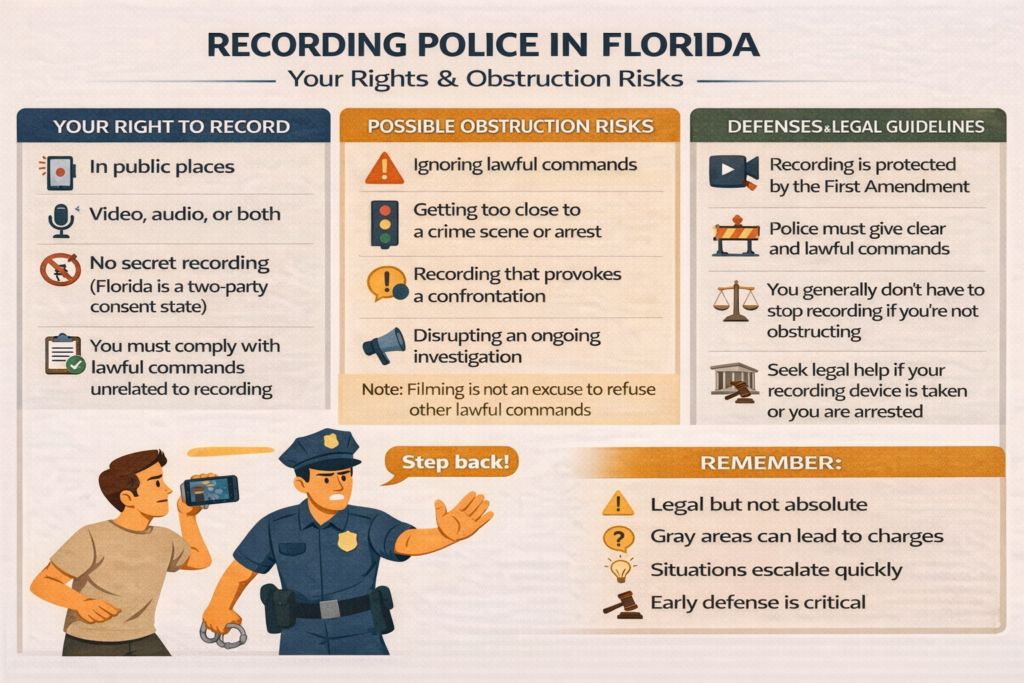
In general, individuals have the right to record law enforcement officers performing their duties in public places.
This includes:
- filming traffic stops
- recording arrests or investigations
- capturing interactions in public spaces
However, Florida is a two-party consent state for audio recording in certain contexts, and the legality of recording can depend on whether the individuals involved have a reasonable expectation of privacy.
More importantly, even lawful recording can become an issue if police believe the conduct interferes with their ability to perform a legal duty.
⚠️ When Recording Can Lead to Obstruction Charges
Recording alone is not obstruction. But the surrounding conduct can lead to charges.
Situations that may result in allegations include:
- getting too close to an active scene after being ordered to step back
- ignoring lawful commands unrelated to recording
- physically interfering with officers or investigations
- escalating a situation while continuing to record
These cases often turn on small details — distance, timing, tone, and whether the officer’s commands were clear and lawful.
🚨 Lawfulness Still Matters
Even in recording cases, the legality of the officer’s actions is critical.
If the officer was not engaged in the lawful execution of a legal duty, an obstruction or resisting charge may not stand.
At the same time, not every disputed command is unlawful. Courts often look at whether the officer had a valid reason to control the scene for safety or investigative purposes.
🧠 Gray Area: Protected Activity vs. Interference
This is where most cases fall.
Recording police is generally protected, but that protection does not extend to conduct that actually interferes with an investigation or creates safety concerns.
Examples of gray area situations include:
- continuing to film after being told to move back
- questioning officers during an active detention
- filming in close proximity to an arrest
- refusing to comply with unrelated lawful commands
In these cases, what one person views as exercising their rights may be interpreted by law enforcement as obstruction.
🛡️ Defenses to Obstruction Charges Involving Recording
In many cases, the defense focuses on whether the recording actually interfered with a lawful police duty.
Potential defenses may include:
- the recording occurred in a public place
- the individual maintained a reasonable distance
- no actual interference occurred
- the officer’s commands were unclear or unlawful
- the situation escalated without legal justification
These cases are often heavily dependent on video evidence — including the very recordings that led to the charge.
⚖️ How These Cases Are Charged
Recording-related cases are typically charged as:
- Resisting or obstructing without violence (misdemeanor)
- In rare cases, more serious charges if physical interference is alleged
Even misdemeanor charges can carry significant consequences, particularly if the case involves allegations of defiance or escalation.
For a breakdown of how nonviolent resisting charges work, see Resisting Arrest Without Violence in Florida.
📍 Why These Cases Are Often Contested
These cases frequently come down to interpretation rather than clear violations.
Key issues often include:
- whether the officer’s commands were lawful
- whether the recording actually interfered
- how quickly the situation escalated
- whether the conduct was intentional
Because of this, small factual differences can have a major impact on the outcome.
📞 Charged With Obstruction While Recording Police?
If you were charged after recording law enforcement, the details of the encounter matter.
These cases often depend on whether the officer was acting lawfully and whether the conduct actually crossed the line from protected activity into obstruction.
Frequently Asked Questions
Can you record police in Florida?
Yes, in most public places, recording police is protected. However, the right is not unlimited and depends on the circumstances.
Can recording police get you arrested?
Recording alone is not a crime, but surrounding conduct — such as interfering with an investigation or refusing lawful commands — can lead to charges.
Do you have to stop recording if police tell you to?
Not necessarily, but you must comply with lawful commands related to safety or scene control. Each situation depends on the facts.
Is recording police protected by the First Amendment?
Generally, yes. Courts recognize a right to record public officials performing their duties, but that right does not allow interference.