
Last updated February 2026
If police find drugs in a car that isn’t yours — or that you were only riding in — you can still be arrested in Florida.
Many people assume that if the vehicle isn’t theirs, or the drugs weren’t in their pocket, they can’t be charged. That’s not how Florida law works.
In shared vehicle situations, prosecutors often rely on a legal theory called constructive possession — which allows charges even when drugs are not found directly on your person.
Understanding how this works can make the difference between dismissal and a felony conviction.
These arrests arise within Florida drug crimes prosecutions, where knowledge and control must be proven beyond a reasonable doubt.
⚖️ Can You Be Charged If the Car Isn’t Yours?
Yes.
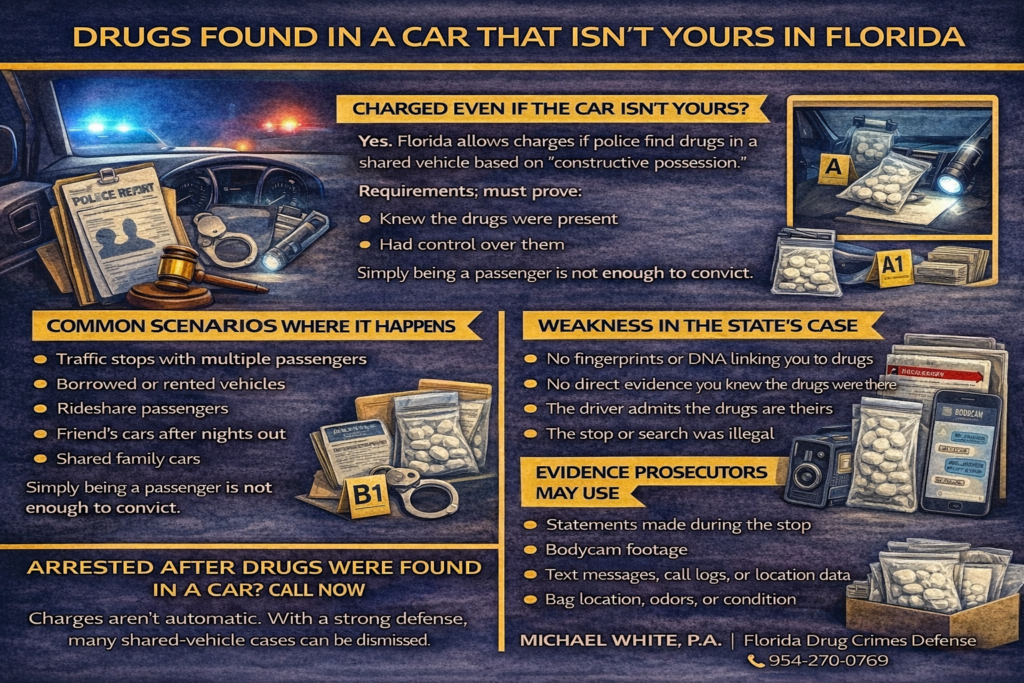
In Florida, drug possession does not require ownership of the vehicle. It requires proof that you:
Knew the drugs were present, and
Had control or dominion over them.
That second requirement is where most of these cases rise or fall.
Simply being present in a vehicle where drugs are found is not enough to convict someone. But police often arrest everyone in the car and let the courts sort it out later.
🧍 What Is Constructive Possession?
When drugs are not found on your body but are located in a shared space — like a center console, under a seat, or in the trunk — prosecutors must prove constructive possession.
Under Florida law, that means the State must prove:
You had knowledge of the drugs, and
You had the ability to exercise control over them.
If multiple people had access to the area, the State’s burden becomes much heavier.
For a deeper explanation of how courts analyze these cases, see our guide to constructive possession in Florida drug cases.
For a deeper explanation of how courts analyze these cases, see our guide to constructive possession in Florida drug cases.
🚓 Common Scenarios Where This Happens
These arrests frequently occur in:
Traffic stops involving multiple passengers
Borrowed or rented vehicles
Rideshare stops
Friend’s cars after a night out
Shared family vehicles
Vehicles searched after DUI stops
Officers may claim:
The drugs were in “plain view”
The odor of marijuana gave probable cause
Everyone in the car had equal access
Someone appeared nervous or evasive
But proximity is not the same as possession.
🚫 When the State’s Case Is Weak
Drug charges in shared-car cases often collapse when:
There are multiple occupants and no direct evidence linking you to the drugs
No fingerprints or DNA connect you to the packaging
The drugs were found in someone else’s bag
The driver admits ownership
The stop or search was unlawful
The vehicle search was extended beyond lawful limits
If police conducted an illegal stop or search, your attorney may file a motion to suppress. If key evidence is excluded, the prosecution may be unable to proceed.
🧪 What Evidence Prosecutors Rely On
In these cases, the State often tries to use:
Statements made during the stop
Bodycam footage
Text messages or phone data
Location of the drugs inside the vehicle
Prior arrests or history
Alleged admissions
But without clear proof of knowledge and control, juries frequently find reasonable doubt.
📍 What Happens After the Arrest?
If you’re arrested in a shared-vehicle drug case, the process usually includes:
First appearance and bond determination
Evidence review and lab testing
Discovery exchange
Pretrial motions (including suppression hearings)
Negotiation or trial
Early legal intervention can dramatically affect whether charges are reduced, diverted, or dismissed.
🛡️ How We Defend “Not My Drugs” Cases
At Michael White, P.A., we focus on:
Challenging constructive possession
Attacking unlawful searches
Exposing weak evidence
Separating passengers from drivers
Preventing assumptions from becoming convictions
Being in the wrong car at the wrong time should not define your future.
📞 Arrested After Drugs Were Found in a Car? Act Quickly.
If you were arrested because drugs were found in a vehicle you were riding in — whether it was yours or not — do not assume the case is automatic.
These cases are often defensible.
📲 Call (954) 270-0769 or schedule a free consultation today.
❓ Frequently Asked Questions
Can I be arrested for drugs found in someone else’s car?
Yes. Florida law allows charges under constructive possession, even if you don’t own the vehicle.
What if I didn’t know the drugs were there?
The State must prove knowledge. Without evidence you knew about the drugs, conviction is far from guaranteed.
Does being a passenger make a difference?
It can. Passengers are often charged, but prosecutors must still prove control and knowledge.
What if the driver admits the drugs were theirs?
That can significantly weaken the case against passengers, but police may still pursue charges.
Can this kind of case be dismissed?
Yes. Many shared-vehicle drug cases are dismissed when the State cannot prove constructive possession or when evidence is suppressed.