
Last updated May 2026
Possession of child pornography — often referred to in modern statutes and courtrooms as child sexual abuse material (CSAM) — is aggressively investigated and prosecuted in Florida.
These cases are typically built through digital forensics, search warrants, and online investigative techniques — often before a suspect even knows they are under investigation.
Despite the seriousness of the charge, prosecutors must still prove specific statutory elements beyond a reasonable doubt.
Florida law in this area continues to evolve, particularly with recent legislative updates affecting how these cases are charged and prosecuted. You can read more about those changes in our overview of Florida’s updated CSAM laws.
For a broader explanation of how online investigations begin and how digital evidence is used, see our guide to Internet Sex Crimes in Florida.
Many of these cases develop from broader online investigations involving communication-based offenses. See how these cases begin in Online Solicitation Of A Minor In Florida.
⚖️ The Governing Florida Statute
CSAM possession cases are generally prosecuted under Fla. Stat. § 827.071.
The statute makes it a crime to knowingly:
-
Possess
-
Control
-
View
-
Or intentionally access
Material that depicts a minor engaged in sexual conduct as defined by Florida law.
Each file or image may be charged as a separate count.
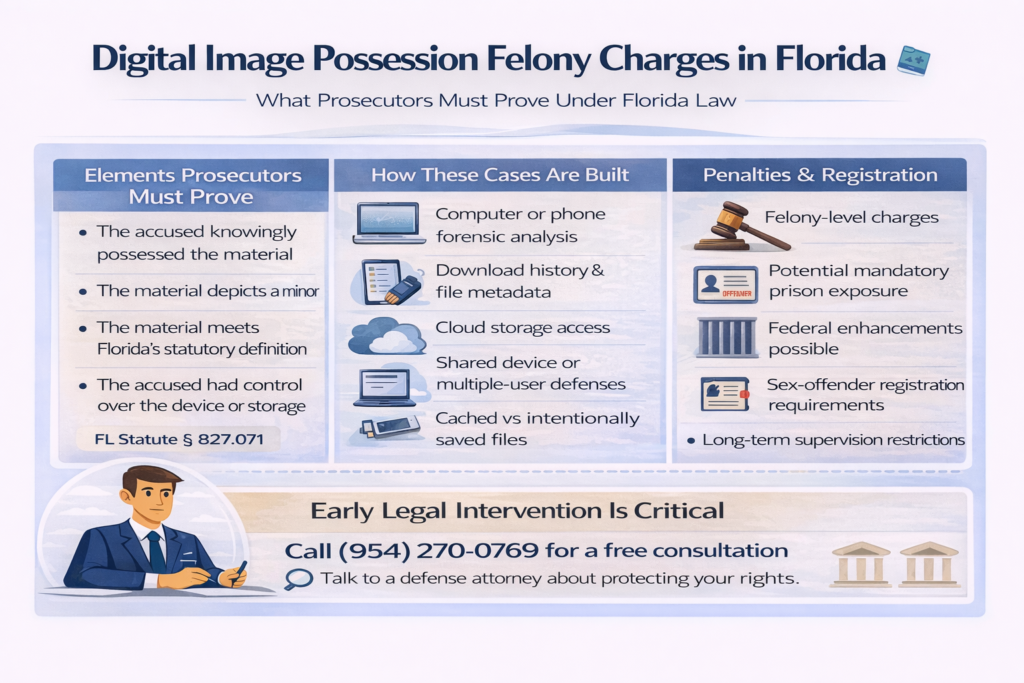
📋 What Prosecutors Must Prove
To convict, the State must establish:
1️⃣ The Material Depicted a Minor
The prosecution must prove:
-
The person shown was under 18
-
The content meets Florida’s statutory definition of sexual conduct
This may involve:
-
Expert testimony
-
Forensic analysis
-
Circumstantial evidence
Age cannot simply be assumed — it must be proven.
2️⃣ The Defendant Knowingly Possessed or Accessed the Material
This is the most litigated element.
The State must show:
-
Awareness of the file’s presence
-
Intentional possession or viewing
-
More than accidental or automatic download
Mere presence of a file on a device is not automatically enough.
Knowledge matters.
3️⃣ The Defendant Exercised Control
Prosecutors may attempt to show:
-
Files were intentionally downloaded
-
Files were saved or organized
-
Search terms were used
-
The material was accessed repeatedly
-
Sharing or distribution occurred
Control becomes disputed in cases involving:
-
Shared computers
-
Multiple household users
-
Remote access
-
Automatic downloads
-
Peer-to-peer background activity
🧠 The Knowledge vs. Accident Defense Issue
Many cases hinge on whether possession was intentional.
Common defense themes include:
-
Auto-cached files
-
Thumbnail generation
-
Accidental downloads
-
Pop-ups or redirects
-
Malware
-
Shared Wi-Fi or shared devices
-
Cloud auto-sync behavior
Digital forensic analysis often determines whether a file was:
-
Opened
-
Viewed
-
Searched for
-
Or merely present
The difference between intentional conduct and passive presence can determine the case outcome.
📁 Deleted Files and Forensic Recovery
Prosecutors frequently rely on:
-
Deleted file recovery
-
Unallocated space analysis
-
Artifact logs
-
Internet history
-
Search history
However, recovery of a deleted file does not automatically prove:
-
Who accessed it
-
When it was accessed
-
Whether it was intentionally downloaded
-
Whether it was ever viewed
Technical nuance matters in these cases.
🚨 Each Image Can Be a Separate Count
In Florida, each image or file may be charged separately.
That means:
-
Multiple third-degree felony counts
-
Potential stacking of exposure
-
Increased sentencing leverage
In negotiations, count volume can dramatically affect strategy.
🏛 State vs. Federal Prosecution
Some possession of child pornography investigations are prosecuted federally rather than in state court.
Federal cases may involve:
-
Joint task forces
-
Homeland Security investigations
-
Cross-state file sharing
-
Larger digital evidence volumes
Federal sentencing structures are significantly different and often more severe.
The forum of prosecution can materially affect exposure.
🔐 Search & Seizure Issues in CSAM Cases
Digital device searches are central to these prosecutions.
Legal challenges may involve:
-
Whether a valid warrant existed
-
Whether probable cause was sufficient
-
Whether the warrant was overbroad
-
Whether the search exceeded scope
-
Whether statements were lawfully obtained
Digital search warrants can be complex and occasionally vulnerable to suppression challenges.
❗ Common Misconceptions
“If I deleted it, I can’t be charged.”
Deleted files are often recoverable through forensic tools.
“If I didn’t open it, it doesn’t count.”
Possession may be alleged even without evidence of viewing, depending on control and access evidence.
“If someone sent it to me, I’m not responsible.”
Intent and knowledge still become central issues.
“If it was on a shared computer, I’m automatically safe.”
Shared access complicates the case — but does not automatically defeat it.
📉 Sentencing Exposure
CSAM possession in Florida can carry:
-
Third-degree felony penalties per image
-
Significant prison exposure
-
Mandatory sex offender registration— which can impose long-term restrictions on where you live, work, and travel. Learn more in Register As A Sex Offender For Sexting Charges In Florida
-
Probation and supervision
-
Federal prosecution risk in certain cases
Sentencing exposure depends heavily on:
-
Number of counts
-
Prior record
-
Distribution allegations
-
Jurisdiction (state vs. federal)
🛑 What To Do If You Are Under Investigation
If you believe you are under investigation:
-
Do not consent to a device search
-
Do not attempt to delete data
-
Do not speak to investigators without counsel
-
Preserve your rights immediately
Early legal analysis of digital evidence and warrant procedure can significantly affect case direction.
📞 If You Are Facing a CSAM Possession Charge
CSAM possession allegations are serious and emotionally charged.
But prosecutors must still prove:
-
Age
-
Knowledge
-
Control
-
Intentional possession
Digital forensic details and search procedure often determine whether the State can meet that burden.
If you are under investigation or charged in Broward County or South Florida, early strategic legal review is critical.
❓FAQs
1️⃣ Does the State have to prove I actually viewed the image?
Not always. Prosecutors must prove knowing possession or access, but viewing may be inferred from forensic evidence depending on the circumstances.
2️⃣ Can accidental downloads lead to charges?
Charges can be filed, but the issue becomes whether possession was knowing and intentional.
3️⃣ Can police trace downloads back to a specific person?
Investigators often trace IP addresses to residences, but linking a device or download to a specific person may require additional evidence.
4️⃣ Can CSAM possession charges be reduced?
Outcomes depend on evidence strength, number of counts, and procedural issues. Negotiation and litigation strategy vary case by case.
5️⃣ Will a conviction require sex offender registration?
In many cases, yes. Registration consequences can be long-term or lifetime depending on classification.