
Last updated April 2026
Most people assume that Miranda rights apply the moment police start asking questions. That’s not how the law works.
In Florida, Miranda protections apply only during custodial interrogation. That means two things must be true:
-
You are in custody, and
-
Police are interrogating you.
To understand when Miranda rights are triggered and what protections they provide, see our guide to Miranda rights in Florida.
Understanding what legally qualifies as “custody” is critical — because if you were in custody and questioned without proper warnings, your statements may be suppressed.
⚖️ The Legal Standard: What Is “Custody”?
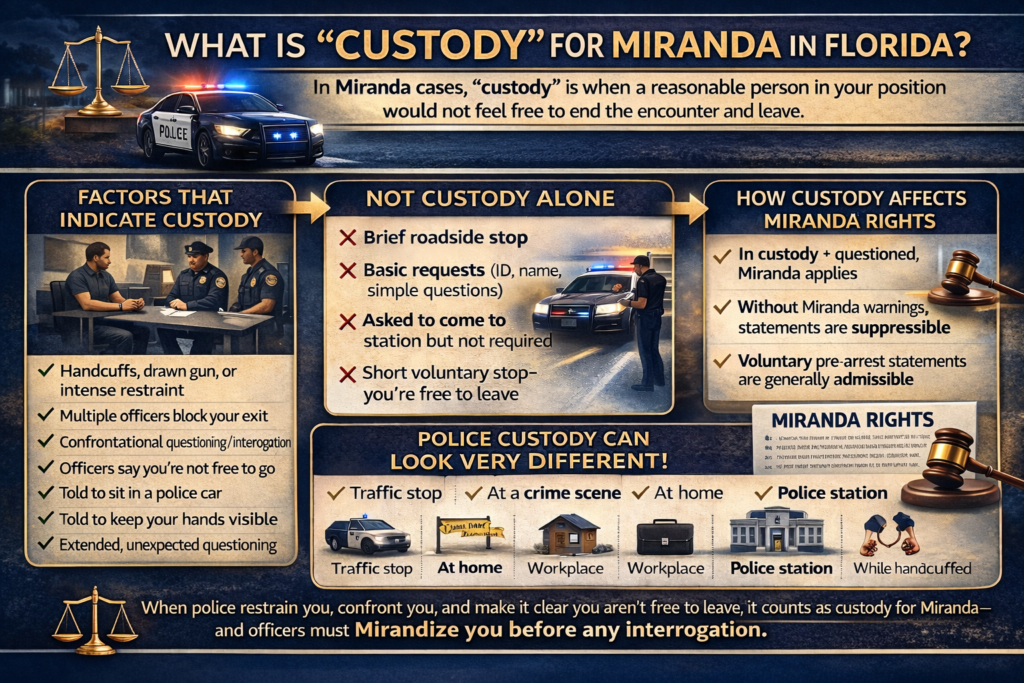
You are considered in custody when a reasonable person in your position would believe they are not free to leave.
Courts look at the totality of the circumstances, not just whether you were formally arrested.
Custody is about restraint on freedom equivalent to a formal arrest.
🚓 Situations That Usually Count as Custody
Florida courts commonly find custody when:
-
You are formally arrested
-
You are handcuffed
-
You are placed in the back of a patrol car
-
Officers tell you that you are not free to leave
-
You are transported to a station for questioning
-
Police physically restrain or block your movement
-
The encounter becomes prolonged and accusatory
If questioning occurs under these conditions without Miranda warnings, suppression may follow.
🚫 Situations That Usually Do NOT Count as Custody
Miranda does not apply automatically in every police interaction.
Courts often find no custody during:
-
Routine traffic stops
-
Temporary investigative detentions (Terry stops)
-
Voluntary interviews
-
Casual on-scene questioning
-
Brief roadside encounters
-
General fact-finding conversations
Even though these situations can feel intimidating, they may not legally qualify as custody.
🚦 Traffic Stops and Custody: A Common Confusion
Traffic stops are one of the most misunderstood areas of Miranda law.
A typical traffic stop is considered a temporary investigative detention, not custody. However, a stop can become custodial if:
-
You are removed from the vehicle and restrained
-
The duration becomes excessive
-
Questioning shifts from traffic matters to criminal investigation
-
You are told you are under arrest or not free to leave
When a stop crosses that line, Miranda protections attach.
🧠 Factors Courts Examine to Determine Custody
Judges look at several objective factors:
-
Location of questioning
-
Duration of detention
-
Number of officers present
-
Tone and language used by officers
-
Physical restraints used
-
Whether weapons were displayed
-
Whether you were told you could leave
No single factor controls the outcome. The analysis is highly fact-specific.
🧠 Where Miranda Custody Cases Often Turn
In many cases, the issue is not whether police claim you were free to leave — it’s whether the situation actually felt that way.
Common problems include:
- officers retaining identification or personal propert
- positioning that blocks movement
- tone and language suggesting compliance is required
- prolonged questioning that shifts from casual to accusatory
These subtle details often determine whether a court finds custody existed.
🔄 Custody vs. Interrogation
Even if you are in custody, Miranda applies only if police are engaging in interrogation.
Interrogation includes:
-
Direct questions about criminal activity
-
Statements officers should know are likely to produce incriminating responses
It does not include:
-
Routine booking questions
-
Basic identification requests
-
Voluntary, spontaneous statements
Both custody and interrogation must exist for Miranda suppression to apply.
The distinction between casual conversation and interrogation is often unclear, particularly when talking to police without a lawyer in Florida.
🛑 What Happens If You Were in Custody Without Miranda?
If police questioned you while you were in custody and failed to give Miranda warnings:
-
Your statements may be suppressed
-
Prosecutors may lose key admissions
-
Derivative evidence may be challenged
These issues are typically raised through a motion to suppress in Florida, where the defense challenges the legality of the questioning.
Even when warnings are given, statements may still be challenged if the waiver was not valid, as explained in invalid Miranda waivers in Florida.
🧑⚖️ Real-World Examples in South Florida
Miranda custody disputes frequently arise in:
-
DUI roadside investigations
-
Drug interdiction stops
-
Domestic disturbance calls
-
Probation violation investigations
-
Police station interviews where officers claim the encounter was “voluntary”
In many cases, bodycam footage contradicts officer claims about whether someone was free to leave.
In some situations, statements made before warnings are given may still be used depending on how they were obtained. Learn more in statements made before Miranda in Florida.
🛡️ Why Custody Analysis Matters
Miranda cases often turn on subtle factual details:
-
Was the patrol car door locked?
-
Were you surrounded by officers?
-
Did police retain your ID?
-
Were you told you were “just being detained”?
Small details can determine whether statements are admissible or excluded.
📍 Fort Lauderdale Miranda Defense Strategy
At Michael White, P.A., we analyze:
-
Body-worn camera footage
-
Timing of questioning
-
Officer tone and phrasing
-
Whether you invoked your rights
-
Whether questioning continued after invocation
Custody disputes are often decisive in suppression hearings.
🚨 Questioned by Police Without Miranda?
If you were questioned while restrained, detained, or placed in a patrol car — and Miranda warnings were not given — you may have strong suppression arguments.
📞 Call (954) 270-0769 for a free consultation.
We’ll review the encounter and determine whether your statements can be excluded.
❓ FAQs — Miranda Custody in Florida
Does being handcuffed automatically mean I was in custody?
Usually yes, but courts still examine the full context.
Are traffic stops considered custody?
Not automatically. Most routine traffic stops are investigative detentions, not custody — unless they escalate.
If I went to the station voluntarily, was I in custody?
It depends. Courts examine whether you were truly free to leave.
What if police never told me I was under arrest?
Formal arrest language is not required. The test is whether a reasonable person would feel free to leave.
Can my statements be thrown out if I was in custody without Miranda?
Yes. Statements obtained during custodial interrogation without proper warnings may be suppressed.