
Last updated April 2026
When police violate Miranda during custodial interrogation, the remedy is usually suppression — meaning your statements can be excluded from evidence. And in many cases, once statements are suppressed, the prosecution loses its strongest proof and the case changes immediately.
This page focuses on how Miranda suppression is litigated in Florida courts, what judges look for at evidentiary hearings, and how defense counsel attacks the State’s claim that a “waiver” was valid.
For a plain-English explanation of when Miranda applies (custody + interrogation), see our guide to Miranda rights in Florida.
🛑 Miranda Violations Lead to Suppression — Not Automatic Dismissal
A Miranda violation does not automatically dismiss a case. Instead, the legal impact is usually:
-
The statements are excluded
-
The State must proceed without them
-
Prosecutors often lose leverage, narrative control, or essential elements of proof
In many prosecutions — especially where the State relies on admissions to establish intent, knowledge, or identity — the defendant’s own words are the backbone of the case. Suppressing those statements can drive reductions or dismissal.
✅ The Three Litigation Questions Judges Decide
At a Miranda suppression hearing, courts typically focus on three issues:
1) Was it custody?
Even if Miranda basics are covered elsewhere, custody is still litigated in detail. Courts look at restraints, location, duration, the number of officers, and whether the situation became “functionally equivalent” to arrest.
2) Was it interrogation?
Judges analyze whether officers asked questions (or used tactics) they should have known were likely to elicit incriminating responses — including subtle questioning designed to produce admissions.
3) Was there a valid waiver?
If warnings were given, the State must still show the waiver was knowing, intelligent, and voluntary. Waiver is frequently where suppression is won.
Whether a waiver is legally valid is often the central issue, as explained in invalid Miranda waivers in Florida.
🧠 Where Miranda Suppression Cases Often Turn
In many cases, the outcome does not depend on whether warnings were given — but on how the interaction unfolded.
Common issues include:
- subtle questioning that becomes interrogation
- unclear or incomplete warnings
- timing gaps between questioning and warnings
- officer testimony that conflicts with video evidence
These details often determine whether statements are admitted or suppressed.
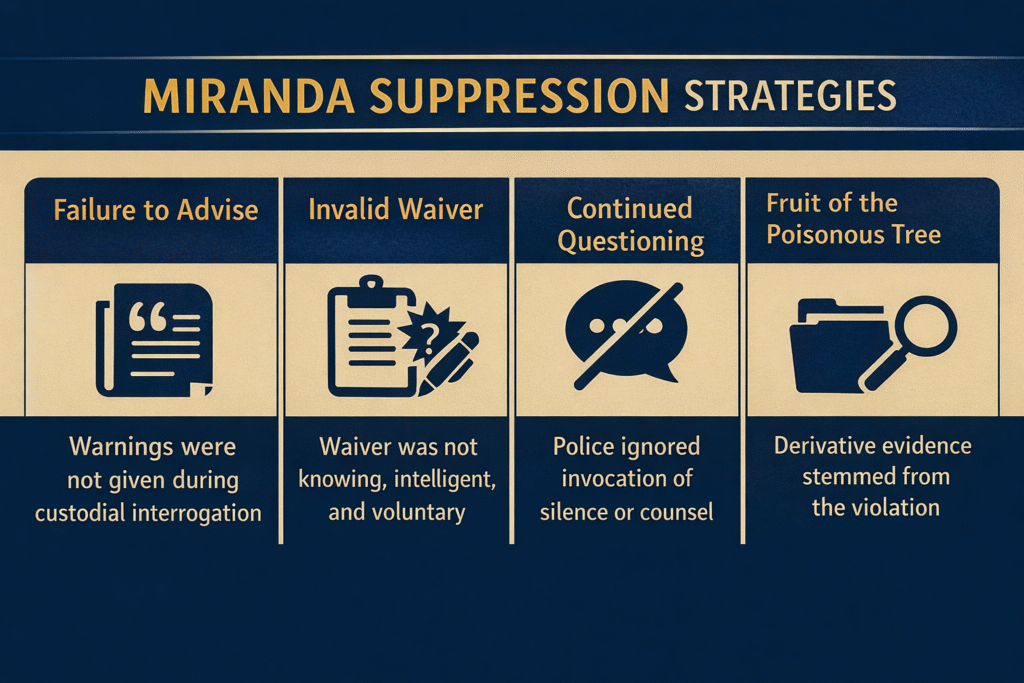
🧠 The Most Effective Miranda Suppression Arguments in Florida
Below are the core ways defense lawyers attack statements in real cases:
❌ Failure to Advise Miranda
If police questioned a person in custody without warnings, the resulting statements are generally inadmissible.
In some cases, statements may still be admissible even without warnings, depending on how they were obtained. Learn more in statements made before Miranda in Florida.
❌ Invalid or Coerced Waiver
Even where Miranda is read, statements may still be suppressed when the waiver was not voluntary or not truly understood. Common fact patterns include:
-
Intoxication or impairment
-
Mental health crisis or sleep deprivation
-
Language barriers or comprehension issues
-
Officers minimizing the significance of rights (“just routine,” “we need your side,” etc.)
-
Pressure tactics that cross the line into coercion
❌ Continued Questioning After Invocation
Once a person clearly invokes:
-
the right to remain silent, or
-
the right to counsel
police must stop questioning. Continued interrogation after a clear invocation is a suppression issue — and credibility/timing often decides it.
❌ “Question First” / Two-Step Interrogations
Some officers question first, obtain admissions, then read Miranda and re-ask questions. Courts scrutinize whether the warnings were used as a “cure” for earlier unlawful questioning. If it’s a deliberate two-step tactic, suppression is often on the table.
🌳 When a Miranda Violation Affects More Than the Statement
In some cases, the harm isn’t limited to the confession.
If officers obtain:
-
additional admissions
-
investigative leads
-
consent to search
-
or physical evidence
Courts may also examine whether the evidence was derived from the unconstitutional interrogation and whether the connection is strong enough to justify exclusion.
These issues are often litigated alongside broader suppression arguments.
👉 For the procedural roadmap and hearing mechanics, see motion to suppress evidence in Florida.
🧑⚖️ What Happens at a Miranda Suppression Hearing
Miranda suppression issues are decided by a judge, not a jury.
At an evidentiary hearing, the court typically reviews:
-
Bodycam footage and interview video
-
Time stamps, sequence of questioning, and tone
-
The exact wording of the warnings
-
Whether invocation was clear and when it occurred
-
Officer testimony versus the video record
Small inconsistencies — especially on timing, location, and “who said what first” — often decide the ruling.
🛡️ How Miranda Suppression Changes Cases
When statements are suppressed:
-
Confessions and admissions are excluded
-
The State often loses leverage for plea negotiations
-
Charges may be reduced
-
Some cases are dismissed when the statements were essential proof
Miranda suppression is one of the most effective pretrial defense tools in Florida criminal cases — especially where the government relies on statements to establish intent, knowledge, or motive.
📍 Fort Lauderdale Defense Strategy for Miranda Suppression
At Michael White, P.A., we litigate Miranda issues by:
-
Reviewing bodycam and interview recordings for custody/interrogation triggers
-
Challenging whether a waiver was voluntary and informed
-
Pinning down timing and invocation language
-
Cross-examining officers on contradictions and missing steps
-
Filing targeted motions to suppress statements
Miranda suppression arguments can also be combined with broader constitutional challenges when misconduct extends beyond interrogation.
📞 Call (954) 270-0769 or request a free consultation.
Serving Fort Lauderdale, Broward County, Miami-Dade, Palm Beach County, and South Florida.
💬 FAQs: Miranda Suppression in Florida
What happens if police violate my Miranda rights?
Your statements may be excluded from evidence. The rest of the case proceeds without them.
Will my case be dismissed if my statements are suppressed?
Not automatically, but many cases weaken significantly or collapse without the defendant’s statements.
Do Miranda violations apply during traffic stops?
Usually no — unless the stop escalates into custody and interrogation.
Can statements be suppressed even after Miranda was read?
Yes. Waivers must be knowing, intelligent, and voluntary. Coercion or confusion can invalidate them.
How does a lawyer raise Miranda suppression issues?
By filing a motion to suppress and litigating the issue at a pretrial evidentiary hearing.