
Last updated December 2025
🛑 What Is a Motion to Suppress in a Florida Criminal Case?
Fight Back When Police Violate Your Rights
If you were arrested in Fort Lauderdale or anywhere in South Florida and police overstepped their legal bounds, a motion to suppress could be the key to getting your case dismissed.
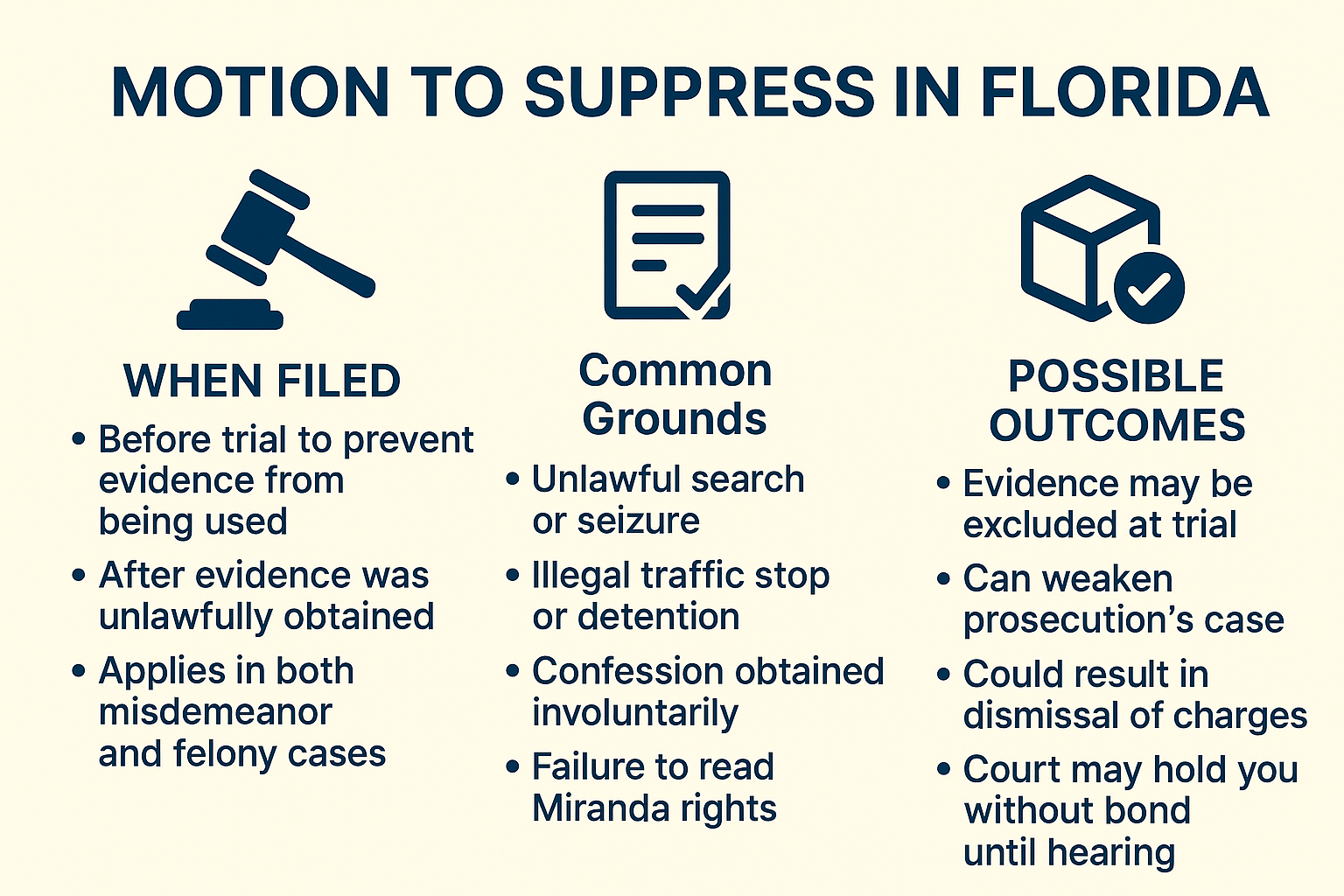
This powerful legal tool asks the court to exclude evidence obtained through unlawful searches, stops, detentions, or interrogations. If the judge grants the motion, the State may be left with little or no evidence to prosecute — and many cases end in dismissal or major charge reductions.
⚖️ What Is a Motion to Suppress?
A motion to suppress is a formal written request asking the judge to keep out evidence that was obtained in violation of your constitutional rights. In Florida, these rights come from:
The Fourth Amendment (unreasonable searches and seizures)
The Fifth Amendment (self-incrimination and Miranda warnings)
The Sixth Amendment (right to counsel)
Article I, Section 12 of the Florida Constitution (state equivalent of the Fourth Amendment)
A motion to suppress often targets:
Evidence from a warrantless search
Drugs, weapons, or contraband found during an unlawful stop or arrest
Statements made without proper Miranda warnings
Evidence that is the “fruit of the poisonous tree” (evidence found only because of an earlier illegal act)
If police violated your rights, the court can suppress that evidence — and sometimes the State is forced to drop the case entirely.
🚨 Common Legal Grounds for Suppression in Florida
We frequently file motions to suppress in cases involving:
🚔 1. Illegal Traffic Stops
Police must have reasonable suspicion to stop your vehicle. Stops based solely on:
Vague “weaving” or “slow speed”
Non-existent lane violations
Mere presence in a “high-crime area”
…may be unconstitutional. If the stop was illegal, everything that follows (statements, field sobriety tests, searches) can be thrown out.
🔍 2. Warrantless SearchesWithout a Valid Exception
Warrantless searches are presumptively illegal unless the State proves an exception, such as:
Consent
Search incident to arrest
Plain view
Automobile exception
Exigent circumstances
We challenge whether those exceptions actually apply and whether they were created after the fact to justify a bad search.
🧍♂️ 3. Illegal Pat-Downs and Detentions
An officer needs reasonable suspicion that you are armed and dangerous to pat you down. “Officer safety” alone is not enough. If the pat-down was unlawful, any weapon or contraband found may be suppressed.
🏠 4. Home or Vehicle Searches Without Probable Cause
The home receives the highest level of constitutional protection. We frequently litigate:
Warrantless entries into homes, apartments, and hotel rooms
Overbroad or stale search warrants
Searches of trunks, closed containers, or locked areas in vehicles without probable cause
🎙️ 5. Miranda and Interrogation Violations
If you were in custody and officers interrogated you without proper Miranda warnings, your statements can be suppressed. Even if Miranda was read, statements may be excluded if:
You asked for a lawyer and questioning continued
You were threatened, coerced, or promised specific outcomes
You did not understand your rights due to language or mental health issues
For deeper dives into specific suppression issues:
📂 Case Example: How a Motion to Suppress Won a Dismissal
Here’s how a motion to suppress typically plays out in a real case:
We investigate the stop and arrest
We review reports, 911 calls, bodycam, dashcam, and any warrant affidavits.We file a detailed written motion
The motion explains the facts, cites the law, and lays out exactly why the evidence should be suppressed.The court schedules an evidentiary hearing
At this hearing, the State must justify how the officers obtained the evidence.Officers testify and are cross-examined
We question them on timing, distances, observations, inconsistencies, and any missing steps in procedure.The judge rules on whether to exclude the evidence
If the motion is granted, the suppressed evidence cannot be used at trial.
In many cases, once a key piece of evidence is suppressed — such as drugs, a gun, or incriminating statements — the prosecutor has no choice but to dismiss or drastically reduce the charges.
This hearing can completely change the trajectory of a case. It’s critical to have a seasoned Fort Lauderdale defense lawyer who actually knows how to litigate suppression issues.
🧷 What Evidence Can Be Suppressed?
A motion to suppress may target:
Physical evidence (drugs, firearms, money, paraphernalia, stolen property)
Digital evidence (cell phone data, text messages, GPS, cloud backups)
Verbal statements (confessions, admissions, comments made during traffic stops)
Identification evidence (show-ups, lineups, photo arrays tainted by suggestive procedures)
If the evidence was discovered only because of an earlier constitutional violation, it may be considered “fruit of the poisonous tree” and excluded as well.
📍 Why Hire Michael White, P.A. to File Your Motion to Suppress?
As a former prosecutor, I know exactly how the State builds its case — and where officers tend to cut corners. That experience allows me to spot issues other lawyers overlook.
At Michael White, P.A., we:
Audit your entire arrest for constitutional violations
Demand and review bodycam, dashcam, CAD, and warrant materials
Draft precise, fact-specific motions to suppress
Cross-examine law enforcement with a prosecutor’s eye
Fight to keep illegally obtained evidence out of court — and leverage successful rulings into dismissals or favorable pleas
📞 Call (954) 270-0769 or request a free consultation to find out whether a motion to suppress could change the course of your case.
💬 FAQs About Motions to Suppress in Florida
❓ What is a motion to suppress in a Florida criminal case?
A motion to suppress asks the court to exclude evidence obtained through illegal or unconstitutional means, such as an unlawful search or failure to read Miranda rights.
❓ What happens if the judge grants a motion to suppress?
If the motion is granted, the excluded evidence cannot be used at trial. This often weakens the prosecution’s case significantly—and may lead to a dismissal.
❓ Can I file a motion to suppress if I consented to a search?
Possibly. If your “consent” was coerced, unclear, or obtained without proper advisements, a motion to suppress may still succeed.
❓ When is the best time to file a motion to suppress in Florida?
Motions to suppress are usually filed after arraignment and before trial. Your defense attorney will review discovery to identify any constitutional violations.
❓ Does a motion to suppress apply to verbal statements too?
Yes. If you made statements without receiving proper Miranda warnings or during an illegal detention, those statements can be suppressed.
✅ Ready to Protect Your Rights?
If police crossed the line, we’ll fight to keep their evidence out of court — and protect your future.
📍 Serving Fort Lauderdale, Broward County, and all of South Florida.
👉 Schedule Your Free Consultation Now.