Last updated April 2026
In every Florida probation violation case, two words determine the outcome:
Willful and substantial.
A judge cannot revoke probation unless the State proves that the alleged violation was both.
If either element is missing, revocation should not occur.
For a broader explanation of how probation violations work, including hearings and outcomes. For a full overview of how these cases are handled, see our guide to probation violations in Florida.
Here’s what “willful and substantial” actually means — and how it affects your case.
⚖️ The Legal Standard in Florida VOP Cases
Unlike a new criminal charge, a probation violation does not require proof beyond a reasonable doubt.
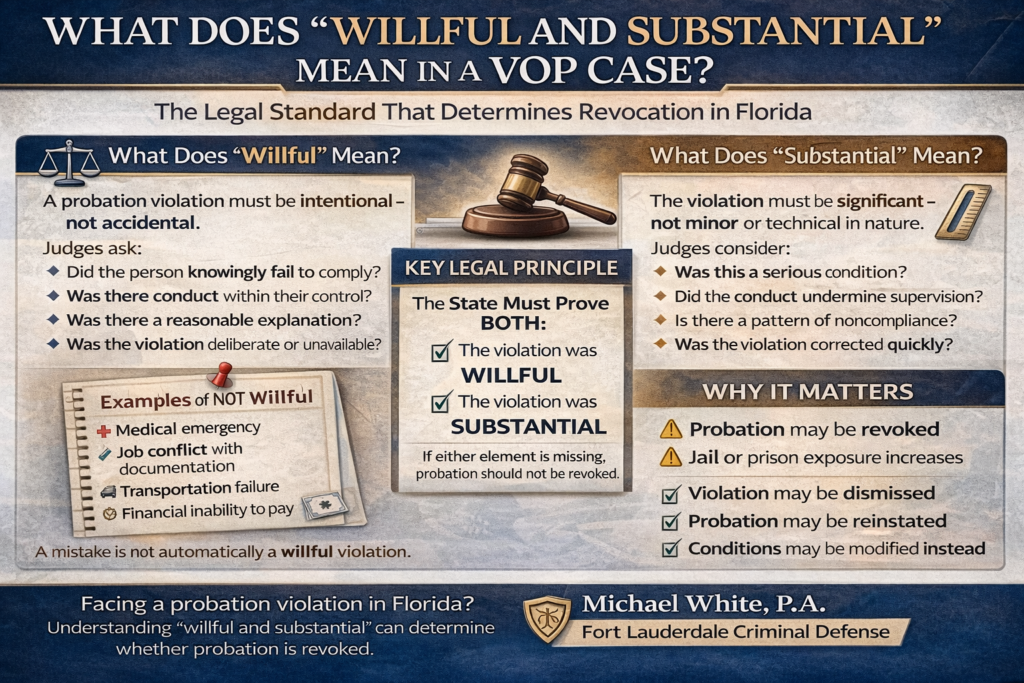
However, Florida courts require proof that the violation was:
✔ Willful (intentional)
AND
✔ Substantial (significant)
Both elements must be established under the greater weight of the evidence standard.
What Does “Willful” Mean?
A violation is willful if the conduct was intentional and within the person’s control.
Judges ask:
-
Did the person knowingly fail to comply?
-
Was compliance reasonably possible?
-
Was the conduct deliberate rather than accidental?
-
Was there a reasonable excuse?
Examples That May NOT Be Willful
-
Medical emergencies
-
Verified job conflicts
-
Transportation breakdowns
-
Inability to pay due to genuine financial hardship
-
Miscommunication with a probation officer
If compliance was impossible or genuinely outside the person’s control, the violation may not be willful.
What Does “Substantial” Mean?
A violation is substantial if it meaningfully undermines the purpose of probation.
Courts consider:
-
The seriousness of the condition violated
-
Whether the violation was minor or technical
-
Whether the issue was corrected promptly
-
Whether there is a pattern of noncompliance
-
Whether public safety is implicated
A trivial or isolated mistake may not meet the substantial threshold.
Why Both Elements Matter
The State must prove both willfulness and substantiality.
If a violation is substantial but not willful — probation should not be revoked.
If it is willful but minor and insubstantial — revocation may also be improper.
This distinction often determines whether probation is reinstated or revoked.
These findings can also influence custody decisions early in the case. Learn more about bond on a probation violation in Florida.
How “Willful and Substantial” Applies to Different Types of Violations
🔹 Technical Violations
In technical cases — such as missed appointments or failed testing — the focus is often on whether the conduct was intentional and significant.
For more on how technical violations differ from new criminal allegations, see technical vs. substantive probation violations in Florida.
🔹 Failure to Pay
Courts cannot revoke probation solely because someone is unable to pay fines or restitution.
The State must prove that nonpayment was willful.
Genuine financial hardship can defeat revocation.
🔹 New Arrest Allegations
When a violation is based on a new arrest, the court still must determine whether the conduct was willful and substantial.
A new arrest does not automatically equal revocation.
For more on that issue, review new arrests while on probation in Florida.
How “Willful and Substantial” Is Litigated at a VOP Hearing
At a violation hearing, defense strategy often focuses on:
1️⃣ Challenging Willfulness
Presenting documentation, testimony, or evidence explaining why compliance was not intentional or possible.
2️⃣ Challenging Substantiality
Arguing that the alleged conduct was minor, isolated, or quickly corrected.
3️⃣ Mitigation
Even when both elements are technically satisfied, judges retain discretion in many cases to reinstate or modify probation.
For a full breakdown of what occurs inside the courtroom, see what happens at a violation of probation hearing in Florida.
What Happens If the State Proves Both Elements?
If the judge finds the violation was willful and substantial, the court may:
-
Reinstate probation
-
Modify conditions
-
Extend probation
-
Revoke probation and impose the suspended sentence
Revocation can lead to jail or prison exposure up to the original statutory maximum.
FAQs: Willful and Substantial in Florida VOP Cases
Does the State have to prove both willful and substantial?
Yes. Florida law requires proof of both elements before probation can be revoked.
Can a probation violation be dismissed if it was not willful?
Yes. If the conduct was not intentional or was beyond the person’s control, the violation may not meet the legal standard for revocation.
What if the violation was minor?
A minor or technical violation may not be considered substantial, particularly if it was corrected promptly.
Does a new arrest automatically meet the willful and substantial standard?
No. A new arrest must still be evaluated under the VOP standard, and the judge must determine whether the alleged conduct satisfies both elements.
Facing a Probation Violation in Florida?
In many cases, the outcome turns on whether the State can prove the violation was willful and substantial.
In some cases, failure to prove this standard can result in dismissal of the violation. Learn more about when a probation violation can be dismissed in Florida.
Understanding that standard — and preparing to challenge it — can determine whether probation continues or is revoked.
Early strategy protects options.