
Last updated April 2026
A DUI Arrest Is Only the Beginning
Many people think a DUI case is decided the night of the arrest.
It is not.
In many cases, what happens after the arrest — in the days and weeks that follow — is what determines whether the charge is reduced, dismissed, or results in a conviction.
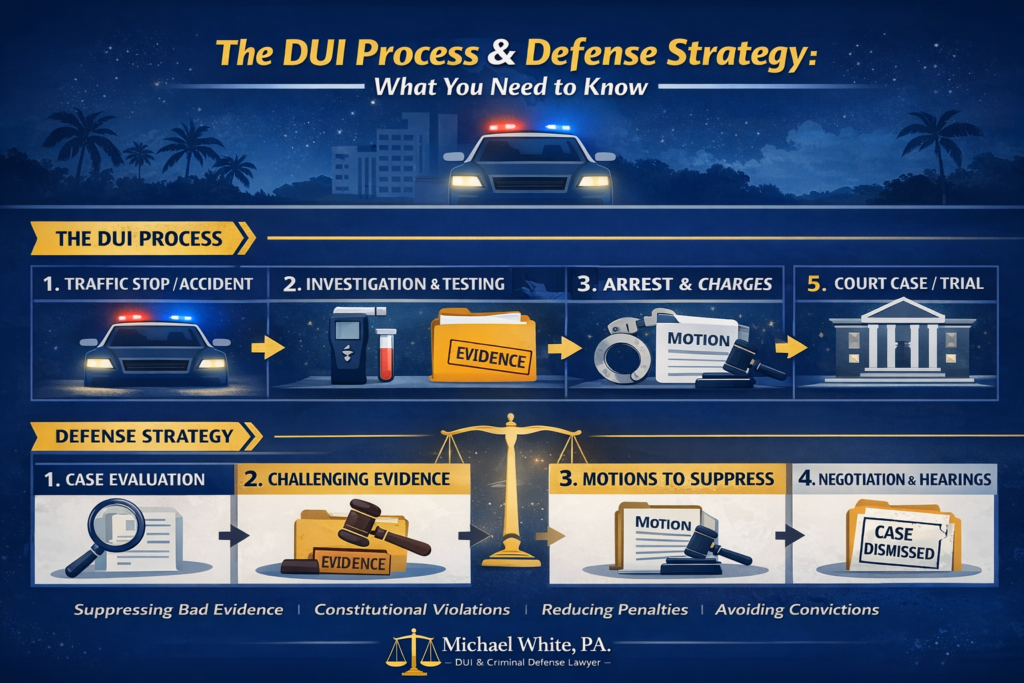
In Florida, a DUI case unfolds in stages — beginning with the stop and investigation, then moving through arrest, license consequences, court proceedings, negotiations, motions, and possible trial. What happens in those stages often determines whether the charge is reduced, dismissed, or results in a conviction.
For a broader overview of DUI charges, penalties, and defense strategy in Broward and South Florida, see our guide to a Fort Lauderdale DUI Lawyer.
The key is understanding that a DUI case is not just about what the officer says happened. It is also about whether the State can prove the charge, whether critical evidence can be excluded, and whether the case can be resolved short of a conviction.
What This Means for Your Case
A DUI arrest is only the starting point — not the outcome.
In many Broward County DUI cases, the result depends on:
- how early the defense begins
- whether key evidence is challenged
- whether weaknesses are identified before the State builds momentum
The issue is not just what happened during the stop or arrest.
👉 It’s whether the State can prove its case after that evidence is tested.
What Happens After a DUI Arrest in Florida?
Most DUI cases follow a similar progression.
That process often includes:
- the arrest and booking process
- temporary driving privileges and license issues
- first appearance or bond conditions in some cases
- arraignment and formal court proceedings
- discovery and evidence review
- motions challenging the State’s evidence
- plea negotiations or case reduction efforts
- trial, if the case cannot be resolved
Some cases move quickly. Others take time, especially when the defense is investigating the stop, challenging testing, or pursuing suppression issues.
If you want a broader explanation of how DUI stops and arrests are challenged at the front end of the case, see our guide to DUI Traffic Stops & Investigations in Florida.
While this process appears straightforward, each stage presents opportunities to challenge the case — and those opportunities are often missed without early strategic action.
The Best DUI Defense Strategies Begin Early
The strongest DUI defense strategies are usually developed early — before the case gains momentum and before key deadlines pass.
Early defense work may involve:
- securing bodycam and dashcam footage
- reviewing probable cause and detention issues
- evaluating breath or blood testing problems
- identifying unlawful searches
- preserving DMV hearing rights
- shaping negotiations before the State fully commits to the charge
That is why early intervention matters. In many cases, the defense is built long before a jury is ever involved.
In many cases, the strongest defenses are developed before the State has fully committed to its theory of the case.
Challenging the Evidence
Not every DUI arrest results in reliable evidence. In practice, many DUI cases are not decided by what evidence exists — but by whether that evidence holds up under scrutiny.
Depending on the case, the defense may challenge:
- whether the stop was lawful
- whether officers had probable cause to arrest
- whether field sobriety exercises were explained or administered correctly
- whether breath or blood testing was reliable
- whether the vehicle search was lawful
- whether statements were obtained improperly
These challenges often shape the entire case.
For example, if your goal is to understand how DUI charges are beaten or reduced, see our guide to How to Get Out of a DUI in Florida.
Motions, Negotiations, and Charge Reductions
Many Florida DUI cases are not won through dramatic courtroom moments. They are won through careful motion practice, strong pretrial advocacy, and strategic negotiation.
In many cases, successful outcomes are achieved not through trial, but by exposing weaknesses early — before the case ever reaches a jury.
That can include:
- motions to suppress unlawfully obtained evidence
- motions limiting weak or unreliable evidence
- negotiations aimed at reducing DUI to reckless driving
- challenging aggravating allegations
- exposing factual weaknesses before trial
Reduction strategy is especially important in cases where the State’s proof is not as strong as it first appears. For more on how these cases are often resolved, see DUI vs. Reckless Driving in Florida.
The DUI Process Is Not Just About Court
A DUI case is not limited to what happens in the courtroom.
It can also affect:
- your driver’s license
- your criminal record
- your employment
- your professional reputation
- your ability to avoid a lasting conviction
That is one reason plea strategy matters so much. A rushed plea can create long-term consequences that could have been avoided through better planning and better lawyering. For many clients, these collateral consequences are more significant than the immediate court penalties.
In many DUI cases, probation becomes one of the most important — and most restrictive — parts of the outcome. Understanding what DUI probation actually involves, and how easily violations can occur, is critical to protecting yourself after a conviction. For a full breakdown, see what DUI probation requires in Florida and how violations happen.
Record Consequences and Future Planning
One of the most misunderstood parts of a DUI case is what happens to the record after the case is over.
In Florida, an actual DUI conviction cannot be sealed or expunged. But not every DUI arrest ends in a DUI conviction, and the outcome of the case can make a major difference in whether record relief may later be available.
For more on that distinction, see Can You Remove a DUI From Your Record in Florida?
If your case resulted in a non-conviction outcome, you may also want to review DUI Arrest Sealing and Record Relief in Florida.
Key DUI Defense Issues (Where Cases Are Won or Lost)
Key DUI process and defense issues include:
- How to Get Out of a DUI in Florida
- DUI vs. Reckless Driving in Florida
- Can You Remove a DUI From Your Record in Florida?
- DUI Arrest Sealing and Record Relief in Florida
These topics often determine not just how a DUI case is defended, but what long-term consequences can be avoided.
Why Strategy Matters More Than Panic
A DUI arrest creates urgency, but urgency should not turn into panic.
A strong defense strategy is built by asking the right questions:
- Can the stop be challenged?
- Can the evidence be excluded?
- Are testing procedures vulnerable?
- Is a reduction realistic?
- Are there long-term record consequences that should shape negotiations?
- Is this a case that should be set for trial?
Those questions are what separate automatic outcomes from strategic outcomes.
In many cases, the difference between conviction and reduction comes down to whether the case is approached strategically — or reactively.
When DUI Cases Are Actually Decided
Most DUI cases are not decided at trial.
They are decided:
- when evidence is reviewed
- when motions are filed
- when weaknesses are exposed
- when negotiation leverage is created
In many DUI cases by the time a case reaches trial, many of the most important decisions have already been made.
Charged With DUI in Fort Lauderdale or South Florida?
A DUI arrest does not automatically mean a conviction, and it does not mean the State’s version of events will go unchallenged.
At Michael White, P.A., we approach DUI cases strategically from the beginning — analyzing the process, identifying weak points in the evidence, and building the strongest possible path toward dismissal, reduction, or acquittal.
Call (954) 270-0769 to discuss your case.