
Last updated March 2026
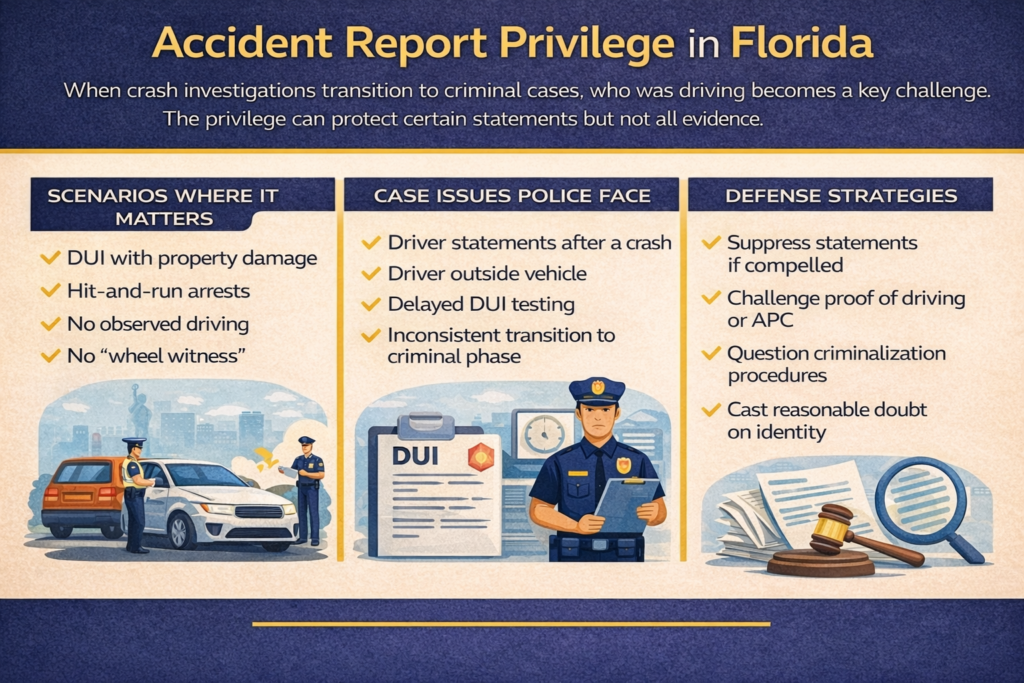
If you were involved in a traffic crash in Florida and later charged with a crime — such as DUI, leaving the scene, or vehicular offenses — some of your own statements may be legally inadmissible.
This protection comes from Florida’s accident report privilege, codified in Florida Statute § 316.066.
When applied correctly, this rule can exclude critical admissions, undermine the State’s proof of who was driving, and in some cases lead to suppression or dismissal of charges.
These issues are part of a broader suppression strategy in DUI cases, which we explain in our guide to Motions to Suppress DUI Evidence in Florida.
🧾 When the Accident Report Privilege Matters Most
Under Florida law, law enforcement officers investigating a traffic crash may require drivers, vehicle owners, and occupants to answer questions necessary to complete a crash report.
Because those statements are compelled, not voluntary, the law provides a safeguard:
Statements made during a crash investigation are:
❌ Not admissible in a criminal or civil trial
❌ Not usable to prove who was driving
❌ Not usable to establish fault or guilt
This privilege exists to encourage cooperation during crash investigations without forcing people to incriminate themselves.
🚫 What the Accident Report Privilege Does Not Protect
The privilege has clear limits. It does not shield:
🧍 Eyewitness testimony from people not involved in the crash
📝 Statements made after the crash investigation ends
💨 Field sobriety exercises and chemical test results
🩸 Breath, blood, or urine testing
🛣️ Physical evidence (vehicle damage, skid marks, debris, bottles)
🕵️ Statements made during a criminal investigation phase
The key question is when the statement was made — not just what was said.
🚔 The Critical Issue: Transition From Crash to Criminal Investigation
Florida courts draw a sharp line between:
Crash investigation, and
Criminal investigation
Before officers may use statements against you criminally, they must clearly communicate that:
the crash investigation has ended, and
the interaction is now a criminal investigation
If officers fail to make this transition clear, statements obtained afterward may still be protected — even if the officer intended to pursue criminal charges.
This transition problem is one of the most litigated issues in crash-related DUI cases. Video evidence often becomes critical in resolving these disputes, as explained in our guide to Bodycam Footage in Florida DUI investigations.
🛡️ How the Accident Report Privilege Is Used in Defense Strategy
A skilled defense attorney may use the accident report privilege to:
Suppress statements identifying the driver through a motion to suppress when those statements were compelled during a crash investigation
Exclude admissions of alcohol consumption or events leading to the crash
Undermine probable cause for arrest. In some cases, the State must rely on indirect or secondhand evidence of who was driving — raising issues under the wheel witness rule in Florida criminal cases.
Eliminate the State’s proof of “actual physical control”
Create reasonable doubt when no independent witness exists
In some cases, excluding a single protected statement is enough to collapse the prosecution’s case.
📍 Accident Report Privilege in DUI & Traffic Crime Cases
This doctrine most commonly appears in:
DUI with property damage or injury
DUI where no officer observed driving
Hit-and-run investigations
Vehicular crimes where identity of the driver is disputed
Understanding when statements are compelled — and when they are not — often determines whether a case survives pretrial motions.
❓ Frequently Asked Questions: Florida Accident Report Privilege
What is Florida’s accident report privilege?
It is a rule under Florida law that makes statements compelled during a crash investigation inadmissible in court.
Can police use my crash-report statements in a DUI case?
Generally no — if the statements were made during the crash investigation phase.
Does the privilege apply to eyewitnesses?
No. Only drivers, owners, and occupants involved in the crash are covered.
Are breath or blood test results protected?
No. Chemical testing and physical evidence are not covered by the privilege.
Can my case be dismissed if officers violated the privilege?
Possibly. Suppressing protected statements can eliminate key elements of the State’s case.
📞 Charged After a Crash in Florida?
Crash-related criminal cases are won and lost on procedural detail. If you were involved in a traffic accident and later charged with DUI or another criminal offense, understanding how Florida’s accident report privilege applies to your case is critical.
Attorney Michael White is a former prosecutor who regularly litigates crash-related suppression issues in Florida courts.
📲 Call (954) 270-0769 for a confidential consultation.