
Last updated March 2026
Robbery cases in Florida often move fast. Police respond quickly, witnesses are shaken, and identifications are sometimes made within minutes.
That speed creates risk.
People are frequently charged based on brief, stressful observations, unclear video, or suggestive identification procedures. When that happens, the case may be built against the wrong person from the very beginning.
If you are facing a robbery charge based on identification, understanding how mistakes happen — and how they are challenged — is critical.
For a complete breakdown of robbery charges, penalties, and defense strategies, see our guide to Robbery Charges in Florida.
🔍 How Mistaken Identity Happens in Robbery Cases
Most robbery identifications occur under poor conditions:
• fast-moving events
• high stress or fear
• limited lighting
• short viewing time
• divided attention (often focused on a weapon)
These are the exact conditions where human perception is least reliable.
Memory is not a recording. It is reconstructive — and it can be influenced by suggestion, stress, and time.
👁️ Why Eyewitness Identification Is Often Unreliable
Jurors tend to trust eyewitnesses.
But decades of research — and countless wrongful conviction cases — show that eyewitness identification is one of the leading causes of misidentification.
Common issues include:
• confidence being mistaken for accuracy
• memory contamination after the event
• influence from police questioning
• cross-racial identification difficulties
• pressure to “pick someone”
A witness saying “I’m sure” does not mean the identification is correct.
🚔 Show-Ups vs. Lineups: Where Problems Begin
Police often use two types of identification procedures:
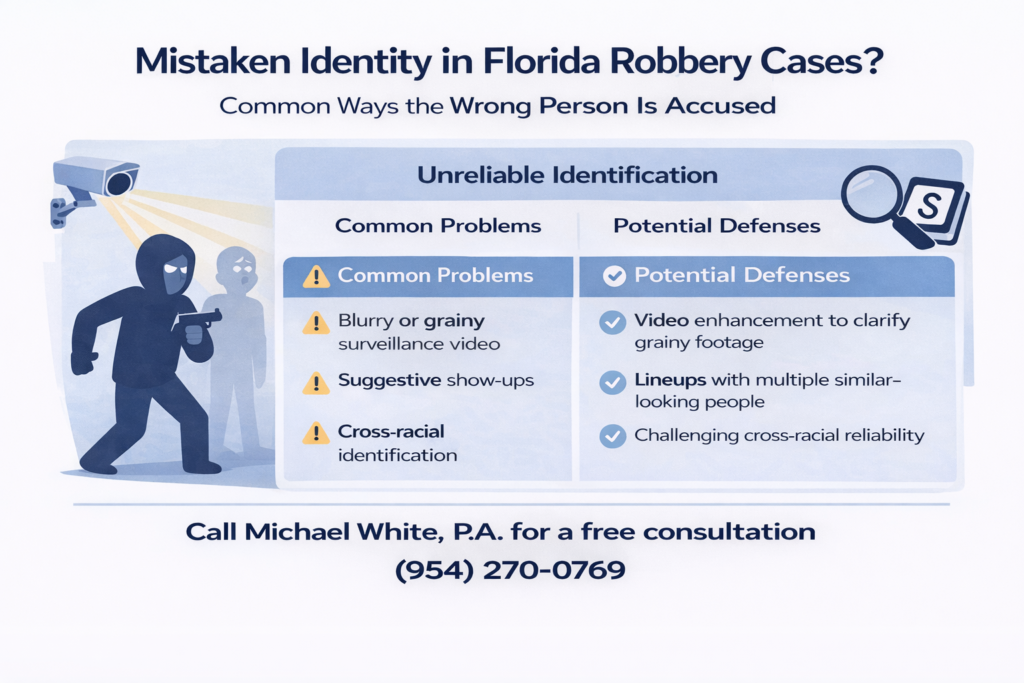
Show-Ups
A witness is shown one person shortly after the incident.
These are highly suggestive:
- the person is usually in custody
- often near police vehicles
- implicitly presented as the suspect
Lineups
A witness is shown multiple individuals and asked to identify the suspect.
Problems arise when:
- fillers do not match the suspect
- one person stands out
- officers give subtle cues
- instructions are unclear
Even small procedural flaws can significantly affect reliability.
🎥 Video Evidence Does Not Eliminate Misidentification
Many robbery cases rely on surveillance footage.
But video is often:
• grainy or low resolution
• missing key moments
• recorded at poor angles
• lacking audio
Clothing, body type, and general appearance can be misleading.
We break down how video evidence can both help and hurt identification in our guide to robbery and surveillance video evidence in Florida.
⚖️ Why Mistaken Identity Leads to Overcharging
Once a person is identified — even incorrectly — the case often builds around that assumption.
Police reports, witness statements, and charging decisions begin to reinforce the same narrative.
That can lead to:
• robbery charges based on weak evidence
• exaggerated “fear” claims
• reliance on interpretation rather than proof
In many cases, these issues overlap with how prosecutors attempt to prove intimidation — which we explain in our guide to what “putting in fear” means in Florida robbery cases.
🔄 How Mistaken Identity Can Change the Entire Case
Identity is a threshold issue.
If the State cannot reliably prove who committed the act, the entire case weakens.
That can lead to:
• dismissal
• acquittal at trial
• reduced charges
• stronger negotiation leverage
In some cases, misidentification can also affect how the offense itself is classified — particularly in situations involving vehicles or alleged carjackings — which we break down in our guide to robbery vs. carjacking in Florida.
🛡️ How the Defense Challenges Identification
Effective robbery defense focuses heavily on identification issues.
Strategies may include:
✔ challenging suggestive show-up procedures
✔ attacking flawed lineup construction
✔ exposing inconsistencies in witness descriptions
✔ using expert testimony on memory and perception
✔ analyzing video frame-by-frame
✔ presenting alibi or timeline evidence
Small details — lighting, distance, seconds of observation — often determine the outcome.
⚠️ Why Early Defense Action Matters
Mistaken identity cases are highly time-sensitive.
Evidence can disappear quickly:
• surveillance footage may be overwritten
• witnesses’ memories change
• digital location data may be lost
Early intervention allows the defense to:
• preserve video evidence
• identify alibi witnesses
• document inconsistencies
• prevent the narrative from hardening
📞 Charged With Robbery Based on Misidentification?
Being accused of a robbery you did not commit is overwhelming — but these cases are often more defensible than they first appear.
Robbery prosecutions frequently depend on interpretation, assumption, and imperfect identification.
The sooner those weaknesses are identified, the stronger your position becomes.
Call Michael White, P.A. at (954) 270-0769 for a confidential consultation.
✅ FAQs: Mistaken Identity in Florida Robbery Cases
Can you be charged with robbery based on mistaken identity?
Yes. Charges can be filed based on eyewitness identification, even if that identification is later proven unreliable.
Are eyewitness identifications reliable in robbery cases?
Not always. High-stress conditions, poor lighting, and suggestive procedures can lead to misidentification.
What is a show-up identification?
A show-up occurs when police present a single suspect to a witness shortly after the incident. These are often challenged as suggestive.
Can video evidence prove identity?
Sometimes, but not always. Poor-quality footage and missing context can make identification unreliable.
Can mistaken identity lead to dismissal?
Yes. If the State cannot prove identity beyond a reasonable doubt, the case may be dismissed or result in acquittal.