
Last updated March 2026
Robbery and carjacking are closely related under Florida law — but they are not the same charge.
Both involve taking property through force, violence, or intimidation. But when a vehicle is involved, the law treats the offense differently — and often more severely.
That distinction can significantly impact how a case is charged, defended, and punished.
For a complete breakdown of robbery charges, penalties, and defense strategies, see our guide to Robbery Charges in Florida.
⚖️ What Is Robbery in Florida?
Under Florida Statute § 812.13, robbery is the taking of property from a person using:
• force
• violence
• assault
• or “putting in fear”
Robbery applies to any type of property — money, phones, bags, or other items.
It is classified as a violent felony, even when no weapon is used.
🚗 What Is Carjacking in Florida?
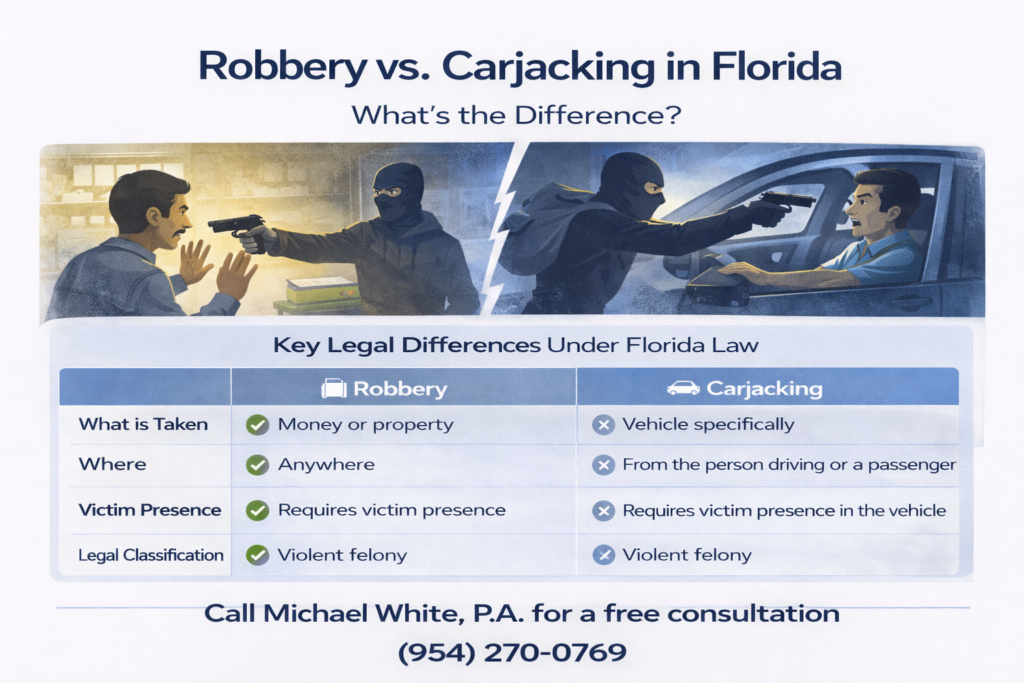
Carjacking is a specific type of robbery involving a motor vehicle.
Under Florida law, carjacking occurs when someone takes a motor vehicle from another person through force, violence, assault, or intimidation.
In other words:
Carjacking is robbery — but limited to vehicles.
Because of the inherent danger involved in taking a vehicle from a person, carjacking charges often carry enhanced penalties.
🔍 The Key Difference: Type of Property
The primary distinction is what is being taken:
Robbery
• applies to any property
• money, phones, personal items
Carjacking
• applies specifically to motor vehicles
• involves taking a vehicle from a person
The legal elements are similar, but the classification changes the charge.
🚨 Why Carjacking Charges Are Often More Severe
Carjacking is typically charged as a first-degree felony and may be punishable by life in prison — particularly when weapons are alleged.
Even without a weapon, the seriousness of taking a vehicle directly from a person increases how aggressively the case is prosecuted.
Allegations involving weapons can significantly increase exposure, which we break down in our guide to strong-arm vs. armed robbery in Florida.
⚖️ Force or Fear Still Controls the Case
Just like robbery, carjacking requires proof of:
• force
• violence
• assault
• or intimidation
Both robbery and carjacking often hinge on whether the State can prove force or intimidation — an issue we analyze in our guide to what “putting in fear” means in Florida robbery cases.
Without force or fear, the charge may not qualify as robbery or carjacking at all.
🔄 How Carjacking and Other Charges Overlap
Some cases involve multiple potential charges depending on the facts:
• robbery (taking other property)
• carjacking (taking a vehicle)
• burglary (entering a vehicle or structure unlawfully)
These distinctions are similar to how Florida law separates robbery from burglary — which focuses on unlawful entry rather than force — as we explain in our guide to robbery vs. burglary in Florida.
The sequence of events often determines which charges apply.
🎥 Evidence Often Determines the Outcome
Carjacking cases frequently rely on:
• surveillance footage
• witness identification
• vehicle tracking data
• body camera footage
Fast-moving encounters and limited visibility can create identification issues.
Identification is often contested in fast-moving vehicle encounters, which we explore in our breakdown of mistaken identity in robbery cases.
🛡️ Defense Strategies in Carjacking Cases
Defense strategies often focus on:
• lack of force or intimidation
• mistaken identity
• lack of intent
• unreliable witness testimony
• inconsistencies in video evidence
In many cases, small factual differences determine whether the charge holds.
⚠️ What to Do If You’re Charged
If you are facing robbery or carjacking charges:
• do not speak to law enforcement
• preserve any available evidence
• identify witnesses immediately
• seek legal counsel as early as possible
Early action can significantly affect how the case develops.
📞 Charged With Carjacking or Robbery in Florida?
These are serious felony charges with life-altering consequences.
But charges are not convictions.
Careful analysis of the evidence — especially force, identification, and timing — can expose weaknesses in the State’s case.
Call Michael White, P.A. at (954) 270-0769 for a confidential consultation.
✅ FAQs
What is the difference between robbery and carjacking in Florida?
Robbery involves taking any property using force or fear, while carjacking specifically involves taking a motor vehicle from a person.
Is carjacking more serious than robbery?
Carjacking is typically charged as a first-degree felony and may carry life exposure, making it one of the most serious robbery-related offenses.
Does carjacking require a weapon?
No. A weapon is not required, but weapon allegations can significantly increase penalties.
Can carjacking charges be reduced?
In some cases, yes — particularly if the State cannot prove force, identity, or intent.
Can mistaken identity affect carjacking cases?
Yes. Identification issues are common in fast-moving vehicle encounters and may lead to reduced or dismissed charges.