
Last updated April 2026
Not all robbery charges are the same in Florida.
One of the most important distinctions prosecutors make is whether the alleged robbery involved a weapon. That single allegation can dramatically change:
The degree of the felony
Prison exposure
Bond conditions
How aggressively the State prosecutes the case
Many people are surprised to learn that the elements of robbery do not change just because a weapon is alleged. What changes is the severity of the charge and the penalties.
Because robbery is classified as a violent felony, these cases are prosecuted alongside other serious violent crimes, even when no one is injured and no firearm is recovered.
This page explains the legal difference between strong-arm robbery and armed robbery, why weapon allegations are often contested, and how defense strategy shifts when a weapon is involved.
For a full explanation of robbery elements, see our main guide on Robbery Charges in Florida.
What Is Strong-Arm Robbery in Florida?
Strong-arm robbery generally refers to robbery without a weapon.
Under Florida law, the State must still allege:
A taking of property
From a person or their custody/control
With intent to deprive
Using force, violence, assault, or “putting in fear” — which we explain in detail in our guide to what “putting in fear” means in Florida robbery cases
The key point: Strong-arm robbery does not require a weapon. For a deeper look at how robbery is charged when no weapon is alleged, see our breakdown of robbery with no weapon in Florida.
Common strong-arm robbery scenarios include:
Physical struggles over property
Purse or phone snatching cases where the State claims force
Alleged threats without a displayed weapon
Confrontations during immediate flight after a taking
Even without a weapon, strong-arm robbery is typically charged as a second-degree felony, exposing a person to up to 15 years in prison.
What Is Armed Robbery in Florida?
Armed robbery is charged when the State alleges the defendant carried, used, or displayed a weapon during the robbery.
Weapons can include:
Firearms
Knives
Other deadly weapons
In some cases, objects alleged to be weapons
Important nuance:
👉 The State does not always need to recover the weapon.
Allegations can be based on witness testimony, video interpretation, or statements made during the incident.
Armed robbery is typically charged as a first-degree felony, and when a firearm or deadly weapon is alleged, it may be punishable by life.
The Key Legal Difference: Penalties, Not Elements
This is where many robbery cases are misunderstood.
What does NOT change:
The definition of robbery
The requirement of force or fear
The need to prove a taking and intent
What DOES change:
Felony degree
Sentencing exposure
Prosecutorial leverage
In other words, a weapon allegation increases punishment, not the core elements of the crime.
The distinction between robbery and theft — particularly whether force or fear exists — is often the threshold issue, as we explain in our guide to robbery vs. theft in Florida.
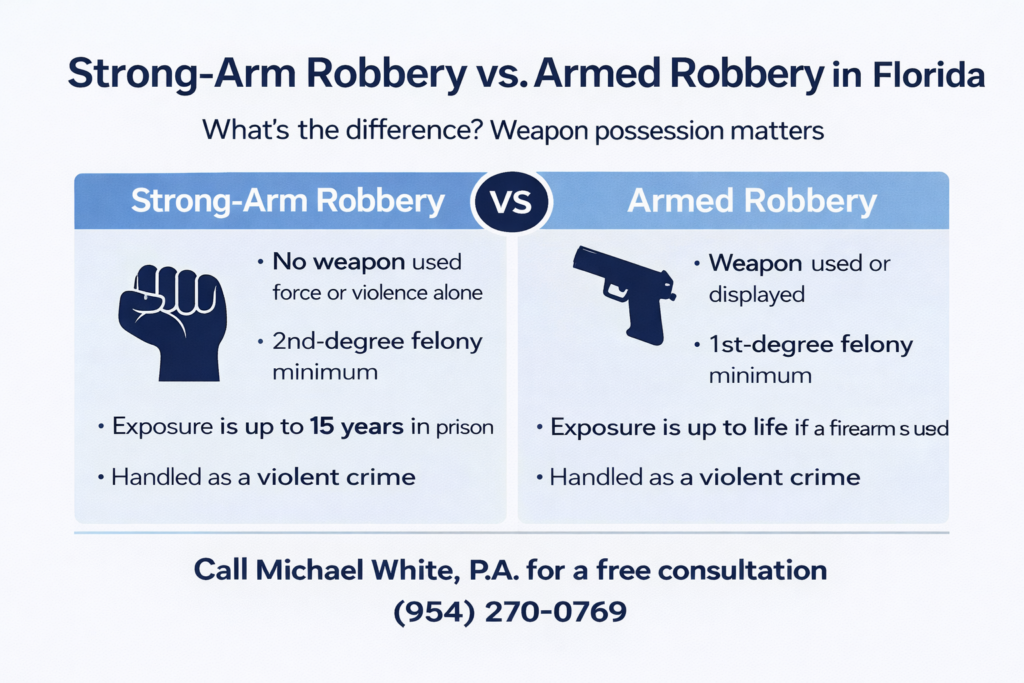
Side-by-Side Comparison: Strong-Arm vs. Armed Robbery
Strong-Arm Robbery
No weapon alleged
Force or fear alone
Typically a second-degree felony
Up to 15 years in prison
Still treated as a violent crime
High bond, but less severe than armed robbery
Armed Robbery
Weapon alleged (firearm, knife, or deadly weapon)
Charged as a first-degree felony
Exposure can reach life in prison
Prosecuted far more aggressively
Weapon enhancements may apply
Why Weapon Allegations Are Often Disputed
Weapon allegations are frequently one of the most contested issues in armed robbery cases.
Common defense issues include:
No weapon ever recovered
Object misidentified as a firearm
Poor lighting or grainy surveillance video
Witness assumptions (“I thought it was a gun”)
Inconsistent descriptions of the weapon
Challenging the weapon allegation can:
Reduce armed robbery to strong-arm robbery
Dramatically lower sentencing exposure
Change bond conditions
Shift plea negotiations
Can Armed Robbery Be Reduced to Strong-Arm Robbery?
Yes — in the right case.
Reductions may occur when:
The State cannot prove a weapon was used or displayed
The alleged weapon was not capable of causing harm
Video contradicts witness descriptions
Statements about a weapon are inconsistent or exaggerated
Even when the robbery charge itself remains, removing the weapon allegation can change everything.
We explain how defense strategy drives these reductions in our guide to whether robbery charges can be reduced in Florida.
Defense Strategies in Strong-Arm and Armed Robbery Cases
Defense strategy often focuses on:
Whether force or fear actually existed
Timing of any alleged force
Mistaken identity in fast-moving incidents
Reliability of witness testimony
Surveillance video interpretation
Challenging weapon allegations
Suppression of evidence when searches or seizures were unlawful
In some cases, self-defense or lawful resistance principles may also affect how alleged threats or force are interpreted.
What to Do If You’re Charged With Robbery in Florida
If you or a loved one is facing robbery charges:
Do not make statements attempting to explain weapon allegations
Preserve messages, photos, and location data
Identify nearby surveillance cameras immediately
Avoid discussing the incident with witnesses
Speak with counsel early — before the State locks in its theory
Early defense involvement can determine whether a case stays an armed robbery or is reduced to strong-arm robbery.
✅ FAQs
What is the difference between strong-arm robbery and armed robbery in Florida?
Strong-arm robbery involves force or fear without a weapon, while armed robbery involves the alleged use or display of a weapon and carries much harsher penalties.
Is a weapon required for a robbery charge?
No. A weapon is not required for robbery. Robbery can be charged based on force or fear alone.
Does the weapon have to be recovered for armed robbery?
Not always. Armed robbery can be charged based on witness testimony or video evidence even if the weapon is never found.
Can armed robbery charges be reduced?
Sometimes. If the State cannot prove a weapon was used or displayed, armed robbery may be reduced to strong-arm robbery.
How serious are armed robbery penalties in Florida?
Armed robbery is typically a first-degree felony, and when a firearm or deadly weapon is alleged, the charge may be punishable by life in prison.