
Last updated March 2026
In Florida, snatching a purse is not automatically robbery, even though police and prosecutors frequently charge it that way. Whether purse snatching is treated as robbery or theft depends on one critical issue:
Was force, violence, or “putting in fear” used at the time of the taking?
That distinction matters because robbery is prosecuted as a violent felony, while theft and related snatching offenses are not.
Because robbery is classified as a violent felony, these cases are often handled alongside other serious violent crimes, even when no weapon is used and no one is injured.
This page explains when purse snatching qualifies as robbery, when it does not, and how these cases are commonly overcharged.
For a full breakdown of robbery elements, see our main guide on Robbery Charges in Florida.
What Florida Law Actually Says About Purse Snatching
Florida law recognizes three different possibilities in purse-snatching cases:
Theft
Robbery by Sudden Snatching
Robbery (§ 812.13)
The charge depends on how the purse was taken, not just the fact that it was taken.
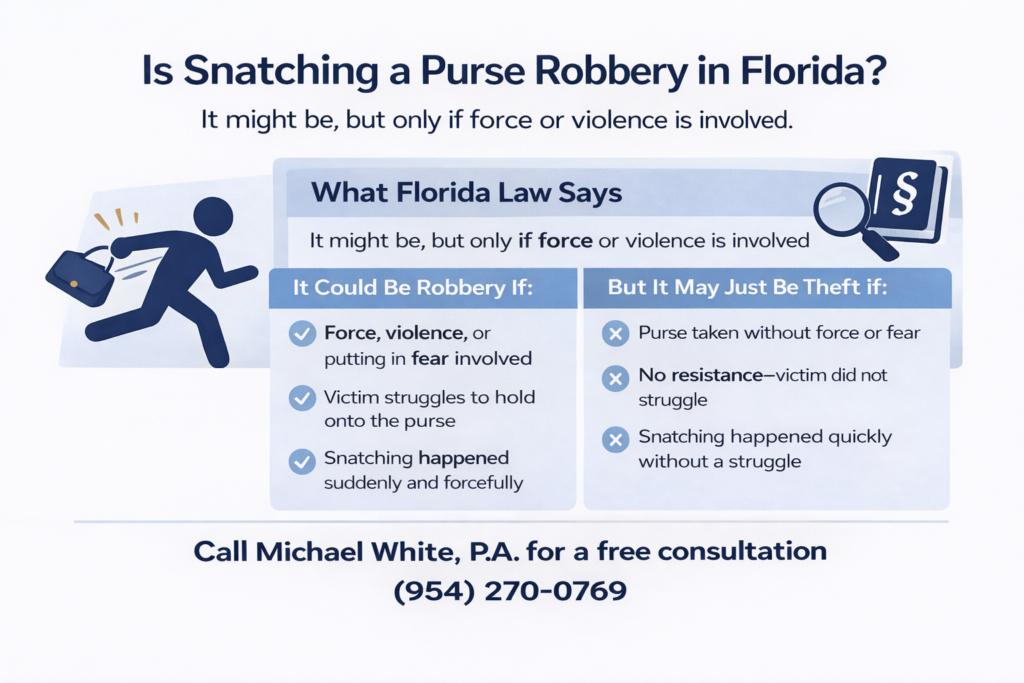
When Purse Snatching Can Be Robbery
Purse snatching may be charged as robbery only if the State can prove that force, violence, assault, or putting in fear occurred during the taking — which we explain in our guide to what “putting in fear” means in Florida robbery cases.
Common facts prosecutors rely on:
The victim struggled to keep the purse
The purse strap broke during a struggle
The victim was pulled, shoved, or knocked off balance
The suspect used threats or intimidation
The victim reasonably feared immediate harm
The key issue is not speed — it’s force or fear.
If force beyond what is inherent in the snatching itself is proven, the charge may be elevated to robbery.
When Purse Snatching Is Not Robbery
In many cases, purse snatching is overcharged.
Purse snatching is not robbery when:
The purse was taken quickly and cleanly
There was no struggle or resistance
The victim did not realize what happened until after
No threats were made
No force beyond the act of grabbing occurred
In those situations, the offense may be:
Theft, or
Robbery by sudden snatching (a separate statute)
Calling every purse snatch a “robbery” ignores the legal requirement of force or fear.
This distinction often determines whether a case is charged as robbery or theft, as we explain in our guide to robbery vs. theft in Florida.
Robbery vs. Robbery by Sudden Snatching (Important Distinction)
Florida has a separate offense called robbery by sudden snatching (§ 812.131).
This offense applies when:
Property is taken suddenly from the person
The victim becomes aware of the taking during or immediately after
No additional force or fear is proven
Why this matters:
Robbery by sudden snatching does not require force or fear
It is not treated the same as robbery under § 812.13
Penalties and defense strategies differ significantly
Many cases that should be charged as sudden snatching are instead charged as full robbery.
Why Prosecutors Overcharge Purse Snatching as Robbery
Robbery charges give prosecutors leverage:
Violent felony classification
Higher bonds
Greater sentencing exposure
Stronger plea bargaining position
In many purse-snatching cases, the robbery charge is filed before:
Video is reviewed
Witness statements are reconciled
Force vs. speed is properly analyzed
Early defense review often exposes these weaknesses.
Can Purse Snatching Robbery Charges Be Reduced?
Yes — frequently.
Robbery charges may be reduced when:
Video shows no struggle
The victim’s statements change
Force occurred after the taking
Fear was speculative, not reasonable
The purse was released immediately
Successful challenges often result in:
Reduction to sudden snatching
Reduction to theft
Dismissal or favorable plea resolution
Common Defense Issues in Purse Snatching Cases
Defense strategies often focus on:
No force or fear at the moment of taking
Timing of any contact
Video evidence contradicting reports
Witness exaggeration
Mistaken identity in fast, chaotic incidents
Illegal detention or search
These cases are often decided on seconds of footage or small factual details.
What to Do If You’re Accused of Purse Snatching
If you or a loved one is accused:
Do not try to explain the situation to police
Preserve clothing, messages, and location data
Identify surveillance cameras immediately
Avoid contact with alleged victims
Speak with counsel early
Early intervention can be the difference between a robbery charge and a non-violent offense.
✅ FAQs
Is snatching a purse always robbery in Florida?
No. Purse snatching is only robbery if the State proves force, violence, assault, or putting the victim in fear at the time of the taking.
What is robbery by sudden snatching in Florida?
It is a separate offense that applies when property is taken suddenly without additional force or fear beyond the act of snatching itself.
Can purse snatching be charged as theft?
Yes. If no force or fear is proven, purse snatching may be charged as theft or sudden snatching instead of robbery.
Does the victim have to resist for it to be robbery?
Resistance is strong evidence of force, but the State may also rely on fear or threats. Each case depends on the facts.
Can robbery charges be reduced in purse snatching cases?
Often, yes. Video evidence, timing issues, and lack of force frequently support reduction or dismissal.