
Last updated March 2026
Yes — in many cases, burglary charges can be reduced to trespass.
But it depends entirely on whether prosecutors can prove intent at the time of entry and whether the entry was actually unlawful.
Burglary is a felony in Florida. Trespass is often a misdemeanor. The difference can mean the difference between years in prison and a far more manageable outcome.
For a full breakdown of burglary classifications and penalties, see our guide to Burglary Charges in Florida.
Here’s when — and how — burglary charges are commonly reduced.
⚖️ The Legal Difference Between Burglary and Trespass
Under Florida law:
Burglary requires entering or remaining in a dwelling, structure, or conveyance with intent to commit a crime inside.
Trespass involves entering or remaining without authorization — but without criminal intent.
The State must prove intent existed at the moment of entry (or at the moment permission was withdrawn).
If they cannot, the burglary charge can collapse.
In many cases, prosecutors rely on circumstantial evidence to argue that intent existed at the time of entry — even where no crime was completed.
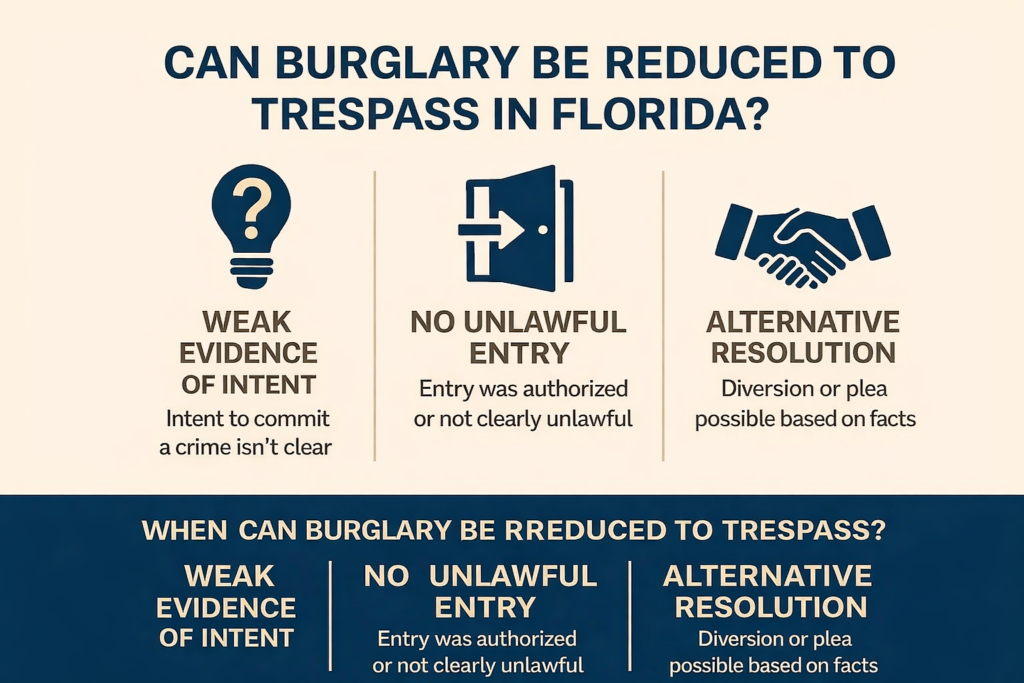
🔎 When Can Burglary Be Reduced to Trespass?
1️⃣ Weak or Unclear Evidence of Intent
Burglary hinges on intent.
Prosecutors must prove beyond a reasonable doubt that you intended to commit a separate crime inside the premises.
Common weaknesses include:
No stolen property recovered — which does not prevent a burglary charge but can weaken the State’s claim of intent
No tools or forced entry evidence
No incriminating statements
Ambiguous behavior
Surveillance footage without clear context
If intent is speculative, the charge may be reduced to trespass.
2️⃣ Consent or Lawful Entry Issues
If you were invited, had prior access, or reasonably believed you had permission to enter, the burglary element of “unlawful entry” may fail.
This frequently arises in:
Relationship disputes
Former roommates
Airbnb or rental misunderstandings
Businesses open to the public
These issues can become even more fact-specific depending on whether the location is treated as a dwelling, structure, or conveyance under Florida law.
If entry was lawful — but a dispute later occurred — the case may not support burglary.
3️⃣ “Remaining After Permission Was Withdrawn” Disputes
Florida burglary law allows prosecution if someone:
Initially entered lawfully,
Permission was revoked, and
They remained with criminal intent.
But proving when permission ended — and when intent formed — is often difficult.
If the State cannot clearly establish that timeline, trespass may be the more appropriate charge.
4️⃣ Negotiated Resolution Based on Facts
Even when the State technically has a burglary case, prosecutors sometimes reduce charges when:
The accused has no prior record
No violence occurred
No property was taken
The alleged victim is not seeking aggressive prosecution
The case has evidentiary vulnerabilities
In many counties, trespass reductions are common in appropriate cases.
🔓 Why Reduction Matters
Burglary in Florida is always a felony.
Depending on the degree, it can carry:
Up to 5 years
Up to 15 years
Or life in prison (in aggravated cases) — particularly in cases involving weapons, violence, or confrontation.
Trespass, by contrast, is typically a misdemeanor and may be eligible for diversion or a withhold of adjudication.
The difference affects:
Prison exposure
Felony record consequences
Employment background checks
Firearm rights
Professional licensing
Reducing a burglary charge to trespass can dramatically limit long-term damage.
🛡️ How Defense Strategy Drives Reduction
Reduction rarely happens automatically. It is usually the result of:
Early evidence review
Challenging intent at entry
Investigating consent issues
Filing suppression motions
Negotiating from evidentiary weakness
Because burglary law is technical, reduction often depends on how aggressively the legal elements are attacked early in the case.
👨⚖️ Can Every Burglary Be Reduced?
No.
If the evidence clearly shows:
Forced entry
Theft inside
Weapons or violence
Strong admissions
Clear surveillance
Reduction becomes more difficult.
Each case turns on its specific facts.
📍 Charged With Burglary in Broward County?
If you’re facing burglary charges in Fort Lauderdale or anywhere in South Florida, early intervention can shape whether the case proceeds as a felony or resolves as something less serious.
At Michael White, P.A., we evaluate:
Intent evidence
Entry legality
Witness credibility
Surveillance reliability
Prosecutorial charging posture
📞 Call (954) 270-0769 or request a consultation to discuss your options.
❓ Frequently Asked Questions
Is trespass a lesser included offense of burglary?
Often, yes. Trespass is commonly considered a lesser offense when the State cannot prove intent to commit a crime inside.
Does the State have to prove I stole something?
No. They must prove intent to commit a crime — not that property was actually taken.
Can a burglary charge be reduced before trial?
Yes. Reductions frequently occur during negotiations or after weaknesses are exposed in discovery.
What if I was invited inside?
If you had consent — or reasonably believed you did — the burglary element of unlawful entry may fail.
Does reducing burglary to trespass avoid a felony?
Typically, yes. Trespass is usually charged as a misdemeanor rather than a felony.