
Last updated March 2026
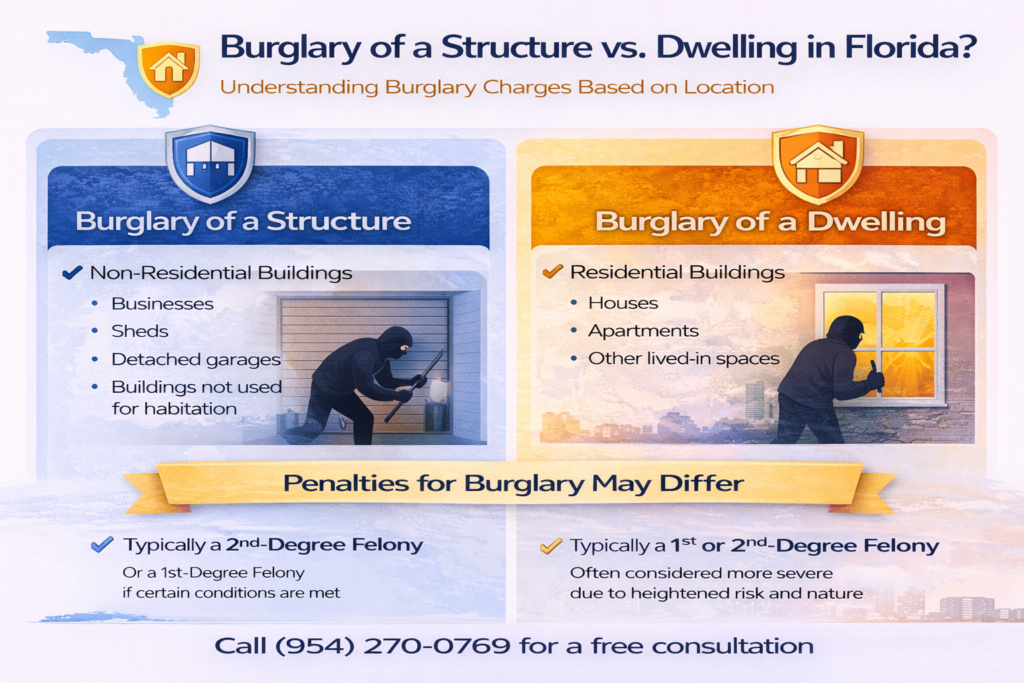
In Florida, the classification of the location — whether it is a structure or a dwelling — plays a major role in how a burglary charge is filed and prosecuted.
While both are felony offenses, burglary of a dwelling is generally treated more seriously than burglary of a structure.
For a full breakdown of burglary charges, degrees, and defenses, see Burglary Charges in Florida.
⚖️ What Is a “Structure” Under Florida Law?
A structure generally refers to a building that is not used as a residence.
Common examples include:
- Businesses
- Warehouses
- Offices
- Commercial buildings
These locations are still protected under Florida burglary law, but they do not carry the same legal weight as dwellings.
🏠 What Is a “Dwelling”?
A dwelling is a place intended for people to live.
This includes:
- Houses
- Apartments
- Condominiums
- Temporary residences
Florida law treats dwellings more seriously because of the risk that people may be present.
🔍 Why the Distinction Matters
The difference between a structure and a dwelling affects:
- The degree of the felony
- Potential prison exposure
- How prosecutors evaluate the case
Generally:
- Burglary of a structure → typically a third-degree felony
- Burglary of a dwelling → typically a second-degree felony
This distinction can have a major impact on how a case is resolved.
🚨 When Charges Become More Serious
Regardless of whether the location is a structure or dwelling, certain factors can elevate the charge.
These include:
- Presence of a weapon
- Allegations of assault or battery
- Presence of a person inside
- Significant property damage
When these factors are present, burglary can be elevated to the highest level. For more on how these enhancements work, see What Makes Burglary a First-Degree Felony in Florida?
🧠 Intent Still Controls the Case
Even though classification matters, the core issue in every burglary case is intent.
The State must prove:
- Intent to commit a crime inside
- That intent existed at the time of entry or unlawful remaining
Because intent is rarely proven directly, prosecutors often rely on circumstantial evidence. For a deeper look at this issue, see Can Burglary Charges Be Based on Intent Alone in Florida?
⚖️ Structure or Dwelling — What About Vehicles?
Florida law also recognizes a third category: conveyances.
These include:
- Cars
- Trucks
- Boats
Each classification carries different legal implications. For a breakdown of how vehicle-related burglary cases are handled, see Burglary of a Conveyance in Florida.
🛡️ Common Defense Issues
Burglary classification cases often turn on:
Was the Location Properly Classified?
Disputes may arise over whether a location qualifies as a dwelling or structure.
Occupancy Issues
Whether someone was present can affect the severity of the charge.
Intent
Intent must still be proven regardless of classification.
Consent or Authorization
If entry was permitted, the burglary charge may fail.
📍 Charged With Burglary in South Florida?
Whether a case involves a structure or a dwelling can significantly affect the outcome — but these cases often hinge on technical legal distinctions and factual disputes.
If you are under investigation or facing charges, early legal strategy can make a major difference.
Call Michael White, P.A. at (954) 270-0769 for a confidential consultation.
FAQs
Is burglary of a dwelling more serious than a structure?
Yes. Burglary of a dwelling is generally treated as a higher-level felony.
What if the building was not being used at the time?
Classification may still depend on whether the location is considered a dwelling under the law.
Do prosecutors have to prove intent?
Yes. Intent is required in all burglary cases.
Can classification affect sentencing?
Yes. Whether a location is a structure or dwelling can significantly impact penalties.