
Last updated March 2026
In Florida, burglary does not just apply to homes or businesses. A person can also be charged with burglary of a conveyance, which usually means unlawfully entering a vehicle with intent to commit a crime inside. Under Florida’s burglary statute, “conveyance” is a defined category, and burglary can apply to a car, truck, van, boat, or similar transport vehicle.
For a broader overview of degrees, penalties, and defenses, see Burglary Charges in Florida.
What Is a Conveyance Under Florida Law?
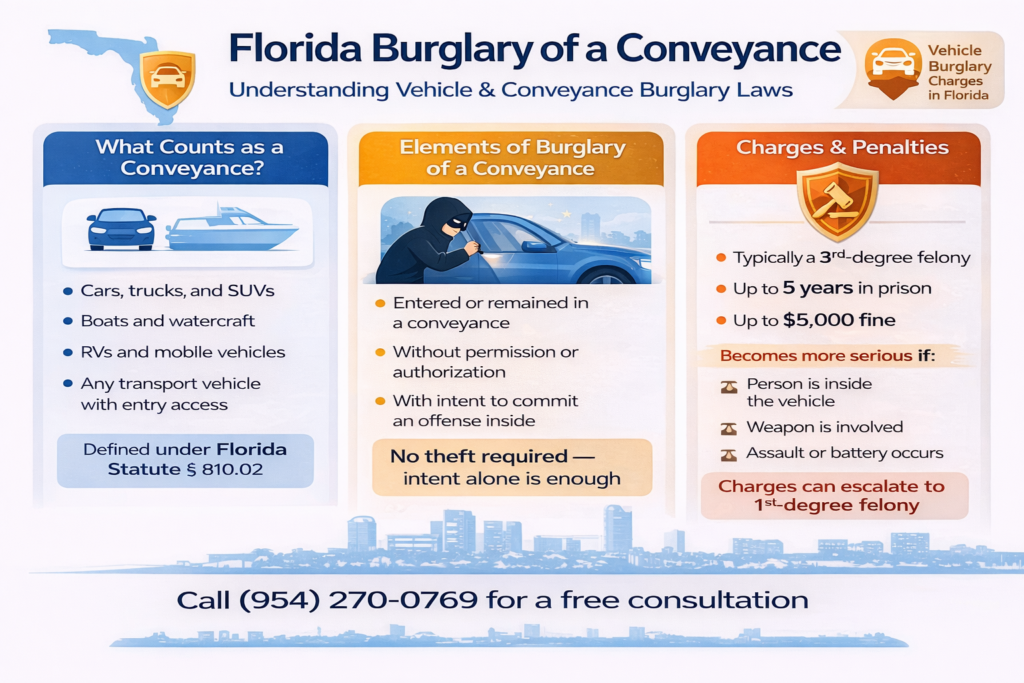
Florida law defines burglary to include entry into a dwelling, structure, or conveyance with intent to commit an offense inside. The related definitions statute separately defines a conveyance as any motor vehicle, ship, vessel, railroad vehicle or car, trailer, aircraft, or sleeping car, and it includes the enclosed space of that vehicle or vessel.
That means burglary of a conveyance can arise from allegations involving:
- Cars
- Trucks
- SUVs
- Vans
- Boats
- Certain trailers or other transport vehicles
The issue is not whether the vehicle was moving. The issue is whether prosecutors claim there was an unlawful entry into a qualifying conveyance with criminal intent.
What Prosecutors Must Prove
To convict someone of burglary of a conveyance in Florida, the State generally must prove:
- The defendant entered a conveyance, or remained in it in a legally prohibited way
- The conveyance was not open to the public, and the defendant was not licensed or invited to enter
- The defendant had intent to commit an offense inside
Florida burglary law does not require the State to prove that property was actually taken. The central issue is often whether intent existed at the time of entry.
That is why many of these cases turn on circumstantial evidence. For a deeper look at that issue, see Can Burglary Charges Be Based on Intent Alone in Florida?
Does Opening a Car Door Count as Entry?
Sometimes, yes. Florida burglary law focuses on entry into the protected space, and courts often treat even slight intrusion as legally significant. In vehicle cases, prosecutors may argue that opening a door and leaning in, reaching inside, or entering part of the body into the vehicle is enough to satisfy the entry element if criminal intent is also proven. That makes the facts extremely important in conveyance cases.
Is Burglary of a Conveyance Always a Felony?
Yes. Burglary is a felony in Florida. A basic burglary of an unoccupied conveyance is generally charged as a third-degree felony. Under Florida’s sentencing statute, a third-degree felony is punishable by up to 5 years in prison, and Florida’s general fine statute allows up to a $5,000 fine for a third-degree felony.
But the charge can become much more serious if aggravating facts are alleged.
When Does the Charge Become More Serious?
Vehicle burglary allegations can escalate depending on the facts. Prosecutors may pursue more serious exposure if they claim:
- Someone was inside the conveyance
- A weapon was involved
- An assault or battery occurred during the incident
- Other statutory aggravating factors apply
Those issues can dramatically change sentencing exposure. For a related discussion of severe enhancement situations, see What Makes Burglary a First-Degree Felony in Florida?.
Common Defense Issues in Burglary of a Conveyance Cases
These cases are often more defensible than they first appear. Common litigation issues include:
Intent
The State must prove intent to commit an offense inside the vehicle. If the evidence only shows suspicious behavior, but not criminal intent at entry, the burglary charge may be vulnerable.
Permission or Authorization
If the vehicle owner gave permission, or the circumstances create a real dispute about consent, that can undermine the unlawful-entry element.
Identification
Many conveyance burglary arrests depend on unclear surveillance footage, nighttime observations, or limited witness descriptions.
Search and Seizure Issues
If police found evidence after an unlawful stop, detention, or search, suppression issues may significantly affect the case.
Burglary of a Conveyance vs. Trespass
In some cases, the real fight is whether the facts support burglary at all. If prosecutors cannot prove intent to commit a crime inside the vehicle, the facts may support a lesser offense instead of burglary. For that distinction, see Burglary vs. Trespassing in Florida.
Charged With Burglary of a Conveyance in Fort Lauderdale or South Florida?
Burglary of a conveyance may sound less serious than burglary of a home, but it is still a felony charge that can carry prison exposure, probation, fines, and a permanent criminal record. Early defense strategy often focuses on intent, consent, identification, and whether the alleged entry actually satisfies Florida’s burglary statute.
If you are under investigation or have already been charged, speaking with a defense lawyer early can make a major difference.
Call Michael White, P.A. at (954) 270-0769 for a free consultation.
FAQs
Is burglary of a conveyance the same as stealing a car?
No. Burglary of a conveyance usually involves entering a vehicle with intent to commit a crime inside. Auto theft is a different offense.
Does the State have to prove something was stolen?
No. Florida burglary law focuses on intent to commit an offense inside, not whether property was actually taken.
What counts as a conveyance in Florida?
A conveyance can include a motor vehicle, vessel, trailer, aircraft, railroad car, or similar transport vehicle.
Is burglary of a conveyance a felony in Florida?
Yes. A basic burglary of an unoccupied conveyance is generally charged as a third-degree felony.