
Last updated March 2026
Yes — in Florida, you can be charged with burglary even if nothing was stolen.
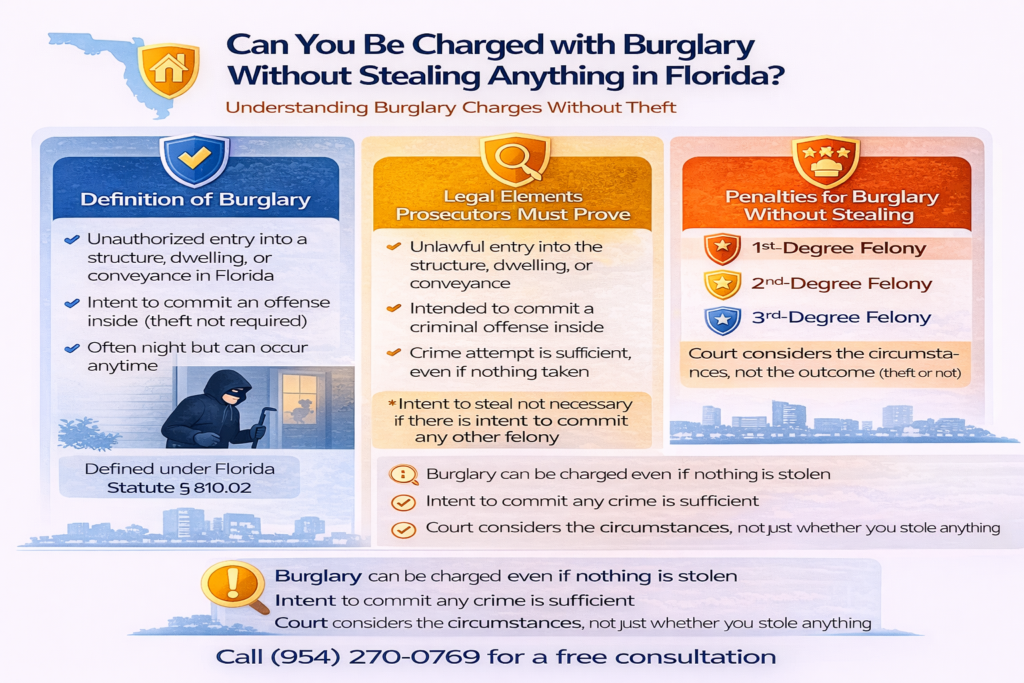
That’s because burglary is not defined by whether property is taken. Instead, it is defined by whether prosecutors can prove that you entered a dwelling, structure, or conveyance with intent to commit a crime inside.
For a full breakdown of burglary charges, degrees, and defenses, see Burglary Charges in Florida.
⚖️ Why Theft Is Not Required
Under Florida law, burglary focuses on intent — not the outcome.
That means:
- No property needs to be taken
- No crime needs to be completed
- The case can be based entirely on alleged intent
This is one of the most misunderstood aspects of burglary law.
🧠 The Role of Intent
To convict someone of burglary, the State must prove:
- Entry into a dwelling, structure, or conveyance
- Without permission (or remaining after permission was withdrawn)
- With intent to commit an offense inside
Intent is the key element — and it is often the most contested.
Because there is rarely direct proof of intent, prosecutors frequently rely on circumstantial evidence. For a deeper explanation of how that works, see Can Burglary Charges Be Based on Intent Alone in Florida?
🔍 How Prosecutors Try to Prove Intent
Even when nothing is stolen, prosecutors may argue intent based on:
- Time of day (late-night entry)
- Location (closed business or private residence)
- Behavior (attempting to conceal presence)
- Possession of tools
- Statements made before or after entry
These factors are often used to build an inference of intent — even where no crime was completed.
⚖️ Why These Cases Are Often Defensible
Burglary cases without theft are frequently vulnerable because:
- Intent must be inferred, not observed
- Innocent explanations may exist
- Evidence may be ambiguous
If prosecutors cannot prove intent beyond a reasonable doubt, the burglary charge may not hold.
In some cases, the facts may support a lesser offense instead. See Can Burglary Be Reduced to Trespass in Florida?
🚨 When Charges Can Still Be Serious
Even without theft, burglary charges can still carry severe penalties depending on the facts.
For example, cases may become more serious if prosecutors allege:
- Entry into a dwelling
- Presence of a person inside
- Use of a weapon
- Allegations of assault or battery
These factors can elevate the charge significantly. For more on how burglary charges reach the highest level, see What Makes Burglary a First-Degree Felony in Florida?
🛡️ Common Defense Issues
Burglary-without-theft cases often focus on:
Lack of Intent
If intent cannot be proven, the burglary charge may fail.
Lawful Entry
If entry was authorized, the burglary element may be defeated.
Misinterpretation of Conduct
Suspicious behavior does not automatically equal criminal intent.
Weak Evidence
Circumstantial evidence may not be enough to meet the burden of proof.
📍 Charged With Burglary in South Florida?
Being charged with burglary — even when nothing was taken — is serious. But these cases often hinge on technical legal issues, especially intent.
If you are under investigation or facing charges, early legal strategy can make a significant difference.
Call Michael White, P.A. at (954) 270-0769 for a confidential consultation.
FAQs
Can you be convicted of burglary if nothing was stolen?
Yes. Florida law requires proof of intent to commit a crime, not proof that a crime was completed.
What kind of intent is required?
Intent to commit any offense inside the property — not just theft.
How do prosecutors prove intent?
Usually through circumstantial evidence, such as behavior, location, and surrounding facts.
Can these charges be reduced?
Yes. If intent cannot be proven, burglary charges may be reduced or dismissed.