
Last updated March 2026
In Florida, burglary charges involving a dwelling are treated more seriously than other types of burglary — and whether the dwelling was occupied at the time can significantly affect how the case is prosecuted.
For a full breakdown of burglary charges, degrees, and defenses, see Burglary Charges in Florida.
⚖️ What Is a “Dwelling” Under Florida Law?
A dwelling generally refers to a place designed for people to live, including:
- Houses
- Apartments
- Condominiums
- Temporary residences
Florida law often treats dwellings differently from structures or conveyances because of the higher risk to human safety.
🔍 What Does “Occupied” Mean?
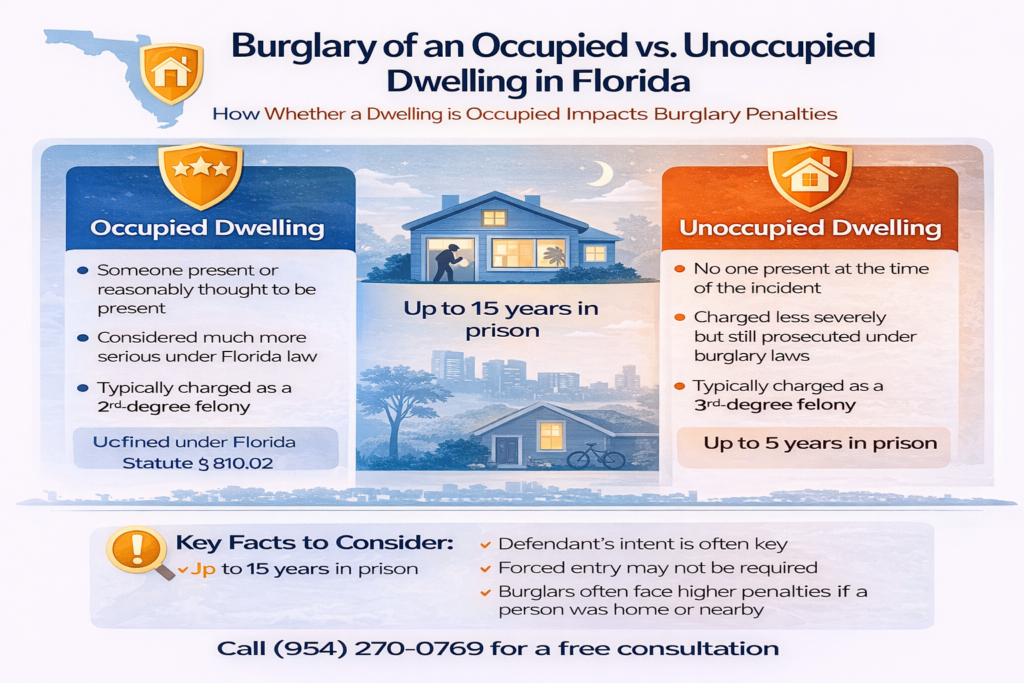
A dwelling is considered occupied when a person is inside at the time of the alleged burglary.
This can include:
- Residents
- Guests
- Any person lawfully present
Even brief presence can be enough to elevate the seriousness of the charge.
🏠 Burglary of an Unoccupied Dwelling
Burglary of a dwelling — even when unoccupied — is typically charged as a second-degree felony.
That means potential penalties may include:
- Up to 15 years in prison
- Up to 15 years of probation
- Up to $10,000 in fines
Florida law treats dwellings as inherently sensitive locations, regardless of whether someone is present at the time.
🚨 Burglary of an Occupied Dwelling
When a dwelling is occupied, the case becomes significantly more serious.
The presence of a person inside increases:
- The risk of confrontation
- The likelihood of violence
- The severity of how prosecutors evaluate the case
If additional factors are alleged — such as weapons or assault — the charge may be elevated even further. For example, cases involving violence or weapons may qualify for the most serious level of burglary under Florida law. See What Makes Burglary a First-Degree Felony in Florida?
🧠 Why Occupancy Matters
The difference between occupied and unoccupied dwellings is not just technical — it often affects:
- Charging decisions
- Bond conditions
- Sentencing exposure
- Negotiation leverage
Prosecutors often treat occupied-dwelling cases as inherently more dangerous, even if no actual confrontation occurred.
🔑 Intent Still Controls the Case
Even in dwelling cases, the State must still prove intent to commit a crime at the time of entry.
That means:
- Entering without intent is not burglary
- Intent formed after lawful entry may not qualify
- Circumstantial evidence is often used to infer intent
For a deeper explanation of how intent is used in burglary prosecutions, see Can Burglary Charges Be Based on Intent Alone in Florida?
⚖️ Dwelling vs. Other Types of Burglary
Not all burglary cases involve dwellings. Florida law separates burglary into:
- Dwellings
- Structures
- Conveyances
Each category carries different implications. For a comparison of how these classifications affect charges, see Burglary of a Structure vs. Dwelling in Florida
🛡️ Common Defense Issues
Burglary cases involving dwellings often turn on:
Was the Dwelling Actually Occupied?
Disputes may arise over whether someone was truly present at the time.
Intent at Entry
The State must prove intent existed at entry — not formed later.
Consent or Permission
If entry was authorized, the burglary element may fail.
Identification Issues
Many cases rely on surveillance or witness identification.
📍 Charged With Burglary of a Dwelling in South Florida?
Burglary of a dwelling — especially when alleged to be occupied — carries serious felony exposure. But these cases often hinge on technical legal elements such as intent, classification, and factual disputes about occupancy.
If you are under investigation or facing charges, early legal strategy can make a significant difference.
Call Michael White, P.A. at (954) 270-0769 for a confidential consultation.
FAQs
Is burglary of a dwelling always a felony?
Yes. Burglary of a dwelling is typically charged as a second-degree felony or higher.
Does it matter if no one was home?
Yes. The presence of a person can increase the seriousness of the charge, but even unoccupied dwellings are treated as serious felonies.
What if I didn’t know someone was inside?
That may be a relevant issue, but the facts of each case matter. Prosecutors may still pursue enhanced charges depending on the circumstances.
Can burglary of a dwelling be reduced?
In some cases, yes — especially where intent or entry is disputed.