
Last updated March 2026
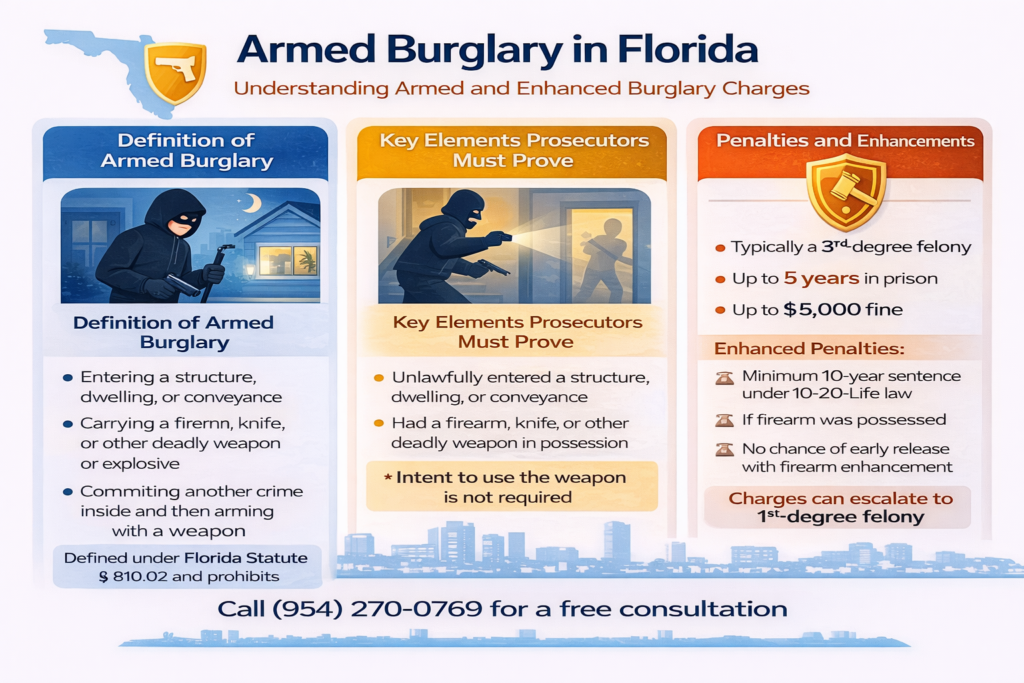
Armed burglary is one of the most serious burglary charges under Florida law. When prosecutors allege that a weapon was involved during a burglary, the charge can be elevated to a first-degree felony punishable by life — even if no one was injured.
For a full breakdown of burglary charges, degrees, and defenses, see Burglary Charges in Florida.
⚖️ What Is Armed Burglary?
Under Florida law, burglary becomes “armed” when a person:
- Enters or remains in a dwelling, structure, or conveyance
- With intent to commit an offense inside
- And is armed with a weapon or firearm at any point during the burglary
Importantly, the weapon does not have to be used. The allegation that a weapon was possessed during the incident is often enough to elevate the charge.
🔺 What Counts as a “Weapon”?
Florida law broadly defines weapons in burglary cases. These may include:
- Firearms
- Knives
- Blunt objects used as weapons
- Any object alleged to be capable of causing serious harm
Even everyday items can sometimes be characterized as weapons depending on how prosecutors frame the case.
🚨 Why Armed Burglary Is So Serious
Armed burglary is typically charged as a first-degree felony punishable by life. This is one of the highest-level non-homicide charges in Florida.
The severity comes from the increased risk of violence when a weapon is involved — even if no injury actually occurs.
For a deeper explanation of how burglary charges are elevated, see What Makes Burglary a First-Degree Felony in Florida?
📊 Potential Penalties
If convicted of armed burglary in Florida, penalties may include:
- Up to life in prison
- Up to life probation
- Up to $10,000 in fines
Additional consequences may include:
- Mandatory minimum sentencing (in firearm cases)
- Permanent felony record
- Loss of firearm rights
🧠 Intent Still Matters
Even in armed burglary cases, the State must still prove intent at the time of entry (or remaining).
That means prosecutors must show that:
- The defendant intended to commit a crime inside
- That intent existed at the moment of entry or unlawful remaining
In many cases, the presence of a weapon is used to support an inference of intent — even where no crime was completed. For a deeper look at that issue, see Can Burglary Charges Be Based on Intent Alone in Florida?
🔍 Common Defense Issues
Armed burglary cases often turn on a few key issues:
Weapon Possession
Was the defendant actually armed?
Was the object truly a “weapon” under the law?
Intent at Entry
If intent cannot be proven at the time of entry, the burglary charge itself may be vulnerable.
Identity
Many cases rely on surveillance footage or limited witness identification.
Overcharging
In some cases, prosecutors may allege a weapon to increase leverage — even where the facts are disputed.
⚖️ Armed Burglary vs. Other Burglary Charges
Not all burglary cases involve weapons. In many situations, the case may involve:
- Unarmed entry into a vehicle or structure
- Disputes over consent or authorization
- Questions about whether intent existed
For example, entering a vehicle without a weapon may be charged differently. See Burglary of a Conveyance in Florida.
📍 Charged With Armed Burglary in South Florida?
Armed burglary charges carry extreme consequences, but they are often highly fact-dependent. Issues involving intent, weapon classification, and identification can significantly affect how the case is charged — and how it is defended.
If you are under investigation or facing charges, early legal strategy is critical.
Call Michael White, P.A. at (954) 270-0769 for a confidential consultation.
FAQs
Does a weapon have to be used for armed burglary?
No. The allegation that a weapon was possessed during the burglary is often enough.
Is armed burglary always punishable by life?
It is commonly charged as a first-degree felony punishable by life, depending on the facts.
What if the object wasn’t really a weapon?
That can be a key defense issue. The classification of the object often matters.
Can armed burglary charges be reduced?
Yes. In some cases, charges may be reduced if the State cannot prove intent, weapon possession, or other key elements.