
Last updated March 2026
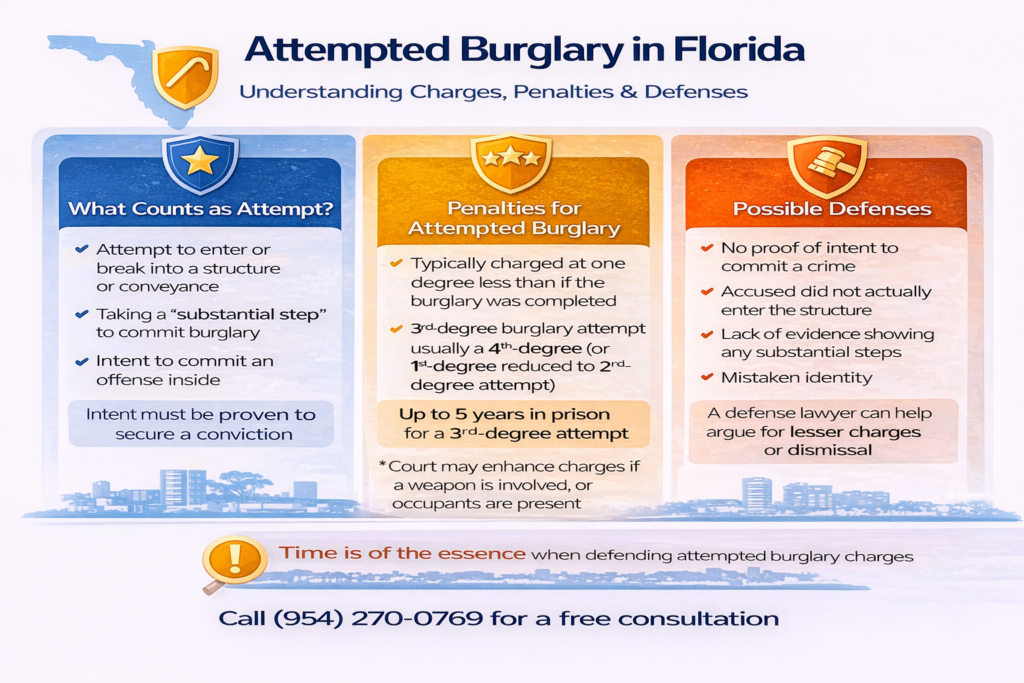
Attempted burglary in Florida is charged when prosecutors claim someone took a substantial step toward committing a burglary — but the crime was not completed.
Even though the burglary itself may not have occurred, an attempt can still be charged as a felony under Florida law.
For a full breakdown of burglary charges, degrees, and defenses, see Burglary Charges in Florida.
⚖️ What Is Attempted Burglary?
Under Florida law, an “attempt” occurs when a person:
- Intends to commit a specific crime
- Takes a substantial step toward committing that crime
- But does not successfully complete it
In burglary cases, this often involves allegations such as:
- Trying to pry open a door or window
- Attempting to enter a structure or vehicle
- Being interrupted before entry is completed
The key issue is whether the conduct went beyond mere preparation and became an actual attempt.
🔍 Attempt vs. Preparation
Not every suspicious act qualifies as an attempt.
For example:
- Walking around a property → likely preparation
- Trying to force entry → may qualify as an attempt
This distinction is often heavily contested in court and can determine whether charges hold up at all.
🧠 Intent Is Still Required
Even for an attempted burglary charge, prosecutors must prove intent to commit a crime inside the location.
That means:
- The State must show what crime was allegedly intended
- The intent must exist at the time of the attempted entry
- Circumstantial evidence is often used to prove intent
In many cases, the State relies heavily on inference rather than direct proof. For a deeper look at how intent is used in burglary prosecutions, see Can Burglary Charges Be Based on Intent Alone in Florida?
📊 Penalties for Attempted Burglary
Attempted burglary is typically charged one degree lower than the completed offense.
For example:
- Attempted third-degree burglary → may be charged as a first-degree misdemeanor
- Attempted second-degree burglary → may be charged as a third-degree felony
- Attempted first-degree burglary → may be charged as a second-degree felony
Even as a reduced-level offense, attempted burglary can still carry serious consequences depending on how the case is charged.
🚨 When Attempted Burglary Becomes More Serious
Attempted burglary charges can become more severe if prosecutors allege aggravating factors such as:
- Weapons
- Occupied dwellings
- Prior criminal history
These factors can significantly increase sentencing exposure and how the case is handled. For example, cases involving more serious burglary allegations may be evaluated under higher-level classifications. See What Makes Burglary a First-Degree Felony in Florida?
⚖️ Attempted Burglary vs. Completed Burglary
The biggest difference between attempted burglary and burglary is whether entry actually occurred.
Burglary requires:
- Entry into a dwelling, structure, or conveyance
- With intent to commit a crime inside
Attempted burglary focuses on conduct leading up to that entry.
In some cases, the facts may not support burglary at all. For example, if entry never occurred and intent is unclear, the case may be reduced or dismissed. See Can Burglary Be Reduced to Trespass in Florida?
🛡️ Common Defense Issues
Attempted burglary cases often turn on:
Was There a “Substantial Step”?
If the conduct does not go beyond preparation, the charge may not qualify as an attempt.
Intent
The State must prove intent to commit a specific crime — not just suspicious behavior.
Identification
Many cases rely on surveillance footage or limited witness descriptions.
Overcharging
Some cases are charged as attempted burglary when the evidence is weak or ambiguous.
📍 Charged With Attempted Burglary in South Florida?
Attempted burglary charges can still carry serious consequences — even if the alleged crime was never completed. But these cases often hinge on technical issues such as intent, conduct, and how far the alleged actions actually went.
If you are under investigation or facing charges, early legal strategy can make a significant difference.
Call Michael White, P.A. at (954) 270-0769 for a confidential consultation.
FAQs
Is attempted burglary a felony in Florida?
It can be. Attempted burglary is usually charged one degree lower than the completed offense, but it may still be a felony depending on the facts.
Do prosecutors have to prove intent?
Yes. Intent to commit a crime is still required, even for an attempt.
What counts as an attempt?
A substantial step toward committing burglary — not just preparation or suspicion.
Can attempted burglary charges be reduced?
Yes. If the evidence of intent or a substantial step is weak, charges may be reduced or dismissed.