
Last updated April 2026
When theft allegations arise between family members or roommates, the situation is rarely simple. We frequently see these cases arise from relationship breakdowns, financial stress, or disagreements over shared property.
What may start as a disagreement over money, shared property, or access to belongings can quickly escalate into a criminal investigation. Police often respond to one-sided statements, incomplete facts, or emotionally charged accusations — and arrests sometimes follow before the full context is understood.
In South Florida, these cases are commonly filed quickly, especially when emotions are high and facts are disputed.
If you’ve been accused of theft by a family member, romantic partner, roommate, or former cohabitant in Florida, you are not alone — and you are not automatically guilty.
Understanding how these cases are evaluated under Florida law is critical to protecting your record.
In many of these situations, what appears to be theft is actually a dispute—see when a theft case is really a civil dispute in Florida.
⚖️ Why These Situations Are Often Misunderstood
Many people search for help in these situations because they know something doesn’t feel like a crime—but law enforcement may treat it that way anyway.
Understanding how Florida law evaluates intent, ownership, and permission is key to preventing a misunderstanding from turning into a criminal charge.
⚖️ When a Family Dispute Becomes a Criminal Theft Case
Under Florida law, theft requires proof that someone knowingly obtained or used property with the intent to deprive the owner of it — even temporarily. To understand how theft offenses are defined and prosecuted under Florida law, see theft charges in Florida.
But in shared living situations, those elements are often unclear.
Common gray-area scenarios include:
-
Shared access to vehicles, tools, or electronics
-
Joint bank accounts or digital payment platforms
-
Borrowed items not returned on time
-
Property disputes after a breakup
-
Rent or utility disagreements framed as “theft”
-
Disputes over gifts, loans, or reimbursement
In many of these situations, the real issue is ownership, permission, or misunderstanding — not criminal intent.
🚨 Why Police Sometimes File Charges Anyway
When officers respond to a domestic or roommate dispute, they often must make quick decisions based on:
-
One person’s version of events
-
Text messages taken out of context
-
Missing property without clear documentation
-
Emotional statements made during arguments
If the complaining party claims property was taken “without permission,” officers may draft an arrest affidavit — even if:
-
The property was shared
-
There was prior consent
-
Ownership is disputed
-
The item was going to be returned
Once charges are filed, the case moves forward unless challenged early.
🔍 The Most Common Weak Points in These Cases
Family and roommate theft cases frequently fall apart because prosecutors struggle to prove:
1️⃣ Criminal Intent
Intent to permanently deprive must be proven. Borrowing, misunderstanding, or emotional retaliation is not automatically theft. This is one of the most important issues in these cases—see how lack of intent defense in Florida theft cases applies.
2️⃣ Exclusive Ownership
If both parties had access or shared use of the property, proving unlawful taking becomes difficult.
3️⃣ Clear Permission Limits
Text messages, shared passwords, spare keys, and prior patterns of use often undermine the State’s theory.
4️⃣ Reliable Valuation
Disputes over used items, gifts, or jointly purchased property frequently lead to inflated valuations that do not hold up in court.
🛡️ Defense Strategies in Family or Roommate Theft Cases
When theft allegations arise from personal relationships, defense strategy focuses heavily on context.
Common approaches include:
✔ Demonstrating shared access or consent
✔ Introducing communications that show permission
✔ Challenging inflated valuations
✔ Showing lack of intent to permanently deprive
✔ Framing the issue as a civil property dispute
✔ Attacking probable cause when police relied on incomplete facts
In many cases, early intervention prevents formal filing — or positions the case for dismissal. What happens early in these cases often determines whether they escalate or are resolved before charges take hold.
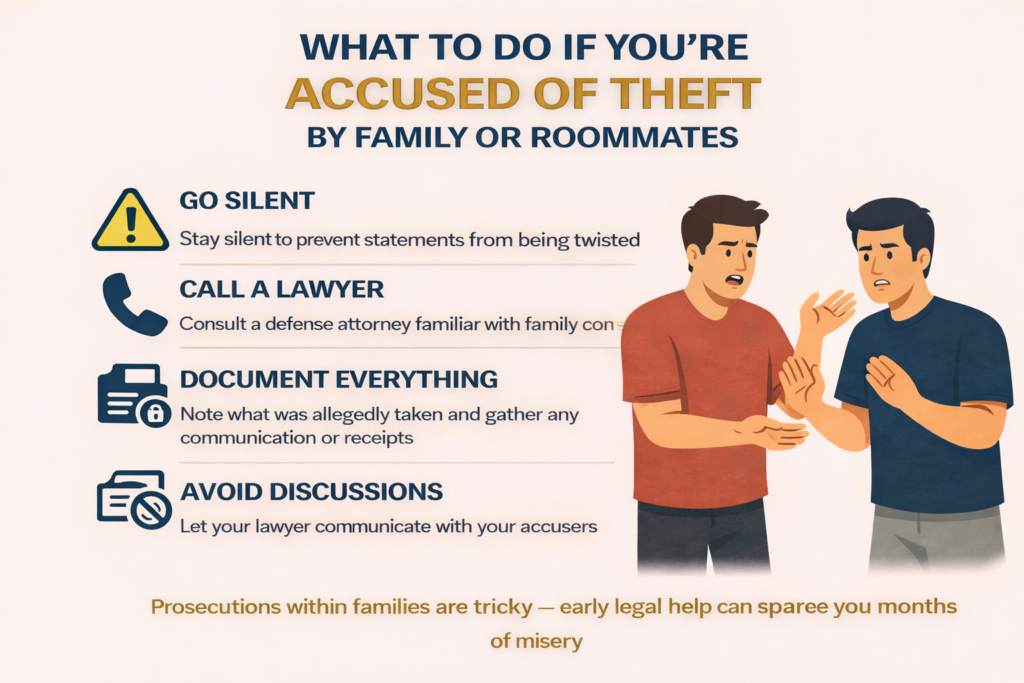
⚠️ What You Should NOT Do
When accused by someone you live with or previously lived with:
❌ Do not argue with the accuser
❌ Do not attempt to “explain” the situation to police
❌ Do not delete messages or alter records
❌ Do not send angry or threatening texts
❌ Do not try to “negotiate” repayment on your own
Statements made during emotional disputes are often used as evidence of intent.
🧭 Early Legal Action Can Change Everything
The earlier a defense lawyer becomes involved, the more options exist:
-
Contacting law enforcement before filing
-
Presenting context and documentation
-
Negotiating civil resolution
-
Preventing exaggerated valuation
-
Protecting you from unnecessary arrest
Many of these cases should never become criminal matters — but without early defense, they often do.
In many cases, early intervention can prevent charges from being filed at all—see when theft charges can be dropped in Florida.
📍 Accused of Theft by a Family Member or Roommate in Fort Lauderdale?
Domestic theft allegations can escalate quickly and damage reputations, housing arrangements, and employment.
At Michael White, P.A., we understand that not every accusation reflects criminal intent. As a former prosecutor, Michael White knows how these cases are evaluated — and how to expose when they lack proof.
👉 If you’re facing theft allegations in Fort Lauderdale or anywhere in Broward County, learn how our theft and fraud defense team can intervene early and protect your record.
📞 Call (954) 270-0769 for a confidential consultation.
❓ Frequently Asked Questions
Can I be arrested for taking property from someone I live with?
Yes — if police believe there was no permission. But shared access and ownership disputes are strong defenses.
What if the property was a gift?
Ownership of gifts is often disputed and may undermine the theft allegation.
Does returning the property automatically dismiss charges?
No. Return may help, but intent at the time of taking is what matters legally.
Can these cases be resolved without trial?
Yes. Many are dismissed, reduced, or resolved civilly when challenged early.