
Last updated April 2026
Being labeled a Violent Felony Offender of Special Concern (VFO-SC) is one of the most serious designations a person on probation or community supervision can face in Florida.
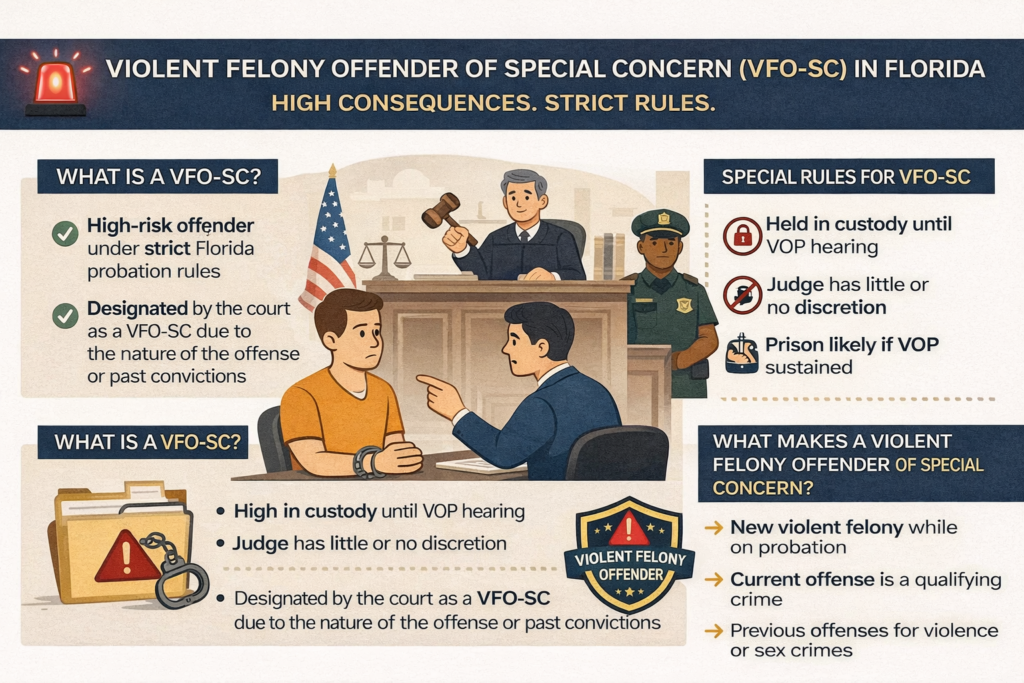
If VFO-SC applies, normal probation rules no longer apply. Judges have little discretion, release before a violation hearing may be prohibited, and prison becomes far more likely if a violation is sustained.
This page explains what VFO-SC means, who qualifies, how these cases are handled, and why defense strategy is fundamentally different.
For a full overview of how these cases are handled, see our guide to probation violations in Florida.
⚖️ What Is a Violent Felony Offender of Special Concern?
Under Florida law, a Violent Felony Offender of Special Concern is a person on probation or community supervision who is designated by the court as presenting a heightened public-safety risk due to violent criminal history or conduct while under supervision.
Once the designation applies, probation violation cases are handled under special statutory rules that sharply limit judicial discretion.
This is not a sentencing enhancement — it is a procedural designation that changes what happens after an alleged violation.
📋 Who Qualifies as a VFO-SC in Florida?
A person may be designated a VFO-SC if the court determines that one or more of the following apply:
-
A new violent felony is alleged while the person is on probation
-
The current offense is a qualifying violent felony
-
The person has prior convictions for violent felonies or certain sex offenses
-
The court finds the individual poses a heightened risk to public safety
The designation is made by the court — often early — and once applied, it controls how the violation case proceeds.
🚨 Why the VFO-SC Designation Is So Serious
VFO-SC cases are treated very differently from standard probation violations.
When VFO-SC applies:
-
The defendant may be held in custody until the VOP hearing
-
Bond or release may be prohibited
-
Judges have little or no discretion to release the defendant pre-hearing
-
Prison becomes far more likely if the violation is sustained
For a deeper look at how bond and pre-hearing release decisions work in standard cases, see our guide to bond on a probation violation in Florida.
This is why VFO-SC cases escalate quickly — often faster than people expect.
⚖️ Special Rules in VFO-SC Probation Violation Cases
Once a VFO-SC designation is in play, several key procedural differences apply:
-
Detention pending the VOP hearing is common
-
The court’s ability to consider mitigation early is limited
-
Timing and evidentiary challenges become critical
-
Defense efforts often focus on preventing the designation itself or limiting its scope
To understand how these procedures differ from standard cases, see our guide to what happens at a VOP hearing in Florida.
Unlike standard VOPs, judges cannot simply “give another chance” in many VFO-SC cases.
⚠️ Danger Hearings in VFO-SC Cases
In many Violent Felony Offender of Special Concern (VFO-SC) cases, courts also address whether the defendant poses a danger to the community.
This determination is often made at or near the start of the probation violation process and can result in:
-
Detention without release pending the violation hearing
-
Limited or no bond options
-
Heightened scrutiny of any request for pre-hearing release
While not every probation violation involves a formal “danger hearing,” VFO-SC cases frequently hinge on these findings, making early legal strategy critical.
🧠 What Judges Focus on in VFO-SC Cases
In deciding how to proceed, courts often focus on:
-
The nature of the alleged violation
-
Whether the conduct involves violence or threats
-
Prior violent convictions or supervision history
-
Risk to the public if release is granted
-
Whether statutory requirements for VFO-SC are met
This is a fundamentally different analysis than in technical or first-time probation violations.
🛡️ Defending a VFO-SC Probation Violation
Defense strategy in a VFO-SC case must be fast, targeted, and precise.
Common defense approaches include:
-
Challenging whether the alleged offense qualifies as a VFO-SC trigger
-
Attacking the legal sufficiency of the designation
-
Contesting probable cause for the alleged new offense
-
Narrowing the scope of allegations to avoid mandatory detention
-
Preparing mitigation for the VOP hearing itself
In many cases, the most important battle happens before the violation hearing even occurs.
Even in high-risk cases, defense strategy focuses on challenging the violation itself. Learn more about defenses to violation of probation in Florida.
⚠️ Possible Outcomes in a VFO-SC Case
If a violation is sustained and VFO-SC applies, the court may:
-
Revoke probation
-
Impose a prison sentence
-
Enforce mandatory detention provisions
-
Limit alternatives that would otherwise be available in standard VOP cases
Because the consequences are severe, early intervention is critical.
🔗 How This Fits Into Florida Probation Law
VFO-SC is part of Florida’s broader probation violation framework, but it represents the highest-risk category of VOP cases.
❓ FAQs: Violent Felony Offender of Special Concern (VFO-SC)
What does VFO-SC mean in Florida?
It stands for Violent Felony Offender of Special Concern — a designation that triggers stricter rules in probation violation cases involving violence or qualifying criminal history.
Does VFO-SC automatically mean prison?
Not automatically, but it significantly increases prison exposure and limits judicial discretion.
Can a judge release a VFO-SC defendant before the hearing?
Often no. Many VFO-SC cases involve mandatory detention pending the violation hearing.
Is VFO-SC decided at sentencing?
No. It is typically applied during probation violation proceedings, not at original sentencing.
Can a lawyer challenge a VFO-SC designation?
Yes. Defense counsel may challenge whether the statutory criteria are met and whether the designation is legally appropriate.
⚠️ Facing a VFO-SC probation violation in Florida?
These cases move fast and leave little room for error. Understanding the designation — and responding immediately — can make a critical difference.