
Last updated March 2026
Being accused of aggravated assault in Florida is serious — and it can lead to felony charges, mandatory prison time, and a criminal record that follows you for life. But not every aggressive moment or verbal threat rises to the legal definition of aggravated assault.
Aggravated assault does not require physical contact — yet it can still result in years in prison, mandatory sentencing enhancements, and a permanent felony record.
Let’s break down what this charge really means, what the prosecution must prove, and how a defense lawyer can fight for your future.
Aggravated assault is prosecuted as a serious felony within Florida’s broader violent crimes framework. For a full overview of how violent offenses are classified and defended under Florida law, see our guide to Violent Crimes in Florida.
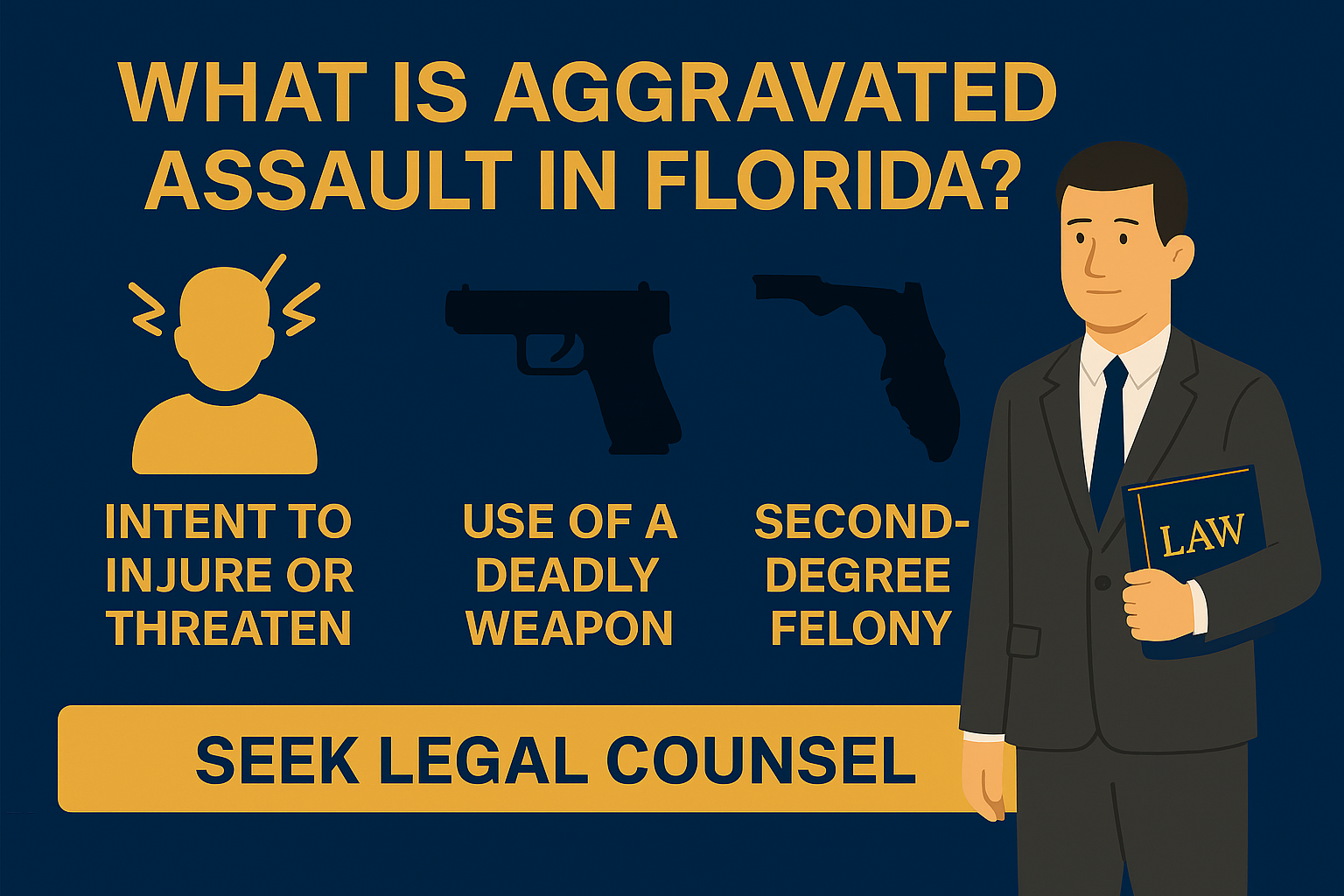
⚖️ What Is Aggravated Assault in Florida?
Under Florida Statute § 784.021, aggravated assault is generally defined as:
an intentional and unlawful threat to do violence to another person
combined with an apparent ability to carry out the threat
creating a well-founded fear that violence is imminent
along with the use of a deadly weapon or intent to commit a felony
Florida law focuses on intent, weapons, perception, and immediacy — meaning a person can be charged with aggravated assault without ever laying a hand on anyone.
That’s right: no physical contact is required.
No physical injury is required either. But the penalties can still rival those imposed for other serious violent offenses.
🔨 What Counts as a Deadly Weapon?
Florida courts interpret “deadly weapon” broadly. It can include:
firearms
knives or blades
baseball bats
a vehicle used to threaten someone
broken bottles or heavy tools
If an object could reasonably be expected to cause great bodily harm or death, prosecutors may argue that it qualifies as a deadly weapon — even if it was never fired, swung, or used to make contact.
But that does not mean every object police label a “weapon” legally qualifies. In some cases, the entire charge turns on whether the object actually meets the legal standard.
For example, Florida courts do not automatically treat pellet guns, BB guns, airsoft weapons, or inoperable firearms the same as real firearms. Learn how those cases are analyzed in Aggravated Assault With a BB Gun or Airsoft Gun in Florida.
🔪 Common Examples of Aggravated Assault in Florida
Aggravated assault charges often arise from everyday confrontations that escalate quickly. Common examples include:
waving or pointing a firearm during an argument
threatening someone with a knife, bat, or heavy object
using a vehicle to intimidate or threaten another person
raising a bottle or tool as if to strike someone
In each situation, the charge is based not on injury, but on the alleged threat, the presence of a weapon, and whether the alleged victim reasonably feared imminent violence.
Many aggravated assault cases arise from highly specific real-world settings. Some begin during domestic arguments, some occur in parking lots or public places, and others grow out of road-rage confrontations where the State claims a vehicle or firearm was used as a deadly weapon.
🔎 Explore Common Aggravated Assault Scenarios and Defenses
Aggravated assault charges often arise in very specific situations — and the details of those situations can make or break a case. If your situation involves any of the following, you can explore a more detailed breakdown below:
Firearm-related allegations — including when displaying or pointing a weapon crosses the legal line
👉 Aggravated Assault With a Firearm in Florida
👉 Brandishing a Firearm vs. Aggravated Assault in FloridaEveryday confrontations that escalate quickly — including traffic disputes and public encounters
👉 Road Rage Aggravated Assault in Florida
👉 Aggravated Assault in a Parking Lot or Public Place in FloridaSituations involving words, gestures, or perception-based conduct
👉 Can Words Alone Be Aggravated Assault in Florida
👉 What Is “Apparent Ability” in Florida Aggravated Assault CasesHow these cases are defended and resolved
👉 How Self-Defense Defeats Aggravated Assault Charges in Florida
👉 Can Aggravated Assault Be Dropped Before Trial in Florida
🔫 Aggravated Assault With a Firearm in Florida
When aggravated assault involves a firearm, the stakes increase dramatically. Under Florida law, merely displaying or brandishing a firearm during an alleged threat can trigger felony prosecution — even if the gun was never fired and no one was physically harmed.
For a deeper breakdown of firearm-specific enhancements, sentencing exposure, and defense strategy, see Aggravated Assault With a Firearm in Florida.
Important points:
You do not have to fire the gun.
You do not have to physically touch anyone.
You do not need to have intended to kill.
Brandishing or displaying a firearm in a threatening manner can be enough to support an aggravated assault charge.
However, not every instance of displaying or “brandishing” a firearm qualifies as aggravated assault under Florida law. The legal distinction often depends on whether the conduct created a real and immediate threat of violence. A closer look at where that line is drawn is explained in Brandishing a Firearm vs. Aggravated Assault in Florida.
And in many cases, the dispute centers on whether the act of pointing or displaying the firearm actually crossed the legal line. That issue is addressed in Is Pointing a Gun Aggravated Assault in Florida.
⚖️ Mandatory Minimum Sentences Under Florida’s 10–20–Life Law
Florida’s 10–20–Life statute imposes mandatory minimum prison sentences when a firearm is used during certain felonies — including aggravated assault in many circumstances.
If the enhancement is applied:
possessing or displaying a firearm may trigger a 10-year mandatory minimum
firing a firearm may trigger a 20-year mandatory minimum
firing a firearm and causing injury may result in 25 years to life
These are mandatory sentences. Judges cannot legally sentence below them unless the prosecutor agrees not to pursue or maintain the enhancement.
Because prosecutors decide whether to apply the firearm enhancement, early defense intervention can be decisive. Challenging whether a firearm was actually used or displayed, disputing intent, and accurately framing the facts can mean the difference between probation and mandatory prison time.
🚗 Road Rage, Public Confrontations, and Domestic Disputes
Many aggravated assault arrests happen in fast-moving situations that are emotionally charged and factually messy.
For example, vehicles can qualify as deadly weapons when used aggressively or to intimidate another driver. These fact patterns are explored more fully in Road Rage Aggravated Assault in Florida.
Public confrontations can also create aggravated assault allegations, especially when witnesses, surveillance cameras, and split-second misinterpretations are involved. For those scenarios, see Aggravated Assault in a Parking Lot or Public Place in Florida.
And in domestic settings, many cases are driven by credibility disputes, changing stories, and allegations made during emotional arguments. Those issues are covered in Domestic Arguments and Aggravated Assault Charges in Florida.
🔍 What Prosecutors Must Prove
To convict someone of aggravated assault, prosecutors must prove four core elements:
1. Intentional and unlawful threat
The State must show the defendant deliberately threatened violence — not merely used harsh language, raised their voice, or acted angrily.
2. Apparent ability to carry out the threat
The alleged victim must reasonably believe the defendant could immediately carry out the threat.
3. Well-founded fear of imminent violence
The fear must be real, immediate, and objectively reasonable — not exaggerated or speculative.
4. Use of a deadly weapon or intent to commit a felony
A deadly weapon does not require physical injury. It includes objects capable of causing serious harm if used in a threatening way.
Aggravated assault is a perception-driven charge. The State does not have to prove physical contact or injury — only that the alleged victim reasonably believed violence was imminent.
Because these cases often turn on nuance, two issues come up again and again: whether the accused had apparent ability to carry out the threat, and whether the facts created a legally sufficient fear of imminent harm. For a deeper explanation of that element, see What Is “Apparent Ability” in Florida Aggravated Assault Cases.
🗣️ Can Words Alone Be Aggravated Assault?
Usually, no.
Words can be part of an assault accusation, but in most cases words alone are not enough. Florida law requires more than an angry statement. The State must prove a real, immediate threat combined with apparent ability and reasonable fear.
That distinction matters in cases involving yelling, verbal arguments, and emotionally charged accusations. For a fuller breakdown, see Can Words Alone Be Aggravated Assault in Florida.
Similarly, not every raised voice, aggressive motion, or gesture with an object qualifies as aggravated assault. Those edge-case scenarios are examined in Is Raising Your Voice or Gesturing a Weapon Aggravated Assault?
🧑⚖️ Penalties for Aggravated Assault in Florida
Aggravated assault is a third-degree felony punishable by:
- Up to 5 years in prison
- 5 years of probation
- $5,000 fine
But there’s more — if a firearm was involved, Florida’s 10-20-Life law may apply, triggering mandatory minimum prison terms (even if the gun wasn’t fired).
Importantly, a conviction for aggravated assault is not eligible for sealing or expungement under Florida law, making the long-term consequences especially serious.
A felony conviction for aggravated assault permanently strips firearm rights under Florida law.
🔒 Is There a Minimum Sentence for Aggravated Assault in Florida?
There is no automatic mandatory minimum sentence for aggravated assault unless a firearm enhancement or another statutory enhancement applies.
When no firearm is involved, aggravated assault remains a third-degree felony, and judges generally retain discretion to impose probation, jail, or prison — especially for first-time or nonviolent offenders.
But when the alleged victim is a law enforcement officer or another protected person such as a firefighter, EMT, or paramedic, the charge can become more serious. Those enhanced cases are addressed in Aggravated Assault on a Law Enforcement Officer in Florida and Aggravated Assault on a Protected Person in Florida.
🔍 Aggravated Assault vs. Simple Assault
Assault charges in Florida involve an intentional threat of violence without physical contact.
Aggravated assault escalates that threat into a felony when a deadly weapon is involved or the threat occurs during the commission of another felony.
Simple Assault (§ 784.011) = threat with no deadly weapon
Aggravated Assault (§ 784.021) = threat + deadly weapon, or intent to commit a felony
No physical injury is required for either charge.
For a full overview of how Florida defines and prosecutes misdemeanor assault, see our guide to Assault Charges in Florida.
🛡️ Legal Defenses to Aggravated Assault
Aggravated assault cases often hinge on details the State struggles to prove. Because the charge is based on threats, intent, and perception — not physical injury — early and aggressive defense work can expose weaknesses that lead to dismissals or reductions.
Common defenses include:
✔ Self-Defense / Defense of Others
Florida law allows the threatened use of force when you reasonably believe you are in danger of imminent harm. In some aggravated assault cases, that can support dismissal through lawful self-defense or Stand Your Ground immunity. For a fuller breakdown, see How Self-Defense Defeats Aggravated Assault Charges in Florida.
✔ Lack of Intent
A threat made in anger without actual intent to threaten immediate violence may not qualify as aggravated assault.
✔ Object Was Not a Deadly Weapon
Not every item police call a weapon legally qualifies.
✔ No Well-Founded Fear
If the alleged victim overreacted, was inconsistent, or had a motive to lie, fear may not be legally credible.
✔ False Accusations
Common in domestic disputes, breakups, and neighbor conflicts.
✔ No Assault Occurred
The words or actions did not create a reasonable fear of imminent violence, even if an argument occurred.
✔ Insufficient or Unreliable Evidence
Poor lighting, lack of video, contradictory witnesses, or absence of a weapon can undermine the State’s case.
In many cases, aggravated assault charges are reduced to lesser offenses such as simple assault or improper exhibition of a weapon. Those outcomes are explained in How Aggravated Assault Charges Get Reduced in Florida.
And in some cases, aggressive early intervention can prevent the case from ever reaching trial. For that stage of the process, see Can Aggravated Assault Be Dropped Before Trial in Florida.
📍 Arrested for Aggravated Assault in Fort Lauderdale or South Florida?
A felony assault charge does not have to destroy your life. With the right strategy and experienced representation, you may be able to:
get charges reduced or dropped
negotiate a non-felony outcome
avoid mandatory prison time
At Michael White, P.A., we bring former prosecutor insight to every violent crimes case in South Florida. We know how the State builds these cases — and how to break them down.
Many aggravated assault cases are won before trial. Early intervention — including pre-filing advocacy, witness review, and evidence preservation — can prevent felony charges from being formally filed or block sentencing enhancements before they attach.
Aggravated assault cases move quickly, and what you say or do early on can make or break your defense. Early legal representation can preserve favorable evidence, challenge weak assumptions, and stop a case from escalating before it fully develops.
🟡 Call today at (954) 270-0769, or schedule your free consultation.
🟢 Protect your rights before charges become convictions.
❓FAQs
Q1: Is aggravated assault a felony in Florida?
A: Yes. Standard aggravated assault is usually a third-degree felony, punishable by up to 5 years in prison and a $5,000 fine. It can become more serious if a firearm or protected-victim enhancement applies.
Q2: Do I have to actually hurt someone to be charged?
A: No. You can be charged even without causing physical injury. The case is based on threats, intent, and whether a deadly weapon or other enhancement applies.
Q3: What qualifies as a deadly weapon?
A: Anything capable of causing serious harm — such as guns, knives, bats, tools, or even a vehicle — if used in a threatening manner.
Q4: Can I claim self-defense in an aggravated assault case?
A: Yes. If you were protecting yourself or someone else from an imminent threat, self-defense or Stand Your Ground may apply.
Q5: Will I go to jail for aggravated assault in Florida?
A: Not necessarily. Many cases are reduced, dismissed, or resolved without prison, especially when the defense moves early and attacks the weakest parts of the State’s case.