
Last updated December 2025
Updated for 2025 — What Felony Defendants in Florida Need to Know
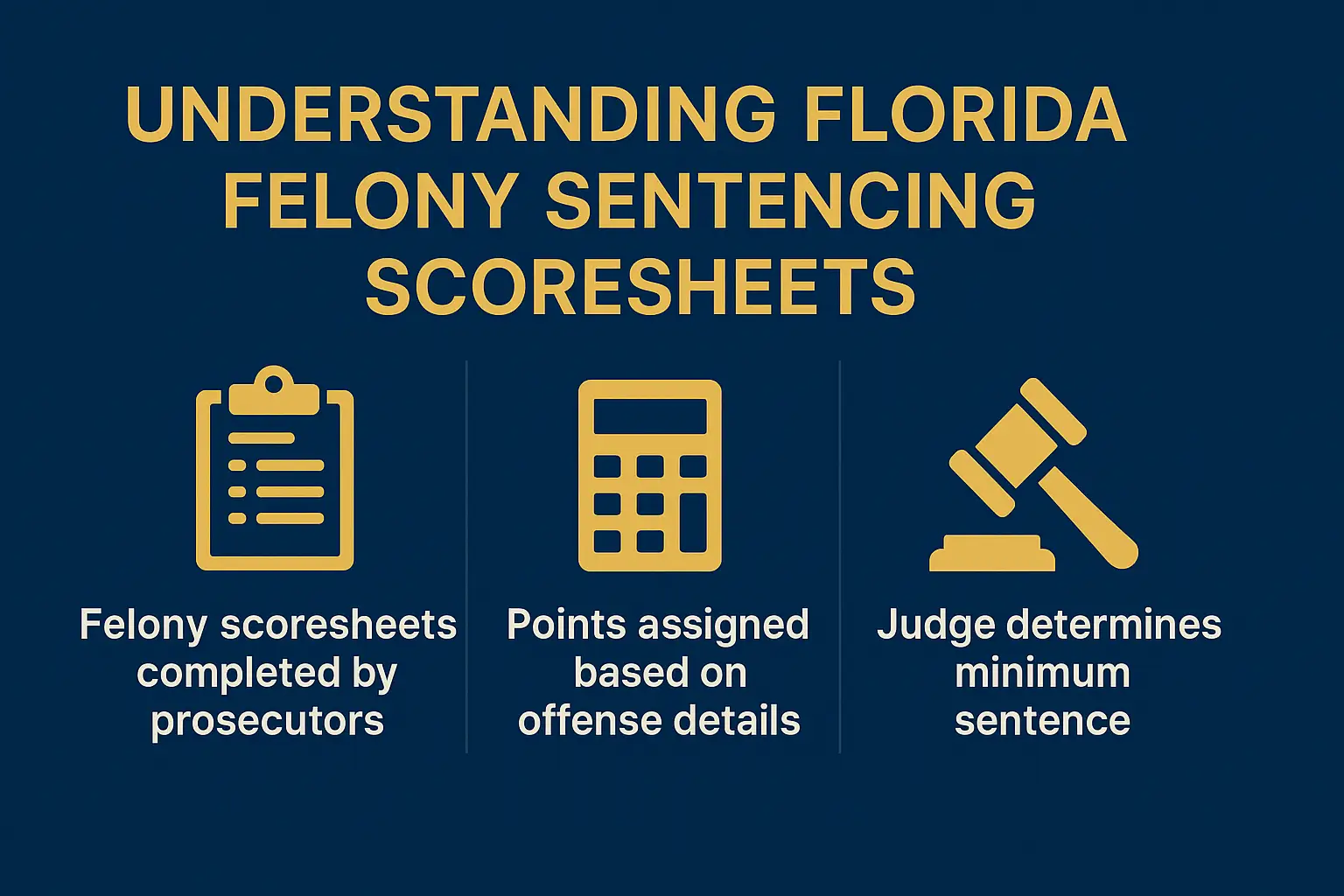
If you’re facing felony charges in Fort Lauderdale or anywhere in South Florida, the prosecutor must prepare a Florida Criminal Punishment Code (CPC) sentencing scoresheet. While the Department of Corrections provides a long technical manual, understanding the fundamentals can help you estimate your sentencing exposure — and see where an experienced defense attorney can reduce or eliminate prison time.
Florida’s sentencing point system is strict and mathematical. In our Broward criminal practice, we’ve seen cases where a few extra points pushed a client from probation into mandatory prison.
This guide explains how scoresheets work, which factors increase sentencing points, and how a lawyer can challenge improper scores to lower your exposure.
⚖️ What Is a Sentencing Scoresheet in Florida?
Florida’s sentencing scoresheet assigns point values based on:
Primary offense
Additional offenses
Victim injury
Prior convictions
Legal status violations (probation, bond, escape)
Community sanction violations
Firearm enhancements
Prior serious felonies
At the end, the prosecutor totals the points:
👉 44 points or more = mandatory state prison
👉 Less than 44 points = judge has discretion
(probation, community sanctions, treatment, or downward departures)
Understanding where your points come from — and whether they’re correct — is critical to negotiating a favorable outcome.
🔍 Breaking Down the Key Factors
🔹 Primary Offense
This is your most serious charge. Each felony is assigned a severity level from 1 to 10.
Higher levels = more points = more exposure.
The primary offense often determines whether the scoresheet starts high or low.
🔹 Additional Offenses
If you’re charged with more than one felony, each additional offense adds points.
In many Fort Lauderdale multi-count indictments, these extra points push defendants above the 44-point prison threshold — even when the additional charges are minor.
🔹 Victim Injury Points
Victim injury is one of the biggest sentencing multipliers:
Minor injury → small point increase
Moderate or great bodily harm → large point increase
Death → dramatic increase
Sexual offenses → high injury points even without visible injury
This category must be challenged aggressively when injury claims are exaggerated or unsupported by evidence.
🔹 Prior Convictions
Prior offenses add points — including:
Relevant juvenile priors
Out-of-state convictions
Certain misdemeanors
Older convictions (10+ years) may not count if there were no new offenses between
Your lawyer can often challenge whether a prior conviction should score.
🔹 Legal Status Violations
Extra points apply if you committed the new offense while:
On probation
On pretrial release
In custody
Escaped or absconding
Out on bond
These points often appear automatically — but many are improperly applied.
🔹 Community Sanction Violations (VOPs)
Violations add:
6 points → technical violations / misdemeanor new law violations
12 points → felony violations
Additional points → multiple VOPs
Judges in Broward often take VOPs seriously; understanding their scoring impact is essential.
🔹 Firearm / Weapon Enhancements
If a firearm was involved:
18 points → possession of firearm
25 points → semi-automatic or machine gun
These enhancements significantly increase prison exposure and are a frequent point of litigation in Broward violent crime cases.
🔹 Prior Serious Felonies
If you have prior serious felonies, the State may add 30 points.
This enhancement appears often in habitual offender cases in Broward, Miami-Dade, and Palm Beach.
📌 Why the Scoresheet Matters in Fort Lauderdale Felony Cases
A single point above 44 can be the difference between:
Probation
Community control
Downward departure eligibility
Mandatory prison
An experienced defense lawyer can:
Challenge improper points
Reduce or eliminate enhancements
Argue for downward departure
Correct errors in victim injury scoring
Protect you from unnecessary prison exposure
In borderline cases near 44 points, the scoresheet is the case.
🧑⚖️ Facing Felony Charges in South Florida? Let’s Review Your Scoresheet.
At Michael White, P.A., we defend clients across Broward and South Florida. We:
Analyze your scoresheet line by line
Challenge inflated injury points
Fight improper prior scoring
Contest firearm and legal-status enhancements
Negotiate reduced exposure whenever possible
📞 Call (954) 270-0769 or request a free case review.
❓ Frequently Asked Questions About Florida Sentencing Scoresheets
1. What is a sentencing scoresheet in Florida?
A tool used in felony cases that assigns point values to charges, injuries, priors, enhancements, and legal status to determine sentencing recommendations.
2. Do all felony cases require a scoresheet?
Yes. Every felony plea or trial in Florida requires a properly completed scoresheet.
3. What happens if my total is over 44 points?
Prison becomes mandatory unless a downward departure applies.
4. Do prior arrests count?
No — arrests alone do not score. Prior convictions, juvenile priors, and certain out-of-state convictions may.
5. Can a lawyer negotiate a scoresheet?
Yes. Defense attorneys often negotiate point reductions, eliminate improper scoring, or argue downward departure factors to avoid prison.