
Last updated March 2026
In Florida aggravated battery cases, the phrase “great bodily harm” is one of the most powerful — and most disputed — elements prosecutors rely on to justify severe felony charges.
Whether an injury actually qualifies as “great bodily harm” can mean the difference between a misdemeanor, a third-degree felony, or a second-degree felony carrying up to 15 years in prison.
Here’s how Florida law defines great bodily harm, what injuries typically qualify, and how defense attorneys challenge these allegations in real cases.
For a full explanation of aggravated battery charges — including penalties, defenses, and how cases are reduced — see our guide to Aggravated Battery in Florida.
⚖️ The Short Answer
“Great bodily harm” means more than minor or temporary injury.
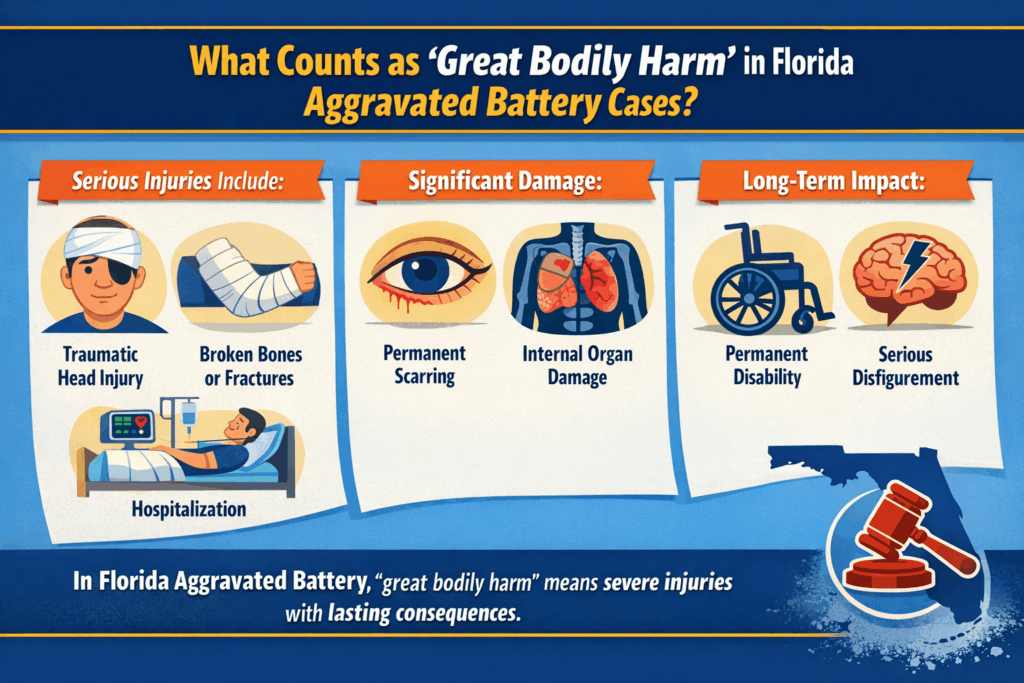
It refers to serious, severe injuries with lasting consequences, not everyday bumps, bruises, or soreness.
Prosecutors must prove that the injury rises above ordinary harm — and that is often where aggravated battery cases fall apart.
We break down how the State attempts to prove this element in our guide to What Prosecutors Must Prove to Convict Aggravated Battery in Florida.
📜 Where “Great Bodily Harm” Comes From in Florida Law
Florida’s aggravated battery statute, § 784.045, elevates a battery to aggravated battery when the State alleges:
Great bodily harm,
Permanent disability, or
Permanent disfigurement,
or when a deadly weapon is used. See how courts analyze that issue in our guide to What Qualifies as a Deadly Weapon in Florida Aggravated Battery Cases.
The statute does not define “great bodily harm” precisely, which gives prosecutors discretion — and gives the defense room to fight.
🩺 Injuries That May Qualify as Great Bodily Harm
While every case is fact-specific, Florida courts have found the following injuries may qualify:
Traumatic head injuries
Broken bones or multiple fractures
Internal organ damage
Serious eye injuries or vision loss
Injuries requiring surgery or extended hospitalization
Permanent scarring or disfigurement
Long-term or permanent physical impairment
These injuries typically involve lasting impact, not just short-term pain.
🔫 Does a Gunshot Injury Automatically Qualify as Great Bodily Harm?
Gunshot wounds are often treated as strong evidence of great bodily harm—but they do not automatically satisfy the legal standard in every case.
Courts still examine:
• The severity of the injury
• Whether there was lasting damage
• The extent of medical treatment required
• Long-term impact on the alleged victim
In some cases, particularly where injuries are relatively minor or recovery is rapid, the defense may challenge whether the injury meets the statutory threshold.
Firearm-related allegations also raise separate legal issues, including potential sentencing enhancements. We examine those issues in our guide to Aggravated Battery Involving a Firearm in Florida.
❌ Injuries That Often Do Not Qualify
Not every injury — even one requiring medical care — meets the legal standard.
Defense attorneys frequently challenge aggravated battery charges involving:
Minor cuts or abrasions
Bruising or swelling
Short-term pain without lasting impairment
Soft-tissue injuries that resolve quickly
Injuries exaggerated in police reports but unsupported by medical records
In many cases, the alleged injury simply does not rise to the level required by law.
🔍 Why This Element Is So Often Disputed
Prosecutors often rely on:
initial police descriptions
emotional victim statements
photographs taken immediately after an incident
But medical records tell a more precise story.
Defense strategies commonly focus on:
emergency room notes vs. police reports
absence of permanent impairment
lack of surgical intervention
expert medical review
timelines showing rapid recovery
When the evidence doesn’t support “great bodily harm,” aggravated battery charges can often be reduced.
⚖️ What This Means for Aggravated Battery Charges
If the State cannot prove great bodily harm, the charge may be:
reduced to felony battery, or
reduced further to simple battery, depending on the facts
That reduction can dramatically lower sentencing exposure and long-term consequences. We explain how these reductions occur in practice in our article on How Aggravated Battery Charges Can be Reduced in Florida.
📊 How “Great Bodily Harm” Affects Sentencing in Florida
Allegations of great bodily harm do more than elevate the charge—they can significantly increase sentencing exposure under Florida’s Criminal Punishment Code.
In many cases, a finding of great bodily harm adds substantial points to the sentencing scoresheet, which can:
• Push a case into a prison-recommended range
• Increase the minimum permissible sentence
• Limit the availability of non-prison resolutions
Even when a case does not carry a mandatory minimum, scoresheet calculations can create significant pressure in plea negotiations.
This is why challenging the “great bodily harm” element is often critical—not just for the charge itself, but for the sentencing outcome.
🛡️ How Defense Attorneys Challenge “Great Bodily Harm”
Effective challenges often include:
Disputing medical causation
Demonstrating injuries were temporary
Highlighting inconsistent injury descriptions
Using medical experts to explain recovery and prognosis
Arguing the injury does not meet the statutory threshold
These challenges are especially powerful early, before prosecutors lock in their theory of the case.
Allegations of “great bodily harm” are one of the primary ways simple battery cases are elevated to aggravated battery under Florida law.
📍 Facing an Aggravated Battery Charge in Florida?
Aggravated battery cases often hinge on whether the injury truly qualifies as “great bodily harm.”
Learn more about how an experienced
violent crimes defense attorney in Fort Lauderdale
analyzes injury evidence, challenges overcharging, and fights to reduce or dismiss aggravated battery allegations.
📞 Call (954) 270-0769 or request a confidential consultation today.
❓ Frequently Asked Questions
What is considered “great bodily harm” in Florida?
Great bodily harm refers to severe injuries with lasting consequences, such as fractures, internal organ damage, permanent scarring, or long-term disability.
Does great bodily harm require permanent injury?
Not always, but injuries that are permanent, disabling, or disfiguring are more likely to qualify. Temporary or minor injuries often do not.
Are bruises or cuts considered great bodily harm?
Usually not. Minor bruising, cuts, or short-term pain typically do not meet the legal threshold.
Can aggravated battery charges be reduced if injuries aren’t severe?
Yes. When the evidence does not support great bodily harm, charges are often reduced to felony battery or simple battery.
Who decides whether an injury qualifies as great bodily harm?
Ultimately, it is a legal determination based on evidence. Prosecutors may allege it, but defense attorneys can challenge the claim through medical records, experts, and cross-examination.