
Last updated February 2026
In Florida, simply pointing a gun during an argument can instantly turn a misdemeanor into a serious felony. Aggravated assault with a firearm is one of the most aggressively prosecuted crimes in Broward County — and it often carries mandatory prison time under Florida’s 10-20-Life law.
Even first-time offenders face years behind bars if the prosecutor chooses to pursue mandatory minimums. But many aggravated assault cases involve misunderstandings, self-defense, or exaggerations — making strong legal defense essential.
If you or someone you love has been arrested or accused, here’s what you need to know — and how a skilled Fort Lauderdale criminal defense lawyer can help.
⚖️ What Is Aggravated Assault with a Firearm?
Under Florida Statute § 784.021, aggravated assault is an assault that:
is made with a deadly weapon, without intent to kill, or
is made with intent to commit a felony.
When that deadly weapon is a firearm, the charge becomes even more serious due to Florida’s 775.087 reclassification statute and the 10-20-Life mandatory minimums.
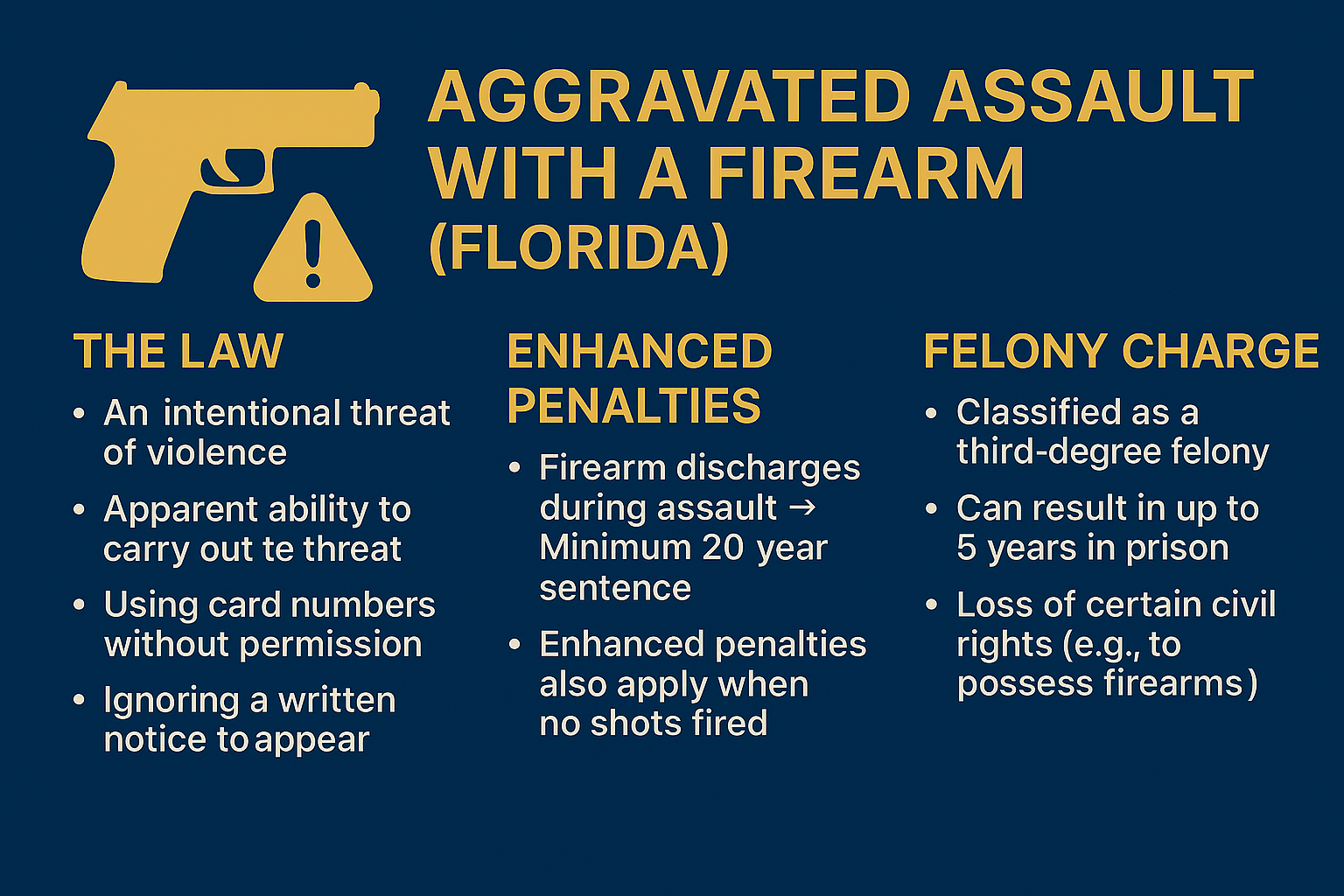
To convict someone, the State must prove:
An intentional, unlawful threat to do violence
Apparent ability to carry out the threat
The alleged victim had a well-founded fear of imminent violence
A firearm was used or displayed during the incident
For the broader definition, penalties, and defenses that apply to all felony assault cases, see our guide to aggravated assault charges in Florida.
⚠️ Important
You do not have to fire the gun.
You do not have to physically touch anyone.
You do not need to have had actual intent to kill.
Brandishing a firearm in a threatening manner is enough to trigger the charge. In many cases, the real dispute is whether the conduct was felony aggravated assault or a lesser firearm offense — see brandishing a firearm vs. aggravated assault in Florida.
This is why many cases that begin as shouting matches, road-rage incidents, or domestic disputes suddenly become serious felony prosecutions.
💣 Penalties Under Florida’s 10-20-Life Law
Florida’s 10-20-Life statute (§ 775.087) imposes mandatory minimum prison sentences for using a firearm during certain felonies — including aggravated assault in many circumstances.
| Action Involving a Firearm | Mandatory Minimum Sentence |
|---|---|
| Possessing a firearm | 10 years |
| Firing a firearm | 20 years |
| Firing and injuring someone | 25 years to life |
🔒 These sentences are mandatory if applied
Judges cannot legally go below these minimums unless the prosecutor agrees to waive or avoid the enhancement. This makes early negotiation, factual challenge, and proper case framing extremely important.
FAQs About Aggravated Assault with a Firearm in Florida
✅ Mandatory minimums may apply even for first-time offenders
✅ Just pointing a gun can trigger a 10-year minimum
✅ Firing a gun increases the minimum to 20 years
✅ Harm or injury can lead to 25-to-life
🚫 Judges cannot sentence below the minimum without State approval
🚫 A conviction creates a lifelong firearm ban and felony record
🚔 Common Scenarios That Lead to Charges
These are among the most frequent factual patterns we see in Broward County:
🚗 Road Rage Incidents
A driver displays a gun after being cut off or confronted. Video evidence or conflicting statements often play a major role.
🏠 Domestic Arguments
A firearm may be shown during a heated moment. These cases often rely heavily on the credibility of one witness.
🍻 Bar or Parking Lot Disputes
Alcohol, crowd dynamics, and poor lighting can lead to exaggerated or unclear accusations.
👥 Neighbor Disputes
Showing a gun to “scare off” someone can lead to aggravated assault charges even where no physical violence occurred.
In many of these cases, the legal issue is not whether the firearm existed — but whether the defendant knowingly threatened violence, whether the fear was reasonable, or whether self-defense applies.
🛡️ Legal Defenses to Aggravated Assault with a Firearm
Every case is fact-specific, but strong defenses often include:
✔ Self-Defense
Florida law allows the use (or threatened use) of force to prevent imminent harm. If the alleged victim was the aggressor, the charge may not stand.
✔ Stand Your Ground Immunity
Under Florida law, you may have the right to avoid prosecution entirely if the threat or use of force was legally justified. Learn how immunity works — and what prosecutors attack — in Self-Defense and Stand Your Ground in Florida.
✔ Lack of Intent
If you did not intentionally threaten violence — for example, accidental display or negligent handling — the charge may fail.
✔ No Reasonable Fear
The alleged victim must have experienced a well-founded fear. If their reaction was exaggerated, inconsistent, or unsupported, prosecutors may struggle to prove the case.
✔ No Real Firearm
BB guns, airsoft guns, toys, or inoperable weapons may not qualify as “firearms” under Florida law.
✔ Evidentiary Challenges
Chain of custody
Surveillance interpretation
Faulty identifications
Witness inconsistencies
Bodycam or lack of video
A skilled defense attorney can use these issues to push for dismissals or charge reductions.
📝 Realistic Outcomes in Aggravated Assault Firearm Cases
Despite the seriousness of the charge, not every case results in prison.
Common defense-driven outcomes include:
Reduction to Improper Exhibition of a Firearm
Reduction to simple assault
Pretrial diversion (sometimes for eligible defendants)
Probation with no jail
Stand Your Ground dismissal
Not guilty verdicts at trial when intent or fear elements fall apart
Because prosecutors must decide whether to apply 10-20-Life, the early defense narrative is crucial.
📍 Charged with Aggravated Assault with a Firearm in South Florida?
A conviction could lead to years in prison, loss of firearm rights, and a permanent felony record. But with the right defense, these cases can often be reduced, mitigated, or won.
At Michael White, P.A., we defend aggravated assault and weapons crimes across South Florida — with insight from a former prosecutor who knows where these cases break down.
🟡 Call today: (954) 270-0769, or schedule a free consultation.
🟢 You have more options than you think.
❓FAQs
Q1: Is aggravated assault with a firearm a felony in Florida?
A: Yes. Aggravated assault with a firearm is a third-degree felony under § 784.021, but the firearm enhancement also invokes Florida’s 10-20-Life statute (§ 775.087). That means mandatory minimum prison terms, even if you didn’t fire the gun.
Q2: Can I go to jail even if I didn’t shoot the gun?
A: Absolutely. Simply pointing or brandishing a firearm in a threatening way can trigger a 10-year minimum sentence under 10-20-Life. Prosecutors often push for prison time unless the defense negotiates lesser charges.
Q3: What is the difference between aggravated assault and aggravated assault with a firearm?
A: Standard aggravated assault may involve a deadly weapon or intent to commit a felony. When that weapon is a firearm, the 10-20-Life law applies — creating non-negotiable minimum sentences and escalating the stakes dramatically.
Q4: Can I claim self-defense if I pulled a gun?
A: Yes. If you reasonably believed you were in danger of death or great bodily harm, you may argue self-defense. Florida’s Stand Your Ground law (§ 776.012) may also provide immunity from prosecution.
Q5: What should I do if I’m arrested for this charge?
A: Do not speak to law enforcement without counsel. Anything you say can be used against you. Contact a weapons crimes defense attorney immediately to challenge the State’s case and explore defenses like self-defense, lack of intent, or mistaken identity.