
Last updated January 2026
Few criminal charges escalate as quickly — or carry consequences as severe — as Battery on a Law Enforcement Officer (BAT LEO). In Florida, what might otherwise be a simple misdemeanor touching can become a felony the moment the alleged victim is a law enforcement officer, correctional officer, firefighter, EMT, transit employee, or other protected official.
These cases often stem from chaotic arrests, tense encounters, resisted handcuffing, or moments of panic. And in Broward County, prosecutors almost always file BAT LEO when any physical contact is alleged — even if the officer was uninjured or even partially responsible for the escalation.
If you or a loved one is facing a BAT LEO charge, here’s what you need to know.
⚖️ What Counts as Battery on a Law Enforcement Officer?
Under Fla. Stat. § 784.07, battery becomes BAT LEO when:
The defendant intentionally touched, struck, or caused bodily harm, and
The alleged victim was a law enforcement officer or other listed official, and
The officer was engaged in lawful duties, and
The defendant knew the person was an officer.
This enhancement is similar to how Florida elevates domestic violence battery, reckless driving, and criminal speeding cases based on special conditions or risks to the public.
These cases often stem from chaotic arrests, tense encounters, resisted handcuffing, or moments of panic. And in Broward County, prosecutors almost always file BAT LEO when any physical contact is alleged — even if the officer was uninjured or even partially responsible for the escalation.
If you or a loved one is facing a BAT LEO charge, here’s what you need to know.
❌ What BAT LEO Is *Not*
Battery on a law enforcement officer does not apply to every physical interaction with police. Accidental contact, reflexive movement, loss of balance, or reactions to pain-compliance techniques do not automatically meet the legal definition of battery.
The State must still prove intentional, unlawful physical contact beyond a
🚨 Penalties for BAT LEO in Florida
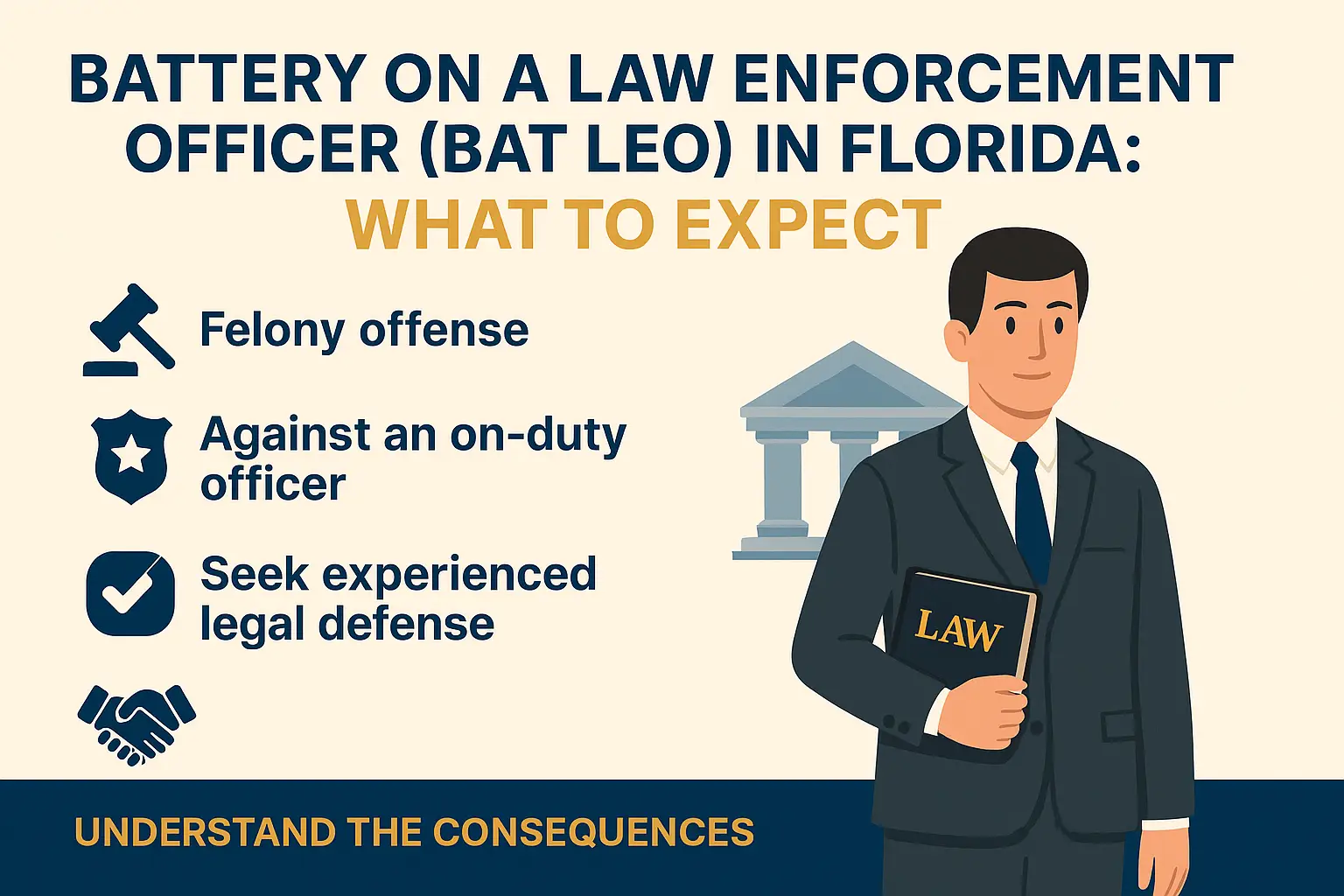
BAT LEO is a third-degree felony, punishable by:
Up to 5 years in prison
Up to 5 years of probation
Fines up to $5,000
Mandatory conviction in many cases (limits on withholds)
No-contact orders
Loss of gun rights if adjudicated guilty
Immigration consequences
Some BAT LEO cases are filed alongside resisting arrest with violence, which carries harsher penalties and can complicate negotiations.
🛑 Common Scenarios Leading to BAT LEO Charges
In South Florida, BAT LEO allegations often arise from:
Pulling away during handcuffing
Officer twisting your arm during arrest
Defensive movements misinterpreted as aggression
Accidental contact during chaotic scenes
DUI stops where balance or confusion is misread as resistance
Overly aggressive officers escalating force
Your rights in these encounters overlap with issues we litigate in motion to suppress hearings (illegal detentions, excessive force, misinterpretation of bodycam footage).
⚖️ BAT LEO vs. Resisting Arrest in Florida
Battery on a law enforcement officer involves alleged intentional physical contact. Resisting arrest charges focus on obstruction or resistance — with or without violence.
In many cases, the same encounter is charged multiple ways based on the same conduct. This charge stacking often creates leverage for the defense to challenge overcharging and negotiate reductions.
🛡️ Defenses to Battery on a Law Enforcement Officer
At Michael White, P.A., common defenses include:
✔ Self-Defense Against Excessive Force
Florida law recognizes the right to defend yourself against unlawful or excessive police force.
✔ Accidental Contact
Many BAT LEO cases involve unintended movements — slipping, pulling away, balance loss, or reaction to pain compliance techniques.
✔ Officer Not Engaged in Lawful Duty
The BAT LEO enhancement only applies if the officer was lawfully performing official duties. If the underlying stop, detention, or arrest was unlawful, the enhancement may not apply — and the charge can be reduced or dismissed. These issues are often litigated through motions to suppress or dismiss.
✔ Lack of Knowledge the Person Was an Officer
Plainclothes operations, unmarked units, or chaotic scenes can create genuine confusion.
✔ Body-Worn Camera Contradictions
Broward and Miami-Dade cases frequently turn on bodycam footage showing officers escalating or misrepresenting events.
❤️🩹 How These Cases Really Play Out in Court
BAT LEO cases are emotional by nature — for police, prosecutors, defendants, and families. But they are also highly defendable, especially when:
Bodycam shows officer aggression
Detention was unlawful
Contact was accidental
The officer exaggerated events
The State overcharged the case
This is especially true when BAT LEO is paired with DUI, DWLS, or a criminal speeding allegation, where the State may be trying to “stack” charges.
🚨 Protect Your Rights With Experienced Legal Counsel
A BAT LEO conviction may also affect your ability to seal or expunge your record if adjudication is entered.
Before making any statements or accepting any plea, contact Michael White, P.A. to review the bodycam, analyze the detention, and build the strongest defense strategy possible.
Battery on a law enforcement officer is treated as a serious violent offense under Florida law.
Learn more about how an experienced violent crimes defense attorney in Fort Lauderdale can challenge overcharging, suppress unlawful police conduct, and pursue early case resolution.
❓ FAQs — Battery on LEO in Florida
1. Is battery on a police officer a felony in Florida?
2. Can I claim self-defense against an officer?
Yes — if the officer used excessive or unlawful force.
3. What if the contact was accidental?
Accidental touching usually does not meet the legal definition of battery
4. What if I didn’t know the person was an officer?
The State must prove you knew or reasonably should have known the victim was an officer.
5. Can BAT LEO be reduced to a misdemeanor?
In South Florida, BAT LEO charges are frequently reduced to simple battery or resisting without violence when body-camera footage contradicts police reports, contact was accidental, or the detention was unlawful.