
Last updated February 2026
Many people believe that “brandishing a firearm” is a specific criminal charge in Florida.
It isn’t.
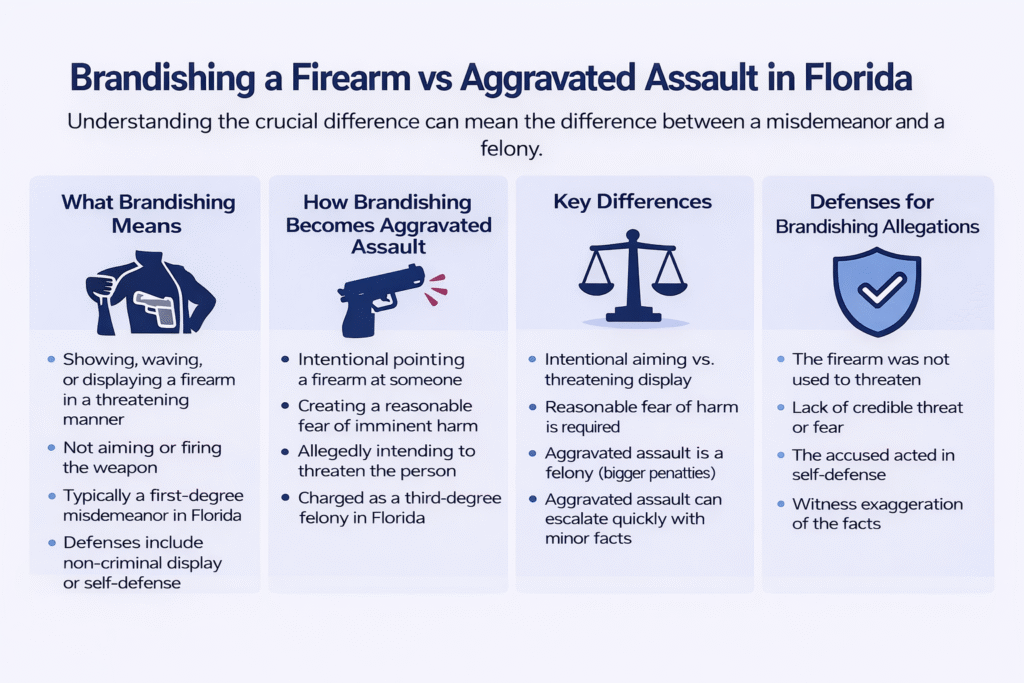
Instead, conduct commonly described as brandishing is usually charged as aggravated assault when a firearm is involved. The difference matters, because aggravated assault is a felony with serious, long-term consequences.
Here’s how Florida law actually treats these situations, when an arrest is likely, and why the label used by police or the public can be misleading.
⚖️ Is “Brandishing a Firearm” a Crime in Florida?
Florida law does not contain a standalone offense called “brandishing a firearm.”
Instead, prosecutors typically rely on existing statutes that criminalize threatening behavior involving a deadly weapon. When a gun is displayed, pointed, or used to intimidate another person, law enforcement often charges:
Aggravated assault, or
In limited situations, improper exhibition of a firearm
Improper exhibition is typically charged when conduct is careless or rise, but does not rise to the level of an intentional threat.
The charge depends on intent, context, and whether the alleged conduct created a reasonable fear of imminent harm.
For the full legal definition, penalties, and defense strategies for felony assault cases, see our guide to aggravated assault charges in Florida.
🚨 What Counts as Aggravated Assault With a Firearm
Aggravated assault is an assault that involves a deadly weapon or an intent to commit a felony.
Because a firearm is automatically considered a deadly weapon, conduct described as “brandishing” often meets the elements of aggravated assaultwhen:
The person intentionally displays or points the firearm
The conduct is perceived as a threat of violence
The alleged victim reasonably fears imminent harm
Importantly, the firearm does not need to be fired, loaded, or used physically.
🔍 How Brandishing and Aggravated Assault Are Commonly Confused
The confusion usually comes from everyday language.
People often use “brandishing” to describe:
Showing a gun during an argument
Lifting a shirt to reveal a firearm
Holding or pointing a gun to intimidate
Displaying a firearm during road rage
Under Florida law, those same actions may be charged as aggravated assault if they rise to the level of a threat.
The legal analysis focuses on what the action communicated, not the word used to describe it.
🚔 When Police Choose One Charge Over Another
Law enforcement typically looks at:
Whether the firearm was pointed or waved
Statements made during the incident
The proximity between the parties
The emotional intensity of the encounter
Whether the alleged victim felt immediate danger
If officers believe the display of the firearm created a credible threat, aggravated assault charges are common.
These decisions are later reviewed by prosecutors and courts, and initial charging decisions are frequently challenged.
🛡️ Defending Firearm Display Allegations
These cases are highly fact-dependent. Common defense issues include:
Lack of intent to threaten or intimidate
The firearm was displayed accidentally or incidentally
The alleged victim did not reasonably fear imminent harm
Self-defense or Stand Your Ground considerations — in some cases, displaying a firearm may be legally justified depending on imminence, proportionality, and who escalated the encounter. Learn how immunity works in Self-Defense and Stand Your Ground in Florida.
Inconsistent statements or credibility problems
Because firearm cases escalate quickly, early intervention is critical.
📌 Why the Distinction Matters
When a firearm is involved, conduct that might otherwise be treated as a gun offense can quickly become a violent felony under Florida law.
Aggravated assault is a felony offense. A conviction can result in:
Prison or probation
Permanent felony record
Loss of firearm rights
Immigration consequences
Employment and licensing barriers
What someone casually calls “brandishing” may expose them to life-altering consequences under Florida law.
If the allegation involves a gun and prosecutors pursue felony assault, see aggravated assault with a firearm in Florida for how 10–20–Life enhancements can change sentencing exposure.
❓ Frequently Asked Questions
Is brandishing a firearm illegal in Florida?
There is no specific crime called “brandishing,” but similar conduct is often charged as aggravated assault.
Do you have to point the gun?
Pointing the firearm strengthens the case, but even displaying it in a threatening manner may be enough.
Does the gun have to be fired or loaded?
No. The firearm does not need to be fired or loaded.
Can aggravated assault charges be reduced?
Yes. Depending on the evidence, charges may be reduced, dismissed, or resolved through pretrial litigation.
Is improper exhibition the same as aggravated assault?
No. Improper exhibition is a different offense and applies in more limited circumstances. Prosecutors often pursue aggravated assault when fear or threat is alleged.