
Last updated December 2025
In Florida drug cases, prosecutors often rely on constructive possession — a legal theory that lets the State argue you “possessed” drugs even if they weren’t on you, near you, or in your personal belongings.
Constructive possession cases frequently arise in:
Cars with multiple occupants
Shared apartments
Borrowed or rented vehicles
Rooms where several people have access
And they are highly defendable, especially in Broward and Miami-Dade, where officers frequently stretch the concept beyond what Florida law allows.
Here’s what constructive possession actually requires, and how we challenge it.
⚖️ What Is Constructive Possession in Florida?
Florida law recognizes two types of possession:
1. Actual Possession
Drugs are found:
In your hand
In your pocket
In a container on your person
2. Constructive Possession
Drugs are found not on you, but somewhere you allegedly had:
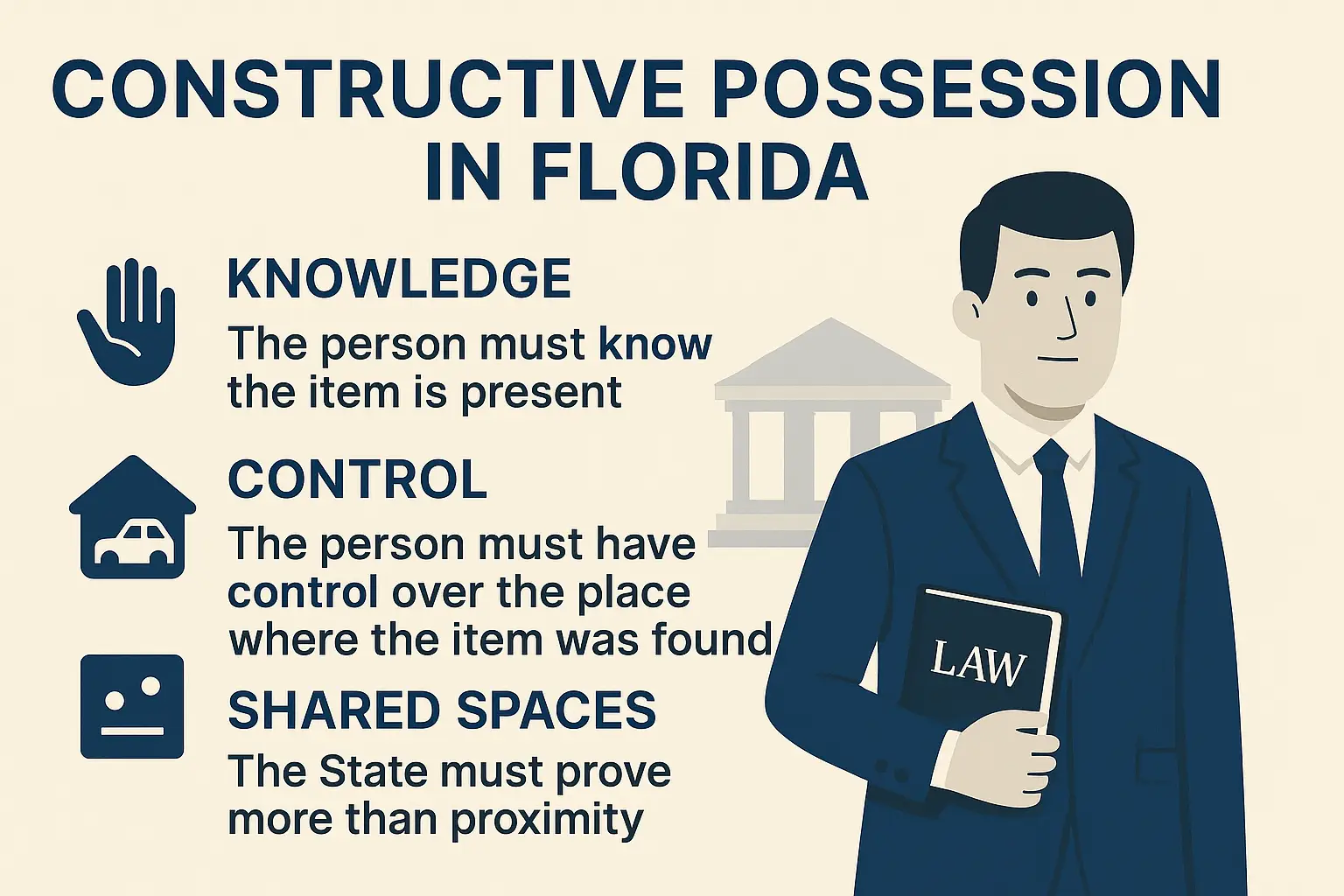
Dominion and control, and
Knowledge that the drugs were present.
If the State cannot prove both elements, constructive possession fails.
Florida courts have consistently ruled that mere proximity is not enough.
This defense parallels the “knowledge” disputes used in Driving While License Suspended cases (DWLS), petit theft, and intent-based DUI cases.
🏠 When Multiple People Have Access, The State’s Burden Is Higher
Constructive possession becomes much harder for prosecutors when drugs are found in:
Shared apartments
Cars with multiple passengers
Hotel rooms
Bedrooms with mixed property
Bags or containers not clearly linked to one person
In these situations, the State must prove:
You knew the drugs were there, and
You could control them apart from others
This evidentiary burden is why constructive possession cases frequently collapse after early litigation or a well-prepared motion to suppress.
🚗 Constructive Possession in Car Cases
Most constructive possession cases in South Florida come from traffic stops. Officers often claim that drugs “belonged to the driver” simply because the drugs were under a seat, in a door pocket, or near the console.
But Florida courts require more:
Fingerprints
Conflicting statements
Admissions
Behavior consistent with concealment
Exclusive access to the area
Without these factors, constructive possession is weak — just like when police attempt unlawful searches during inventory searches or backpack searches.
📘 Knowledge + Control: What the State MUST Prove
To convict you, prosecutors must establish:
1. Knowledge
You knew the drugs were present.
Evidence may include:
Statements
Text messages
Admissions
Conduct
Behavior during stop
2. Control
You had the ability to exercise dominion over the drugs.
Florida law requires independent proof of both elements when the location is not exclusively yours.
This concept fits squarely with your drug crimes practice area and often overlaps with Fourth Amendment challenges.
🧑⚖️ How We Attack Constructive Possession
At Michael White, P.A., we routinely challenge these cases using:
✔ Lack of Exclusive Possession
If others had access to the area, the State must produce additional evidence. Many cases collapse here.
✔ No Proof of Knowledge
Officers love assuming “everyone knew.” The law requires actual proof of awareness.
✔ No Proof of Control
Being near something is not “control.” Especially true in vehicles or shared living spaces.
✔ Unlawful Stop or Search
If the discovery resulted from an unlawful search, we file a motion to suppress using your firm’s standard suppression strategy.
✔ Inconsistent Body-Worn Camera Footage
Florida juries take inconsistencies seriously — especially if the officer exaggerates proximity, ownership, or behavior.
✔ Lack of Forensic Support
No fingerprints, no DNA, no admissions = weak case.
🚨 Speak With a Fort Lauderdale Criminal Defense Lawyer Today
Constructive possession cases look strong on paper — but they are often among the easiest drug cases to defeat.
Contact Michael White, P.A. today so we can challenge the stop, dispute knowledge and control, and undermine the State’s theory from day one.
❓ FAQs — Constructive Possession in Florida
1. What is constructive possession in Florida?
When drugs are not found on you but the State claims you had knowledge and control over them.
2. Can multiple people be charged with possession?
Yes — but proving knowledge and control becomes much harder for the State.
3. Is proximity enough to prove constructive possession?
Absolutely — especially in shared spaces or weak-evidence cases.
4. Can I beat a constructive possession charge?
No. Proximity alone is never enough.
5. Can unlawful searches defeat constructive possession?
Yes. If the search was illegal, the evidence may be suppressed.