
Last updated November 2025
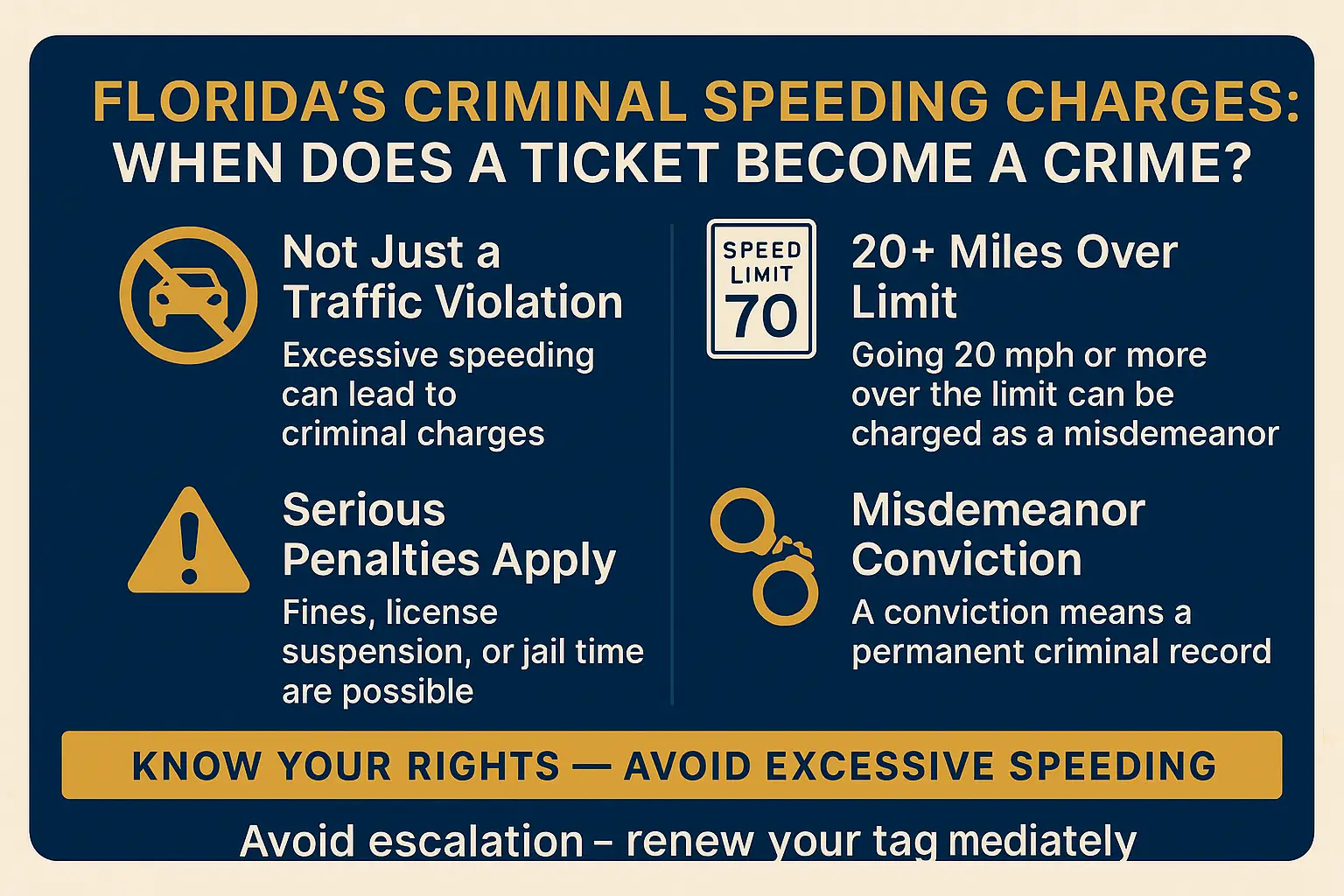
Most speeding tickets in Florida are civil infractions — the kind that cost you a fine or points on your license. But under Florida law, speeding can quickly cross the line into a criminal traffic offense, especially if your speed is excessive or your driving endangers others.
Once speeding becomes criminal, you’re no longer dealing with a simple citation. You’re dealing with:
Mandatory court dates
Possible jail or probation
A permanent criminal record
Here’s how to tell the difference — and what to do if you’re charged in Fort Lauderdale or anywhere in South Florida.
⚖️ When Does Speeding Become a Crime in Florida?
1. Excessive Speed (50+ MPH Over the Limit)
Under Fla. Stat. § 316.1926, driving 50 mph or more above the posted limit is a criminal offense:
First offense: $1,000 fine + possible suspension
Second offense: $2,500 fine + mandatory 1-year suspension
Third offense: Misdemeanor — up to 1 year in jail
This is one of the most common ways drivers in South Florida end up with criminal traffic charges.
2. Reckless Driving
If the speed is paired with willful or wanton disregard for safety, prosecutors can charge reckless driving under § 316.192, even if you weren’t 50+ mph over.
Penalties may include:
Jail
Probation
License penalties
Significant fines
This often overlaps with other serious traffic allegations, including DUI cases where speed and erratic driving play a role.
3. Speeding in Special Zones
Speeding in:
School zones
Construction zones
Airport roadways
…carries enhanced penalties and increases the likelihood of criminal charges, especially when people or workers are present.
🛑 Real Arrest Scenarios in South Florida
Drivers are often charged criminally when:
They’re clocked at 105 mph on I-95
They weave through traffic at high speed
They speed through a school zone during active hours
They’re involved in a crash while speeding
Agencies in Broward and Miami-Dade take aggressive enforcement positions—especially after a crash or social-media footage.
🧾 Criminal Speeding vs. Civil Speeding
| Feature | Civil Speeding | Criminal Speeding |
|---|---|---|
| Handled by | Clerk of Court | State Attorney / Criminal Division |
| Consequences | Fines, points, school | Jail, probation, criminal record |
| Court Appearance | Not required | Mandatory |
| License Impact | Points | Possible suspension |
| Record Impact | No criminal record | Misdemeanor record |
🛡️ Legal Defenses to Criminal Speeding
At Michael White, P.A., common defenses include:
Challenging radar or LIDAR calibration
Questioning operator certification
Contesting dashcam interpretation
Arguing lack of intent or emergency necessity
Negotiating the charge down to a civil infraction or reckless driving diversion
Many first-time clients receive a withhold of adjudication, avoiding a formal conviction.
(Hyperlink withhold of adjudication to your sealing/expungement page.)
📍 Arrested for Speeding in Fort Lauderdale?
A criminal speeding charge can:
Impact your career
Spike your insurance
Trigger license suspension
Lead to jail or probation
This is not “just a ticket.” It’s a criminal charge with long-term consequences.
🚨 Get Legal Help Before Things Get Worse
If you were arrested or charged with criminal speeding, reckless driving, or excessive speed, you need a defense plan immediately.
Contact Michael White, P.A. to protect your driving record, your job, and your future.
❓ FAQs — Criminal Speeding in Florida
❓ Is speeding 30 over the limit a criminal offense in Florida?
Not usually — but once you hit 50+ mph over, it becomes a criminal traffic violation.
❓ Can I go to jail for speeding in Florida?
Yes — especially if it’s charged as reckless driving or involves excessive speed.
❓ Will this go on my criminal record?
If it’s filed as a misdemeanor and not reduced, yes — unless you receive a withhold of adjudication.
❓ Can I seal or expunge a criminal speeding charge?
Possibly — especially if adjudication is withheld and you meet eligibility requirements.
❓ Do I need a lawyer for a speeding charge?
Yes — a criminal speeding case carries serious consequences. A lawyer can negotiate reductions, challenge the evidence, and protect your record.