
Last updated January 2026
Fort Lauderdale Domestic Violence Injunction Lawyer
Being served with a domestic violence injunction in Florida can disrupt your life instantly. You may be ordered out of your home, restricted from seeing your children, forced to surrender firearms, and required to appear in court within days. These cases move fast — and a permanent injunction can impact employment, licensing, housing, and any related criminal charges.
As a former prosecutor and Fort Lauderdale domestic violence injunction lawyer, I defend respondents in injunction cases across Broward County. Whether the allegations are exaggerated, misleading, or entirely false, you deserve a strong, strategic defense.
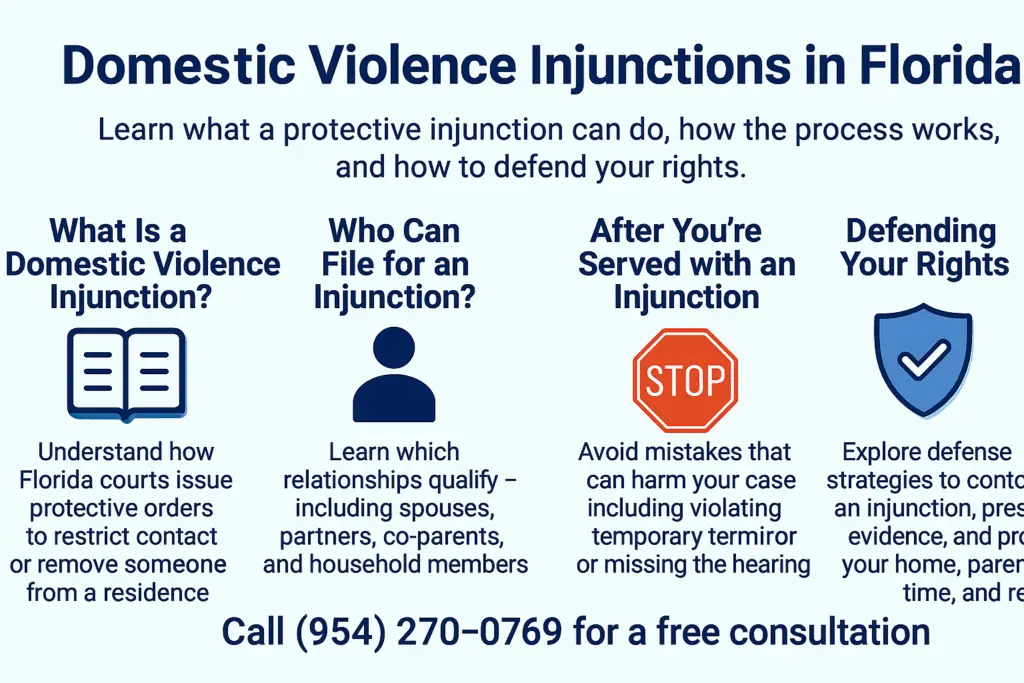
📜 What Is a Domestic Violence Injunction?
A domestic violence injunction is a civil restraining order, but violating it can lead to criminal charges. Florida allows several types of injunctions:
Domestic violence injunctions
Dating violence injunctions
Repeat violence injunctions
Sexual violence injunctions
Stalking/cyberstalking injunctions
The petitioner (the person filing) can request:
No contact
Stay-away orders
Temporary custody or visitation limits
Firearm surrender
Removal from the home
These restrictions often go into effect before you’ve had a chance to respond.
Related resources:
⚠️ Temporary vs. Final Injunctions
Once the petition is filed, a judge may issue a temporary injunction (TRO) without hearing your side. This TRO remains in effect until the final hearing, usually within 15 days.
At the final hearing, the judge may:
Deny the petition
Extend the temporary order
Enter a final injunction (for a set term or permanent)
A final injunction can affect:
Professional licenses
Security clearances
Firearm ownership
Criminal DV cases
Divorce, custody, and timesharing cases
📂 What Happens After You’ve Been Served
Once served, you must follow the temporary order perfectly — even if you disagree with it. Violating the order, even accidentally, can result in immediate arrest.
Steps to take immediately:
Read every page carefully.
Your hearing date, restrictions, and stay-away zones are listed in the order.Do NOT contact the petitioner.
Even if they contact you first, you can be arrested for responding.Preserve all evidence.
Screenshots, texts, emails, social media, GPS data, and call logs may help your case.Gather witnesses.
Anyone with firsthand knowledge may be critical at the hearing.Speak with a lawyer immediately.
You may have one chance to defeat the injunction.
More detailed guidance:
🔍 How Judges Evaluate Injunction Petitions
For a domestic violence injunction to be granted, the judge must find:
Past violence or credible threats, AND
A reasonable fear of imminent future violence
Common evidence includes:
Testimony from both parties
Messages, texts, and emails
Police reports or 911 calls
Social media posts
Witness statements
Photos, videos, or medical reports
Your lawyer’s ability to cross-examine the petitioner and expose inconsistencies is crucial.
🛡️ Defense Strategies Against Domestic Violence Injunctions
Every case is different, but strong defense themes often include:
1️⃣ Exposing false allegations or exaggerations
We compare the petition, testimony, texts, and prior statements for contradictions, inconsistencies, and motives to lie (custody battles, breakups, retaliation).
2️⃣ Showing no reasonable fear of future violence
A petitioner must prove present fear, not old drama. We highlight:
Long gaps with no incidents
Cooperative co-parenting
Counseling or treatment
Relocation or distance between parties
3️⃣ Presenting your evidence & witnesses
We can offer:
Messages contradicting accusations
Witnesses who observed interactions
Evidence that the petitioner was the aggressor
Proof of self-defense or mutual argument
Employment or character testimony
4️⃣ Protecting you from criminal exposure
Injunction hearings are recorded and can be used in:
Domestic violence criminal charges
Violation of injunction cases
Custody and dependency cases
Sometimes the best defense is not testifying — and letting evidence contradict the petition.
5️⃣ Motions to Dismiss, Modify, or Dissolve
We can file motions to:
Dissolve a final injunction due to changed circumstances
Modify terms (child contact, property access, firearms)
Sanction false or abusive filings
🚔 Violation of Injunction = Criminal Charge
Once an injunction is in effect, violating any term can lead to:
Arrest
Jail or probation
GPS monitoring
New criminal charges
Examples of violations:
Returning to the home
Calling/texting/messaging
Social media interaction
Third-party contact
Being within a restricted distance
If accused of a violation, you may face both civil and criminal consequences.
⭐ Why Choose Michael White, P.A.
Former prosecutor with deep DV + injunction experience
Skilled cross-examination and credibility challenges
Familiar with Broward judges and procedures
Strategic protection of your criminal and family-law exposure
Focused on clearing your name and protecting your future
📞 Call (954) 270-0769 for a free injunction defense consultation.
❓ FAQs – Domestic Violence Injunctions in Florida
1) Is a domestic violence injunction a criminal charge?
No. It’s a civil court order. However, violating an injunction can lead to criminal charges.
2) Will a domestic violence injunction show up on my record?
Yes, injunctions are public record and can appear in background checks, especially for sensitive jobs and licenses.
3) What happens at the final injunction hearing?
Both sides can present witnesses, documents, messages, and other evidence. The judge then decides whether to deny the petition, issue a temporary extension, or enter a final injunction.
4) What if the petitioner keeps contacting me?
You still must follow the order. Politely decline communication, keep records of their attempts, and tell your lawyer. The safest route is to let the court address it.
5) Can a domestic violence injunction be dissolved or modified?
Yes. You can file a motion to dissolve or modify if circumstances change, the parties reconcile, or the petition was based on false or stale allegations.