
Last updated January 2026
A felony DUI charge in Florida is life-altering. Unlike a standard misdemeanor DUI, felony DUI cases expose defendants to state prison, permanent felony records, and long-term license revocation — even for people with no prior criminal history.
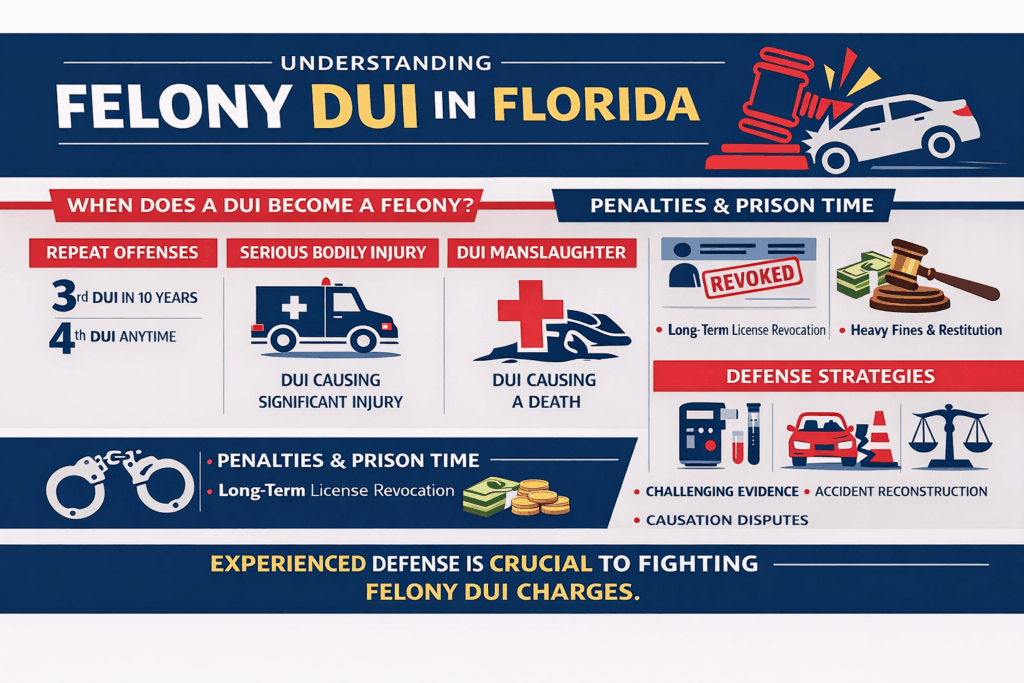
Felony DUI charges arise in three primary ways:
• DUI based on prior convictions
• DUI involving serious bodily injury
• DUI manslaughter
Each carries severe penalties, aggressive prosecution, and limited room for error. A full breakdown of Florida DUI penalties is explained separately.
Felony DUI charges exist within Florida’s broader DUI laws and defense framework, which we explain in out overview of DUI cases in South Florida.
⚖️ What Makes a DUI a Felony in Florida?
Under Florida law, most DUI charges begin as misdemeanors. A DUI becomes a felony when aggravating factors elevate the offense beyond simple impairment.
The most common felony DUI categories include:
• Repeat DUI convictions
• DUI causing serious bodily injury
• DUI causing death (manslaughter)
Each category has different elements, sentencing exposure, and defense strategies — but all are prosecuted aggressively.
🔁 Felony DUI Based on Prior Convictions
Florida enhances DUI charges based on prior offenses, even when no accident occurs.
A DUI becomes a felony when:
• You are charged with a third DUI within 10 years, or
• You are charged with a fourth DUI at any time, regardless of age of priors
These cases are typically charged as third-degree felonies and carry:
• Up to 5 years in prison
• Up to $5,000 in fines
• Mandatory adjudication of guilt
• Long-term or permanent driver’s license revocation
Even when no one was injured, prosecutors often seek prison time based on criminal history alone.
🚑 DUI With Serious Bodily Injury in Florida
DUI involving serious bodily injury (DUI-SBI) is a third-degree felony under Florida Statute § 316.193(3)(c)(2).
What qualifies as “serious bodily injury”?
Florida law defines serious bodily injury as:
• A substantial risk of death
• Serious permanent disfigurement
• Protracted loss or impairment of a bodily function
Common examples include:
• Broken bones requiring surgery
• Traumatic brain injury
• Internal bleeding
• Permanent mobility or sensory loss
These cases often hinge on medical documentation, accident reconstruction, and causation, not just BAC numbers.
Penalties for DUI-SBI
• Up to 5 years in prison
• Up to $5,000 in fines
• Mandatory felony conviction
• Driver’s license revocation
• Florida sentencing points for victim injury
Because injury points often push scores above the prison threshold, even first-time offenders can face mandatory incarceration.
⚰️ DUI Manslaughter in Florida
DUI manslaughter is one of the most serious charges under Florida law.
A person may be charged with DUI manslaughter when:
• They are driving or in actual physical control of a vehicle
• They are impaired by alcohol or drugs (or have a BAC of 0.08 or higher)
• A crash results in the death of another person or unborn child
Degree and penalties
• Second-degree felony: up to 15 years in prison
• First-degree felony (leaving the scene): up to 30 years in prison
• Mandatory minimum 4-year prison sentence
• Permanent driver’s license revocation
These cases often involve intense scrutiny of accident dynamics, toxicology timing, and officer conduct at the scene.
📊 Sentencing Exposure and Mandatory Prison
Felony DUI cases are heavily influenced by Florida’s Criminal Punishment Code.
Factors that increase sentencing exposure include:
• Victim injury or death points
• Prior criminal history
• High BAC allegations
• Allegations of reckless or aggressive driving
• Leaving the scene
Unlike misdemeanor DUI, withholds of adjudication are often unavailable, and prison sentences are common — even for defendants with no prior felony record.
⏱️ Why Early Legal Intervention Matters
Felony DUI investigations begin immediately after an accident or arrest.
Early defense involvement allows counsel to:
• Preserve accident scene evidence
• Retain reconstruction and toxicology experts
• Prevent overcharging before formal filing
• Influence charging decisions and sentencing posture
Waiting too long often means defending a case after prosecutors have already locked in their theory.
❓ Frequently Asked Questions
Is felony DUI always prison time in Florida?
Not always, but prison is common — especially in injury or manslaughter cases.
Can felony DUI charges be reduced?
Sometimes. Reduction depends on causation, evidence strength, and early defense strategy.
Can felony DUI be sealed or expunged?
Generally no, due to mandatory adjudication — unless charges are reduced to a qualifying offense.
Do I need a lawyer immediately?
Yes. Early intervention is one of the most important factors in felony DUI outcomes.
What makes a DUI a felony in Florida?
A DUI becomes a felony when it involves serious bodily injury, a fatality (DUI manslaughter), or a qualifying history of prior DUI convictions, such as a third DUI within 10 years or a fourth DUI at any time. The specific charge depends on both the facts of the incident and the defendant’s prior record.