
Last updated December 2025
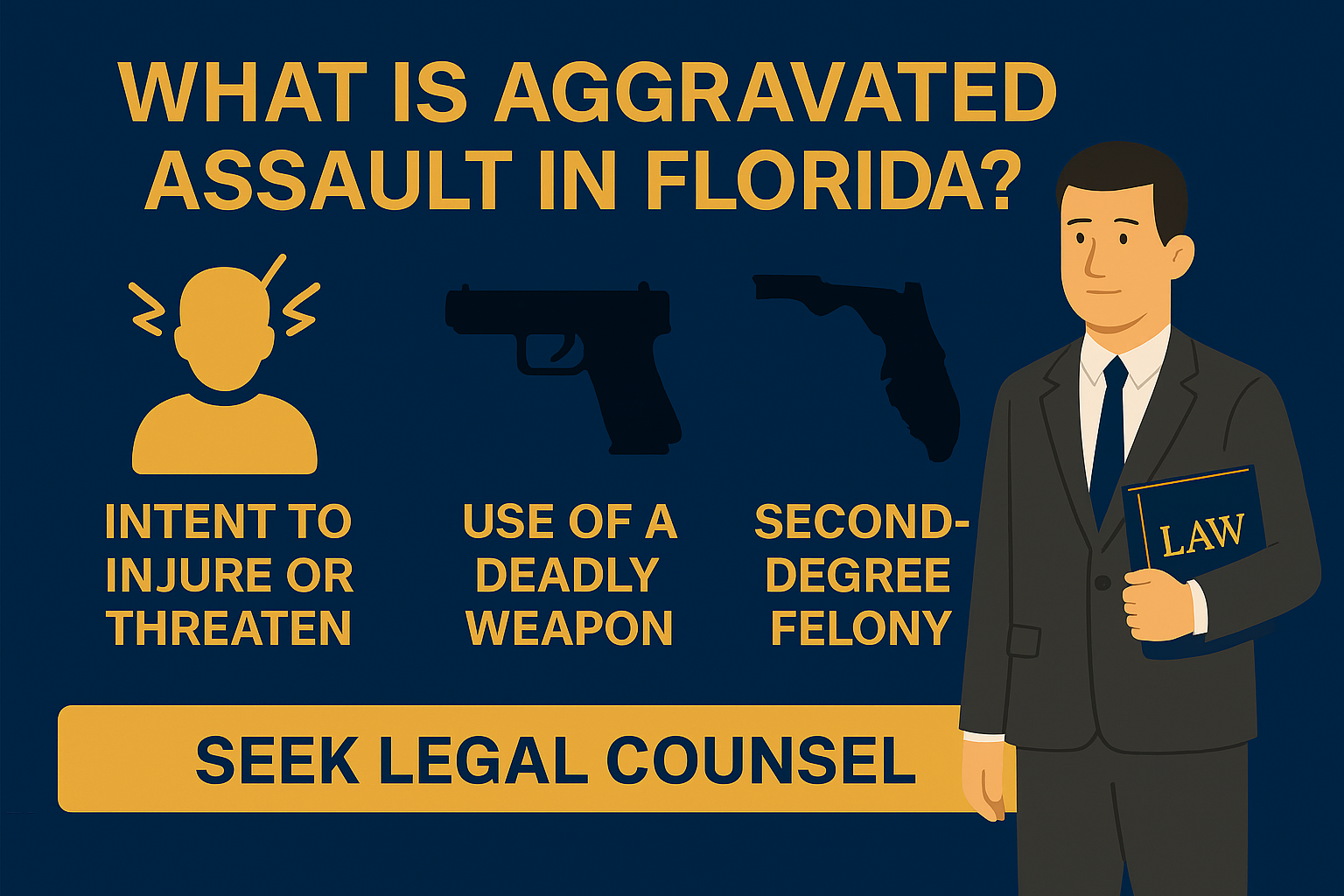
Aggravated assault is one of the most misunderstood — and overcharged — violent offenses in Florida. Unlike simple assault, which involves only threats, aggravated assault requires either a deadly weapon or intent to commit another felony. A conviction can bring prison time, long probation terms, and permanent loss of firearm rights.
If you’re facing this charge in Florida, understanding what the State must prove — and the defenses available — is essential.
⚖️ What Is Aggravated Assault in Florida?
Florida Statute §784.021 defines aggravated assault as an assault:
With a deadly weapon without intent to kill,
ORWith intent to commit a felony.
To convict someone, prosecutors must prove four core elements:
1. Intentional and unlawful threat
The State must show the defendant deliberately threatened violence — not merely used harsh words or gestures.
2. Apparent ability to carry out the threat
The alleged victim must reasonably believe the defendant could immediately harm them.
3. Well-founded fear of imminent violence
The victim’s fear must be real, immediate, and credible — not exaggerated or speculative.
4. Use of a deadly weapon or intent to commit a felony
A “deadly weapon” does not require physical injury; it includes objects capable of causing serious harm, such as:
Firearms
Knives
Cars used aggressively
Heavy blunt objects
Tools used as weapons
The definition is broader than most people realize, and prosecutors often stretch this element.
🔍 Aggravated Assault vs. Simple Assault
Simple Assault (§784.011) = mere threat with no weapon.
Aggravated Assault (§784.021) = threat + deadly weapon OR intent to commit a felony.
No physical injury is required for either charge. Aggravated assault is based almost entirely on perception — what the alleged victim believed was about to happen.
This makes the charge highly dependent on witness credibility, bodycam footage, and context.
📊 Penalties for Aggravated Assault in Florida
Aggravated assault is typically a third-degree felony, punishable by:
Up to 5 years in prison
Up to 5 years of probation
Up to $5,000 in fines
Mandatory counseling or anger management
Permanent loss of firearm rights if convicted
🚓 Enhanced Penalties
Aggravated assault becomes far more serious if the victim is:
A police officer
Firefighter
EMT/paramedic
Correctional officer
Public transit employee
These offenses carry:
Minimum mandatory sentences (often 3 years or more)
Higher sentencing scoresheets
Limited plea options
⚠️ Aggravated Assault WITH a Firearm
If a firearm is used, Florida’s 10-20-Life statute may impose mandatory minimum prison terms, even for first-time offenders.
👉 For firearm-specific penalties, see Aggravated Assault with a Firearm in Florida.
🔥 Common Situations That Lead to Aggravated Assault Charges
Many aggravated assault arrests start as misunderstandings or moments of anger:
Road Rage
Drivers display weapons or use cars aggressively, leading to felony charges.
Domestic or Relationship Disputes
Arguments escalate and one party claims threats were made with a weapon.
Neighborhood Disputes
Confrontations over noise, property, or parking may involve objects that police classify as “deadly weapons.”
Bar or Street Confrontations
Alcohol and misinterpretations can cause witnesses to exaggerate behavior.
These cases often rely heavily on perception, which creates many opportunities for defense.
🛡️ Defenses to Aggravated Assault
A strong defense can often lead to dismissals or charge reductions (like improper exhibition of a weapon or simple assault). Common defenses include:
✔ Self-Defense / Defense of Others
Florida’s Stand Your Ground law allows threats of force if you reasonably believed you were in danger of imminent harm.
✔ Lack of Intent
A threat made out of anger without actual intent to follow through may not qualify as aggravated assault.
✔ Object Was Not a Deadly Weapon
Not every item cops label as a weapon legally qualifies.
A pen, phone, or small object may not meet the legal standard.
✔ No Well-Founded Fear
If the alleged victim overreacted, was inconsistent, or had a motive to lie, fear may not be credible.
✔ False Accusations
Common in domestic disputes, breakups, and neighbor conflicts.
✔ Insufficient or Unreliable Evidence
Poor lighting, lack of video, contradictory witnesses, or absence of a weapon can undermine the State’s case.
📍 Broward County Perspective
In Fort Lauderdale and across Broward County, aggravated assault cases are aggressively prosecuted — especially when weapons or threats of violence are involved. But prosecutors must still prove every element beyond a reasonable doubt.
Your defense attorney can:
Challenge whether a “deadly weapon” was used
Discredit the alleged victim’s fear
File motions to suppress unlawfully obtained evidence
Seek reductions to lesser charges
Present Stand Your Ground immunity arguments
A strategic and early defense approach often determines whether the case ends in dismissal, reduction, or trial.
👉 Learn more about our Violent Crimes Defense services.
❓ Florida Aggravated Assault: Frequently Asked Questions
Q1: What makes assault “aggravated” in Florida?
Use of a deadly weapon or intent to commit a felony.
Q2: Is aggravated assault a felony in Florida?
Yes. It is a third-degree felony with up to 5 years in prison.
Q3: Can I claim self-defense to aggravated assault?
Yes. Florida law allows self-defense if you reasonably believed force was necessary.
Q4: Does aggravated assault require physical contact?
No. Assault is about the threat of violence, not physical injury.
Q5: Can aggravated assault charges be dropped?
Yes. Weak evidence, self-defense, or lack of proof may lead to dismissal or reduction.