
Last updated December 2025
In Florida, burglary isn’t always about breaking and entering. Under Florida Statute § 810.02, you can be charged even if you were invited onto a property but stayed after permission was revoked, or if prosecutors claim you entered with intent to commit a crime inside. These definitions are broad, and small factual differences can mean the difference between a felony conviction and a full dismissal.
As a Fort Lauderdale criminal defense attorney and former prosecutor, I’ve handled countless burglary cases — from misunderstandings between acquaintances to serious felony allegations involving dwellings or vehicles. Understanding how the law defines entry, intent, authorization, and remaining is essential to fighting burglary charges, or any property crime.
⚖️ Florida’s Legal Definition of Burglary
Under § 810.02, burglary means:
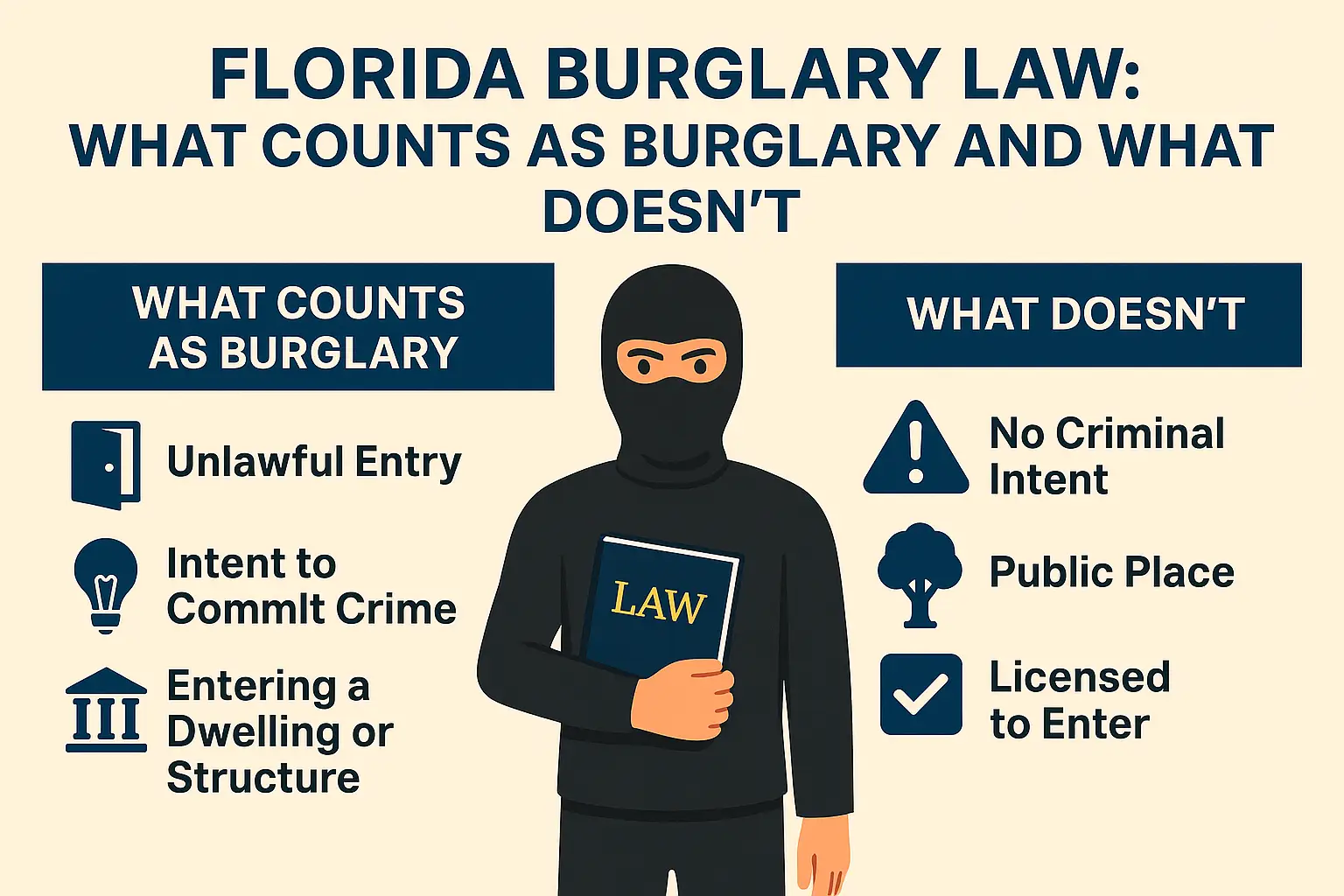
Entering a dwelling, structure, or conveyance with intent to commit an offense inside,
or
Remaining inside after permission has been withdrawn with intent to commit an offense.
Burglary applies when:
The premises were not open to the public, and
You were not authorized to enter or stay.
Burglary Degrees in Florida
Third-degree felony — Unarmed, unoccupied structure or conveyance
Second-degree felony — Occupied structure, or unarmed entry into a dwelling
First-degree felony — Armed burglary, burglary with assault or battery, or burglary with dangerous instruments
To learn how these tie into enhanced versions, see: Burglary with Assault or Battery in Florida: What It Means & How to Defend It.
🧭 The “Entry” Requirement: It’s Broader Than Most People Realize
In Florida, any part of your body crossing the plane of a door or window counts as entry. Even the slightest intrusion (like reaching an arm inside a window or leaning into a car) may satisfy the statute.
Entry can include:
Leaning into an open car window
Stepping just inside a garage
Reaching into a porch or screened enclosure
Entering the curtilage of a home (yard space closely associated with the residence)
Curtilage is a major issue in many cases — the law treats it almost like the home itself.
🧠 What Doesn’t Count as Burglary
Not every unauthorized presence equals burglary. You may have a strong defense if:
✔ You had consent or invitation
If someone with authority allowed you inside — even temporarily — the State must prove they revoked consent before the alleged offense.
✔ No proof of intent
Prosecutors must show intent at the moment of entry, not intent that formed afterward. Many cases fall apart on this point alone.
✔ You remained accidentally
If you were asleep, intoxicated, or confused about where you were, “remaining with intent” becomes extremely hard to prove.
✔ Mistaken identity or weak evidence
Surveillance video, digital evidence, and witness credibility are frequent issues in Broward burglary prosecutions.
For deeper analysis of intent-based defenses, see:
Theft Charges in Florida: How to Protect Your Record
🔧 Burglary Tools: An Often-Charged Add-On
Under § 810.06, possessing any “tool, machine, or implement” with intent to use it for burglary is a separate third-degree felony.
Prosecutors routinely add this charge for:
Screwdrivers
Pry bars
Flashlights
Gloves
Multitools
Window punches
But the State must prove intent, not mere possession. Many burglary-tools charges get dismissed for lack of evidence.
🚨 Penalties for Burglary in Florida
Penalties vary based on the type of property and circumstances:
Third-Degree Felony (up to 5 years)
Unarmed burglary of an unoccupied structure
Unarmed burglary of a conveyance (vehicle)
Second-Degree Felony (up to 15 years)
Burglary of an occupied structure
Burglary of an unoccupied dwelling
Burglary during a declared state of emergency (looting enhancement)
First-Degree Felony (up to Life)
Armed burglary
Burglary with assault or battery
Burglary using a motor vehicle to damage property
Burglary causing over $1,000 in damage
When burglary is charged alongside theft, criminal mischief, or assault, a skilled defense attorney can often challenge the State’s theory and negotiate reductions.
🔗 Burglary vs. Trespass: Why Intent Matters
Trespass = unauthorized entry
Burglary = unauthorized entry + intent to commit a crime inside
Many cases that begin as burglary end up reduced to trespass when prosecutors cannot prove specific criminal intent at the time of entry.
For more on how prosecutors evaluate intent, see:
Assault in Florida: How the Law Defines and Punishes It
If your burglary case is dismissed or amended, you may qualify for relief under:
Fort Lauderdale Record Sealing & Expungement
🔍 Common Real-World Scenarios in Broward County
1. Airbnb or Vacant Rental Confusion
If someone enters a unit they believed they were renting, intent collapses.
2. Domestic or Relationship-Related Burglary Claims
Accusations often arise from breakups, disputes, or mixed living arrangements.
3. Vehicle Burglary Without Forced Entry
“Burglary of a conveyance” is charged even if a car is unlocked — but intent still must be proven.
4. Remaining After Permission Is Revoked
Common with acquaintances, party guests, or family disputes.
❓ Florida Burglary FAQs: Key Definitions & Defenses
1. What is the legal definition of burglary in Florida?
Entering a dwelling, structure, or conveyance with intent to commit an offense inside, without authorization.
2. Can you be charged with burglary if the door was open?
Yes, if you entered intending to commit a crime — even if no forced entry occurred.
3. What’s the difference between burglary and trespass?
Trespass involves unauthorized entry but no intent to commit another crime.
4. Are all burglary charges felonies?
Yes, burglary is always a felony in Florida, with degrees based on severity.
5. Can a burglary charge be dismissed?
Yes. If intent or entry is unproven, cases are often reduced or dismissed.
💬 Contact a Florida Burglary Defense Attorney Today
If you’ve been charged with burglary in Broward or anywhere in Florida, act fast. Burglary cases hinge on intent, authorization, and evidence quality — all of which can be challenged aggressively.
Contact Michael White, P.A. for a free consultation with a former prosecutor who knows how to dismantle the State’s case.