
Last updated October 2025
A “resisting arrest” charge in Florida often starts with a misunderstanding — or an officer who escalates a minor situation. Under Florida Statute §843.02, simply pulling away or asking questions can lead to arrest for “resisting without violence.” When force is alleged, the charge becomes a felony.
The key to winning these cases lies in showing what really happened — and whether the officer used lawful authority or went too far.
⚖️ Florida’s Resisting Arrest Laws
Florida divides resisting arrest into two main categories:
Resisting without violence (§843.02) — a first-degree misdemeanor, punishable by up to one year in jail.
Resisting with violence (§843.01) — a third-degree felony, punishable by up to five years in prison.
To convict you, prosecutors must prove that you:
1️⃣ Knowingly obstructed an officer performing a legal duty, and
2️⃣ The officer was acting lawfully at the time.
That second part — lawful authority — is often where your defense begins.
See how statutory definitions matter in related offenses like Assault in Florida: How the Law Defines and Punishes It, which explains how intent and context shape outcomes.
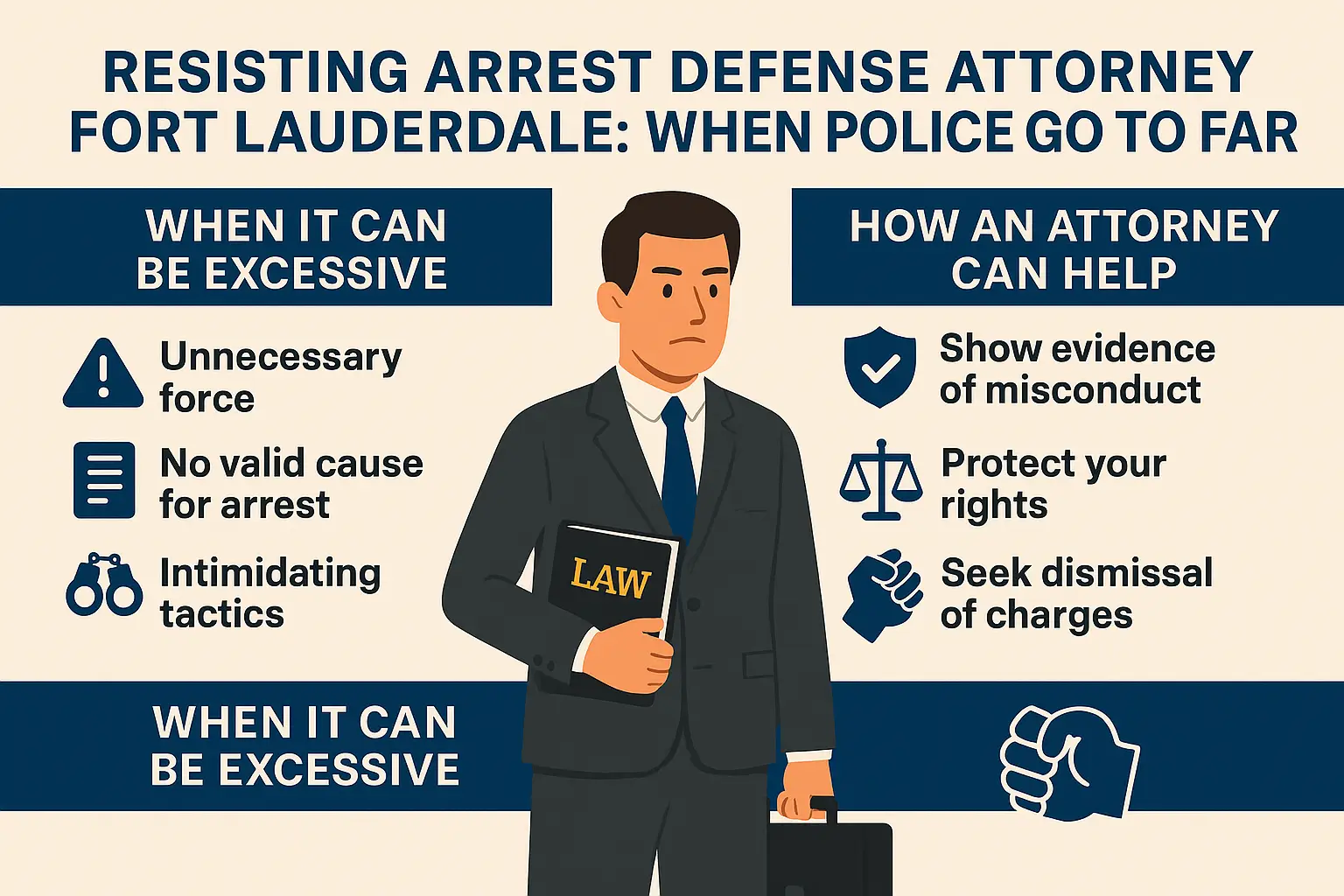
🧠 When Police Overstep
Not every use of force or verbal protest qualifies as resistance. You have the right to:
Ask why you’re being detained.
Refuse unlawful searches or seizures.
Film encounters, as long as you don’t interfere.
If officers act outside legal bounds, your attorney can file a Motion to Dismiss or Motion to Suppress based on unlawful arrest or excessive force. Learn how similar motion practice wins DUI cases in Fort Lauderdale’s Top DUI Lawyer.
🚨 Evidence That Wins These Cases
Successful defenses often depend on video. Fort Lauderdale police and Broward Sheriff’s deputies now use body-worn cameras, which often contradict arrest reports.
Your lawyer will review:
BWC and dashcam footage,
Witness statements,
Medical reports showing injuries, and
Timing and distance data that refute the officer’s version.
When discrepancies arise, charges are frequently dropped before trial.
See how post-charge strategy can protect your future in Fort Lauderdale Record Sealing & Expungement.
🔗 Common Companion Charges
Resisting arrest often accompanies DUI, battery on LEO, or disorderly conduct. When these stack, each element must still stand on its own. Review how multi-count cases are handled in DUI Attorney Pembroke Pines FL: How Local Defense Wins in Broward.
For official definitions and statutory language, visit the Florida Senate Chapter 843 – Obstructing Justice section.
❓ Florida Resisting Arrest FAQs: Common Questions & Answers
1. Can I be charged with resisting if I didn’t touch the officer?
Yes. Even verbal refusal or passive resistance can lead to charges, though they’re harder to prove.
2. What if the officer used excessive force?
Your attorney can move to dismiss or file a civil rights complaint based on unlawful use of force.
3. What’s the penalty for resisting arrest without violence?
Up to one year in jail, one year of probation, and a $1,000 fine.
4. Can I fight a resisting arrest charge in court?
Yes. Video, witness accounts, and officer inconsistencies often lead to dismissal.
5. Can this charge be expunged later?
If dismissed or dropped, yes — see our Fort Lauderdale Record Sealing & Expungement page for eligibility.
💬 Contact a Fort Lauderdale Resisting Arrest Defense Lawyer Today
If you were accused of resisting arrest in Broward County, don’t face it alone.
Contact Michael White, P.A. today for a free consultation with a former prosecutor who knows how to expose unlawful arrests and protect your rights.