
Last updated November 2025
Updated for 2025 – Featuring Recent 4th DCA Case Law
A sudden traffic stop. A question: “Can you show me your identification?”
In Florida, the answer isn’t always straightforward. Whether you must show ID depends on when an officer is legally entitled to ask — and whether you’re in a consensual encounter, a lawful detention, or a full-blown arrest.
In Broward and Palm Beach, these distinctions matter — because a misstep by law enforcement can mean the difference between a valid arrest and a case ripe for suppression.
📜 1. Legal Framework: Statutes & Key Concepts
- § 901.151 – Florida Stop and Frisk Law: Allows officers to detain someone temporarily if there’s reasonable suspicion of criminal activity, and to ask limited identity questions.
- § 322.15 – Driver License Requirement: Drivers must carry and present a valid license; passengers generally are not required to show ID absent reasonable suspicion.
- Detention vs. Consensual Encounter: A stop becomes a detention when a reasonable person would not feel free to leave. Only then can refusal to identify have legal consequence.
📌 Related: 👉 Driving With a Suspended License in Florida
🚗 2. Drivers vs. Passengers
Drivers: You must show your license, registration, and proof of insurance when lawfully stopped.
Passengers: Different rule. Unless the officer can articulate suspicion specific to you, you may politely decline to show ID. Refusal alone cannot justify arrest for resisting — especially under recent 4th DCA decisions.
🚨 3. Detention vs. Arrest — Why the Distinction Matters
A detention is a short, investigative stop based on reasonable suspicion. An arrest requires probable cause.
Your obligation to identify yourself applies only within a lawful detention. If the stop itself lacks a valid basis, any demand for ID may be unlawful — and your refusal cannot justify arrest.
⚖️ 4. Recent 4th DCA Rulings (2024–2025)
🧾Saintil v. State, No. 45D2024-0624(Fla. 4th DCA Mar 26 2025): The court reversed a loitering & prowling conviction where the defendant provided a false name and claimed no ID in a parking lot. The 4th DCA held that lack of ID alone does not justify “reasonable alarm.”
👉 Takeaway: Simply refusing to show ID doesn’t create lawful suspicion.
The decision underscores that officers must justify a detention before an ID request has legal weight — a major point for Broward residents.
🏝️ 5. Local Insight (Broward & Palm Beach)
The 4th DCA covers Broward, Palm Beach, St. Lucie, Martin, and Indian River Counties.
In these jurisdictions, judges often scrutinize whether the stop was valid before any ID request. If not, defense attorneys can seek to suppress evidence or dismiss charges arising from an unlawful detention.
👉 Tip: If you were detained for refusing ID, your lawyer should challenge the stop first — not the refusal.
🧠 6. Practical Guidance When Stopped
Drivers: Always carry and present license and proof of insurance.
Passengers: Ask “Am I free to go?” If yes, you can politely decline ID. If detained, state your name/DOB but don’t argue.
Record details: officer name, badge number, length of stop, and any statements.
Call a lawyer if you believe the stop was unlawful or the detention exceeded legal scope.
🔍 7. Bottom Line
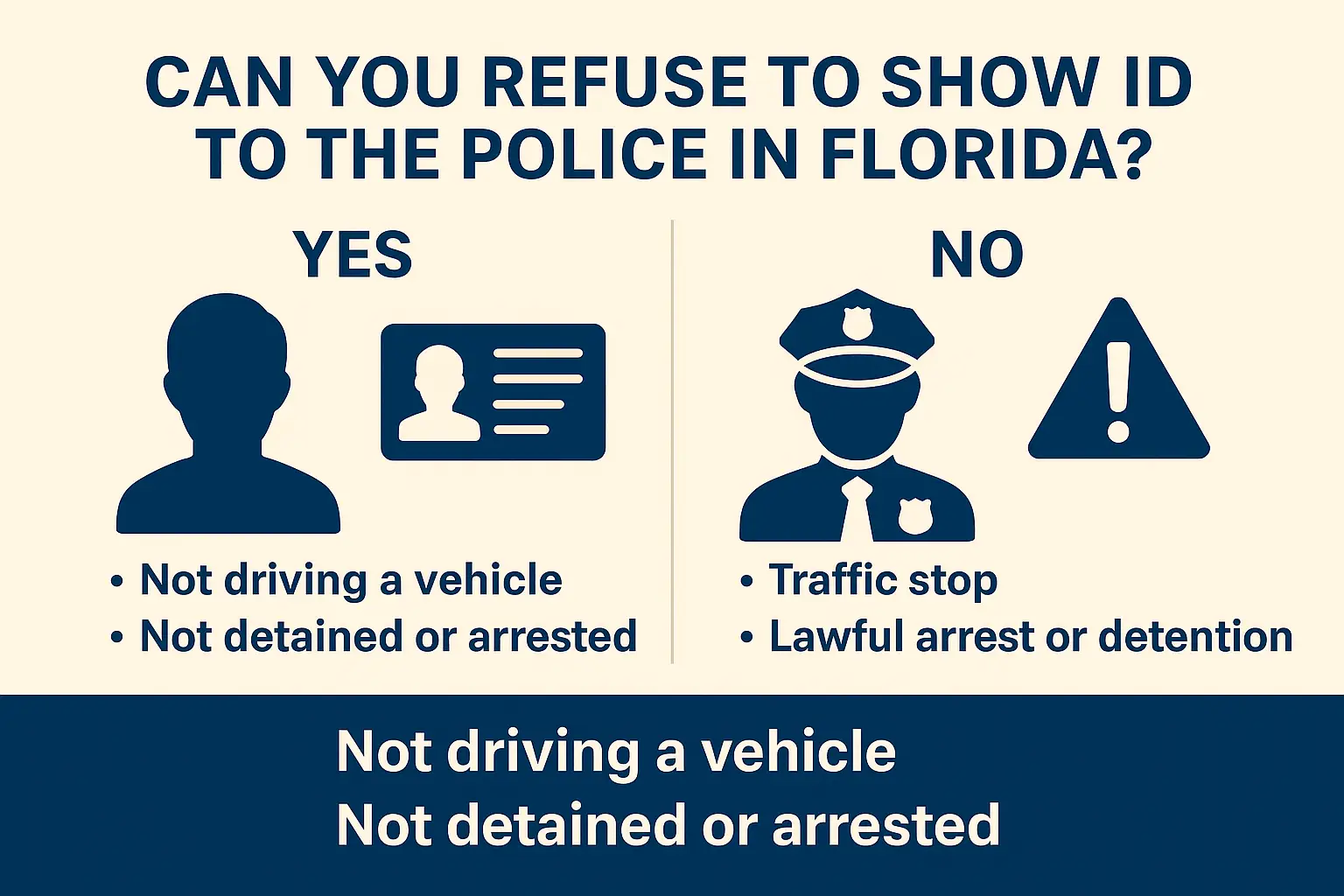
You can refuse to show ID in Florida — but only when the encounter is consensual and not a lawful detention.
If detained under § 901.151, you must provide basic identifying information. In Broward and Palm Beach, recent 4th DCA rulings make clear that refusal alone is not probable cause for arrest.
If police escalated after you declined, you may have a viable suppression issue.
❓ FAQs
Q1️⃣ Do I have to show ID if I’m just walking down the street?
Not usually. If you’re free to leave, you may politely decline. Only during a lawful detention under § 901.151 must you identify yourself.
Q2️⃣ Do passengers have to show ID in a traffic stop?
No — not unless the officer has reasonable suspicion specific to you. Otherwise, declining is not a crime.
Q3️⃣ Can I be arrested for refusing ID in Broward?
Only if the detention was lawful and refusal was paired with other behavior creating “alarm.” The 4th DCA’s Saintil case (2025) reinforced this limit.
Q4️⃣ What’s the difference between detention and arrest?
Detention: brief stop based on reasonable suspicion.
Arrest: custody based on probable cause.
Your ID duty exists only in the first.
Q5️⃣ What should I do if I was charged after refusing ID?
Contact a defense lawyer immediately. Document everything about the stop — location, officer info, and whether you were told you could leave. These details can support a motion to suppress.
📞 Call Michael White, P.A.
If you were stopped in Broward or Palm Beach and accused of refusing to show ID, your rights depend on whether the stop was lawful.
Contact Michael White, P.A. for a free case assessment and defense built on the latest 4th DCA law.