
Last updated January 2026
Fort Lauderdale Defense for Delayed-Report Sex Crime Allegations
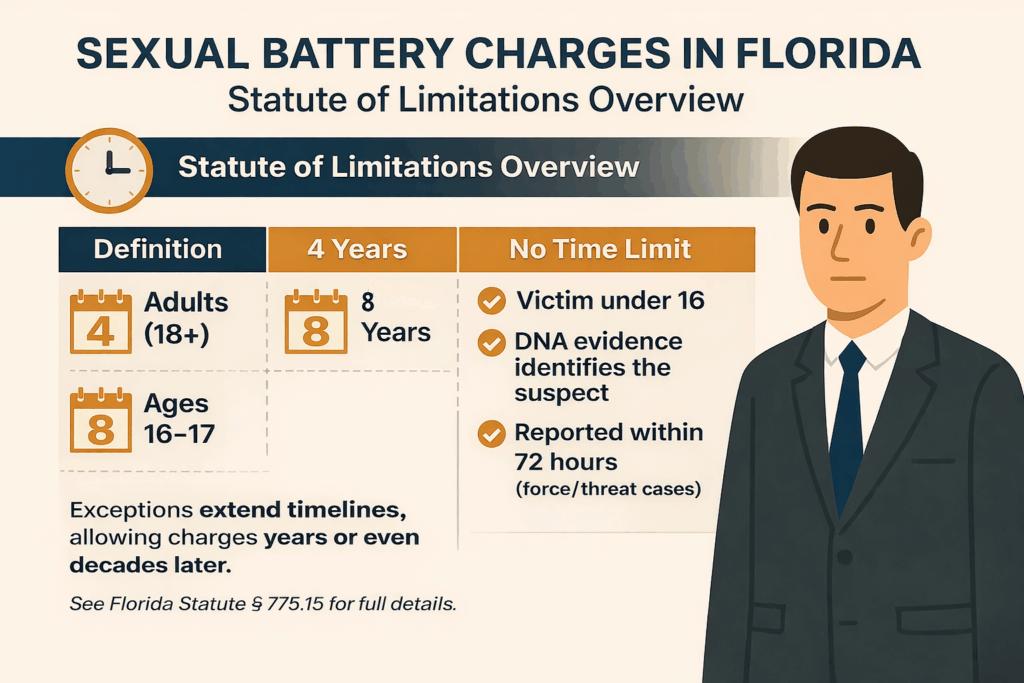
Think the case is too old to prosecute? Think again. In Florida, some sexual battery cases can be filed many years later — and in certain situations, the law allows prosecution at any time depending on the victim’s age, the offense level, and whether key statutory conditions apply.
If you’re being investigated for sexual battery (often referred to as “rape” or “sexual assault”), the most important question is whether the State can still file charges — and whether a statute-of-limitations defense can be used to seek early dismissal.
At Michael White, P.A., we defend individuals accused of sexual battery across Fort Lauderdale and South Florida. As a former prosecutor, I know how these cases are evaluated and charged — and how to challenge stale accusations, missing evidence, and timing defects before they become permanent damage.
📞 Confidential consultation: (954) 270-0769
⚖️ What Is a “Statute of Limitations” in a Sexual Battery Case?
A statute of limitations is the legal deadline for the State to commence prosecution. Under Florida law, that generally means the filing of a charging document (and, in some situations, executing process without unreasonable delay).
Important: Sexual battery statute-of-limitations rules are not one-size-fits-all. Florida has special provisions that can extend, delay, or eliminate the filing deadline in sexual battery cases.
⏳ The General Rule for Felonies (Starting Point Only)
Florida’s default time limits for felonies are often used as a starting point:
4 years for most first-degree felonies
3 years for most other felonies
But sexual battery is governed by multiple exceptions and special timelines in § 775.15 — which is why cases that “feel old” may still be prosecuted.
Because statute-of-limitations rules depend on the specific offense charged, it’s important to understand how Florida defines and prosecutes sexual battery before evaluating filing deadlines.
🧠 Special Florida Rules for Sexual Battery Statute of Limitations
1) Victim Under 18: When the “Clock” Starts Can Change
For certain offenses (including sexual battery), if the victim is under 18, Florida law provides that the limitations period (if one applies) generally does not begin to run until the victim turns 18 or the offense is reported to law enforcement (or another governmental agency), whichever happens first.
2) Reported Within 72 Hours: Some Cases May Be Filed “At Any Time”
Florida law provides that a first- or second-degree felony sexual battery may be prosecuted at any time if the victim is under 18 and the offense was reported within 72 hours of commission.
Florida law also provides that if the victim is 16 or older and a first- or second-degree felony sexual battery is reported within 72 hours, the prosecution may be commenced at any time.
3) Victim Under 16: “At Any Time” (With Specific Limits on Reviving Barred Cases)
Florida law provides that if the offense is a violation of § 794.011 and the victim was under 16, prosecution may be commenced at any time, subject to statutory “not otherwise barred” limitations built into the statute.
4) Victim Under 18 (Offenses on or after July 1, 2020): No Time Limit
For sexual battery offenses committed on or after July 1, 2020, if the victim was under 18 at the time of the offense, prosecution may be commenced at any time.
5) Victim 16 or Older (Not Reported Within 72 Hours): Often an 8-Year Rule Applies
Florida law provides that — except for specific “at any time” exceptions — a prosecution for a first- or second-degree felony sexual battery, where the victim was 16 or older, generally must be commenced within 8 years, with additional statutory conditions/limitations.
🧬 DNA Identification Rules Can Extend (or Remove) Deadlines
Florida also has provisions allowing prosecution to be commenced after DNA identifies the accused, including for sexual battery offenses, subject to conditions in the statute (including preservation/availability requirements).
Because DNA rules are fact-sensitive, these cases often turn on:
what was collected,
what was tested,
what was preserved,
and whether identification “should have been established” earlier with due diligence.
🛡️ How We Defend Delayed-Report Sexual Battery Allegations
A statute-of-limitations defense is not a “technicality.” It can be a powerful, case-ending issue — but it must be handled precisely.
Common defense strategies include:
🔹 Limitations Analysis (Charge + Date + Exception)
We analyze:
the specific charged offense level,
the alleged victim’s age,
report timing,
and whether the State is relying on a statutory exception (72-hour report, under-18 rules, DNA identification, etc.).
🔹 Motion Practice: Dismissal When the Case Is Time-Barred
If the prosecution was commenced outside the applicable window, we can pursue early dismissal through pretrial motion practice.
🔹 Attack the Reliability of Stale Evidence
Delayed allegations often create:
missing witnesses,
faded memory,
destroyed records,
unavailable surveillance,
and forensic gaps.
We highlight these issues aggressively — especially when the State’s case depends on a narrative built long after the fact.
⚠️ What to Do If Police Contact You About an “Old” Sexual Battery Allegation
If detectives call, show up, or ask to “clear things up”:
Do not give a statement
Do not consent to a phone/device search
Do not contact the complainant
Call counsel immediately
Timing issues, report details, and charging decisions are often being evaluated before arrest — and early intervention can prevent a case from being filed at all.
Sexual battery cases are prosecuted differently than many other offenses, and they fall within a broader category of serious sex crimes under Florida law that require early, strategic defense.
❓ Frequently Asked Questions
1) Is there a statute of limitations for sexual battery in Florida?
Sometimes — but Florida law includes multiple exceptions that can extend deadlines or allow prosecution “at any time,” especially depending on the victim’s age, report timing, and other statutory conditions.
2) Can Florida prosecute a sexual battery case years later?
Yes. Some sexual battery cases may be prosecuted years later — and certain categories can be filed at any time, depending on the statute’s rules and effective dates.
3) Does the limitations period start immediately if the alleged victim was a minor?
Not always. For certain offenses involving victims under 18, the statute provides that the limitations period (if any) may not begin running until the victim turns 18 or the offense is reported, whichever occurs earlier.
4) What is the significance of the 72-hour report rule?
For certain first- or second-degree felony sexual battery offenses, a report to law enforcement within 72 hours can affect whether the case may be commenced “at any time.”
5) Can DNA evidence change the statute of limitations?
It can. Florida law contains provisions that can extend (and in some circumstances remove) deadlines when DNA identifies the accused, subject to statutory requirements.
6) If a case is time-barred, can it be dismissed before trial?
Potentially, yes. If the State commenced prosecution outside the applicable statute-of-limitations window, the defense may be able to pursue dismissal through pretrial motion practice.