
Last updated January 2026
Fort Lauderdale Sex Crime Defense Attorney
When someone who accused you of a sex crime later recants—changes their story or says the allegation was false—it can feel like the nightmare should be over.
In Florida, it often isn’t.
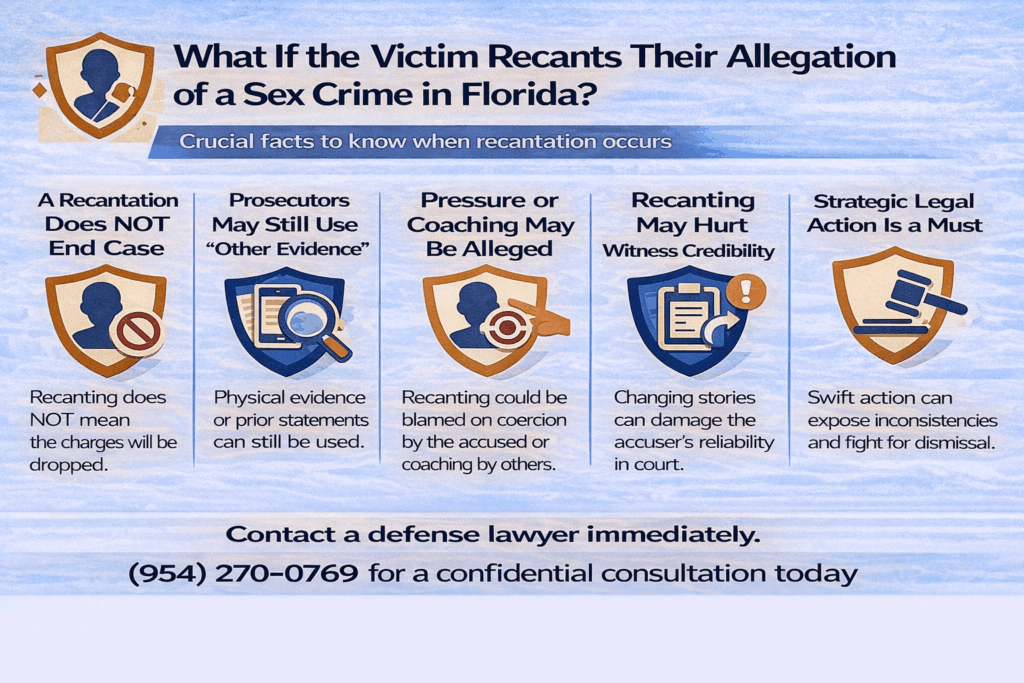
A victim recanting a sex crime allegation does not automatically end the case. Prosecutors may still move forward, relying on prior statements, digital evidence, or third-party testimony. In some cases, a recantation can even make things more complicated if the State claims the change was the result of pressure or coercion.
If a recantation has occurred—or may occur—early legal strategy is critical.
At Michael White, P.A., we defend clients throughout Fort Lauderdale and South Florida in high-stakes sex crime cases, including situations where the accuser has recanted or expressed doubt about the allegation.
📞 Confidential consultation: (954) 270-0769
⚠️ Does a Recantation Automatically Get a Sex Crime Case Dismissed?
No.
In Florida, the State—not the alleged victim—controls the prosecution.
Even if the accuser:
Withdraws the allegation
Refuses to testify
States the accusation was false
Prosecutors may still proceed if they believe there is sufficient evidence.
Sex crime cases fall within a broader category of serious sex crimes in Florida, and recantation is only one factor in the State’s charging decision.
🧠 Why Prosecutors May Continue After a Recantation
Florida prosecutors often argue that recantations are unreliable and may claim they occurred because of:
Pressure from the accused or family members
Fear, embarrassment, or emotional conflict
Financial or custody-related concerns
Coaching or influence after the initial report
As a result, the State may attempt to rely on other evidence instead.
🔍 What Evidence Can Still Be Used?
Even after a recantation, prosecutors may try to use:
Prior statements made to police
Recorded forensic interviews
Text messages, emails, or social media messages
Medical or forensic evidence
Outcry statements to third parties
Testimony from investigators or witnesses
These cases often continue through the same investigative process as other sex crime allegations, which is why recantation alone is rarely enough.
⚖️ How a Recantation Can Still Help the Defense
While recantation does not automatically end the case, it can be powerful defense evidence when handled correctly.
A recantation may:
Undermine the accuser’s credibility
Create reasonable doubt at trial
Support motions to dismiss or suppress
Expose inconsistencies in the State’s narrative
Weaken the prosecution’s ability to prove guilt beyond a reasonable doubt
The key is how and when the recantation is documented and used.
In some cases, a recantation supports a broader defense theory that the accusation was unreliable or false from the outset. When evidence shows inconsistencies, motive to fabricate, or external pressure influencing the original report, the case may resemble situations where someone was falsely accused of a sex crime — requiring a focused credibility-based defense.
🚫 Why You Should Not Handle a Recantation Yourself
One of the biggest mistakes defendants make is trying to:
Contact the accuser
Ask them to “set the record straight”
Encourage a written recantation
This can backfire badly. Prosecutors may claim:
Witness tampering
Coercion or intimidation
Consciousness of guilt
If a recantation is going to occur, it must be handled through counsel, not directly by the accused.
🛡️ What a Defense Lawyer Does When a Victim Recants
When a recantation occurs, immediate legal action can make a critical difference. Defense steps may include:
Preserving the recantation properly
Comparing the recantation to prior statements
Identifying inconsistencies and motives
Challenging the reliability of forensic interviews
Filing motions to suppress or dismiss
Preventing improper pressure on the accuser
Using the recantation strategically in negotiations or court
Swift, strategic action can turn a recantation into a case-changing event.
⚠️ What You Should Do If the Accuser Recants
If you learn that the accuser has recanted or is considering doing so:
Do not contact them directly
Do not discuss the case with anyone but your lawyer
Preserve all communications and evidence
Contact a defense attorney immediately
Mishandling this moment can undo its value entirely.
📍 Sex Crime Defense in Fort Lauderdale & South Florida
At Michael White, P.A., we understand how prosecutors treat recantations—and how to use them effectively without making the situation worse.
We defend clients throughout Fort Lauderdale, Broward County, and South Florida in sensitive, high-stakes sex crime cases.
📞 Call (954) 270-0769 or request a confidential consultation today.
❓ Frequently Asked Questions
If the victim recants, will the charges be dropped?
Not automatically. Prosecutors may still proceed if they believe other evidence supports the case.
Can a victim be forced to testify after recanting?
In some cases, yes. Prosecutors can subpoena witnesses and rely on prior statements.
Does recantation mean the allegation was false?
Not necessarily. The State may argue the recantation is unreliable or the result of pressure.
Can recantation help get a case dismissed?
Yes. When used correctly, a recantation can significantly weaken the prosecution’s case and support dismissal or reduction.
Should I ask the accuser to recant in writing?
No. Direct contact can be used against you. Any recantation must be handled through counsel.