
Last updated November 2025
Florida’s Stand Your Ground (SYG) law gives defendants a powerful opportunity: the chance to earn pretrial immunity from prosecution if they acted in lawful self-defense.
That means:
No trial
No conviction
No criminal record
Full immunity from both criminal and civil liability
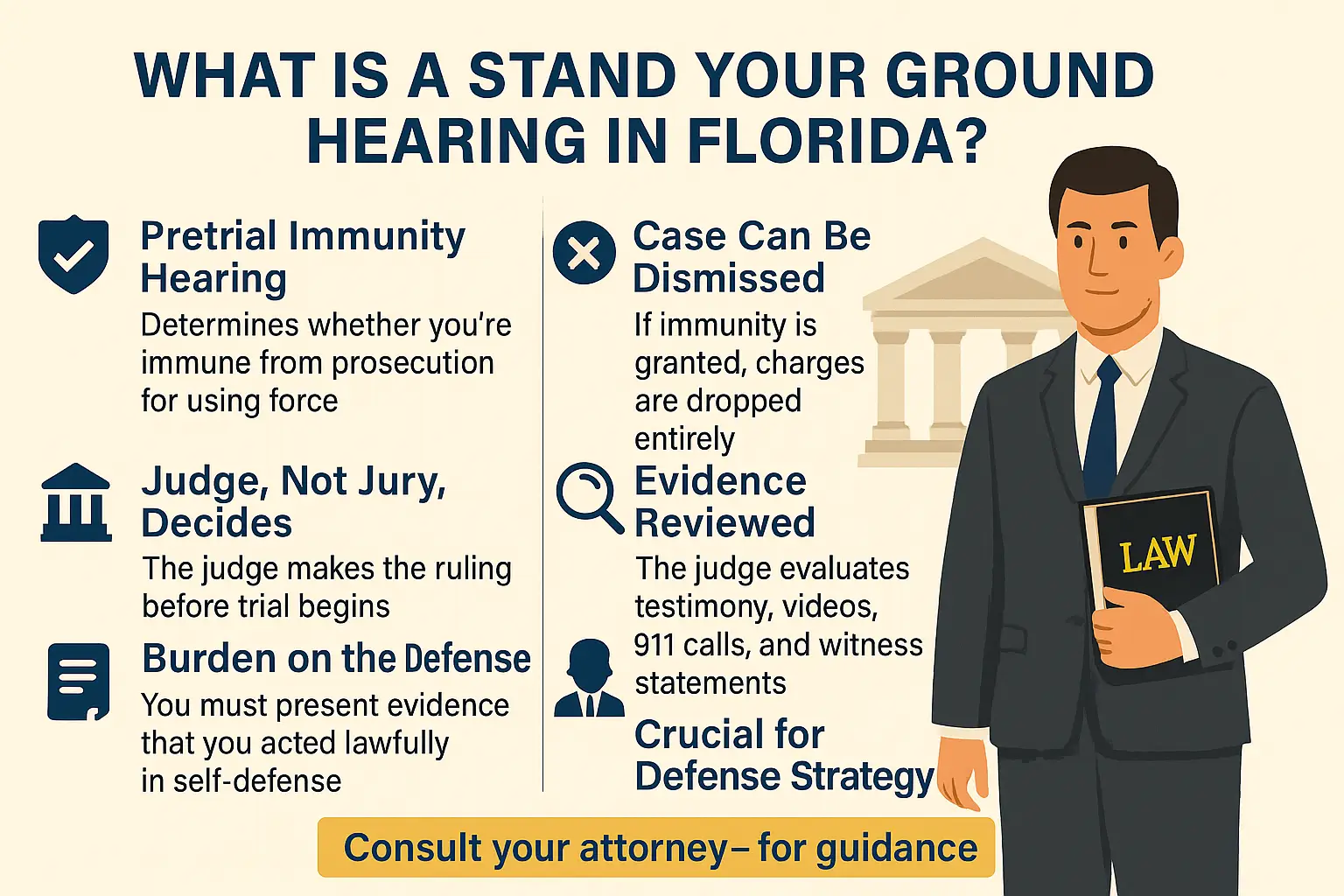
A Stand Your Ground hearing happens before trial, where your attorney presents evidence to a judge showing you acted legally and should not face prosecution at all.
In Broward County and throughout Florida, these hearings are often decisive. When handled properly, they can end the entire case.
Here’s how they work.
⚖️ What Is a Stand Your Ground Hearing?
Under Fla. Stat. § 776.032, a defendant may seek immunity by proving they acted in lawful self-defense. A Stand Your Ground hearing is a pretrial evidentiary hearing where the defense argues:
You were justified in using force
You reasonably believed force was necessary
You were lawfully present
You were not committing a separate crime
If the judge finds you were justified, the case ends — immediately.
This procedural option is closely related to self-defense arguments used in domestic violence cases, BAT LEO charges, and other confrontational offenses.
🏛️ How a Stand Your Ground Hearing Works
These hearings typically involve:
1. Testimony
Your defense attorney may present:
Your testimony
Eyewitnesses
Forensic experts
Medical records
Scene photographs
Body-worn camera footage
2. Cross-Examination
The State cross-examines witnesses to challenge:
Reasonableness of your fear
Necessity of force
Prior statements
Timeline of events
3. The Judge’s Role
Unlike trial:
There is no jury
The judge makes the ruling
The State carries the burden to disprove justification by clear and convincing evidence
This standard is HIGH — significantly stronger than typical pretrial motions such as a motion to suppress.
🔥 What Makes a Good Stand Your Ground Case?
Successful SYG hearings frequently involve:
✔ Clear threat or aggressive behavior by the alleged victim
Especially in DV, road-rage, or bar confrontation cases.
✔ Evidence showing your fear was reasonable
Bodycam footage, 911 calls, neighbor statements, injuries.
✔ Situations where retreat wasn’t required
Florida law does not require retreat when you’re lawfully present.
✔ Clean defendant background
Helps the judge assess credibility and necessity.
✔ Consistency between your statements and the evidence
Contradictions are heavily exploited by prosecutors.
These hearings share similar evidentiary structures with self-defense considerations in battery, aggravated assault, and criminal speeding with confrontation cases.
🚫 When Stand Your Ground Does Not Apply
Immunity is generally not granted when:
You were committing a crime during the incident
You were the initial aggressor and didn’t withdraw
You pursued or escalated the confrontation
Force was used in a way not supported by evidence
Injury resulted from negligent or reckless behavior
In these cases, defenses may shift toward trial-based self-defense, reductions, or negotiations.
🧩 What Happens If You Win?
Winning a SYG hearing means:
Case dismissed
Immunity from prosecution
Immunity from civil suits
This is one of the few ways to end a case completely before trial — another being a successful motion to suppress (which excludes key evidence).
🛑 What Happens If You Lose?
Losing a SYG hearing does not mean you are guilty.
It simply means the judge believes the State met its burden to move forward.
After that, you still have several options:
Trial
Negotiated plea
Reduction of charges
Diversion (in rare cases)
Continued investigation of inconsistencies
Some of these outcomes mirror strategies used in domestic violence battery and DUI negotiations.
🛡️ Speak With a Fort Lauderdale Criminal Defense Lawyer Today
Stand Your Ground hearings are complex, technical, and incredibly important.
If you acted to defend yourself, you deserve the chance to fight for immunity.
Contact Michael White, P.A. today so we can prepare your evidence and protect your future.
❓ FAQs — Stand Your Ground Hearings in Florida
1. What is the purpose of a Stand Your Ground hearing?
To determine whether you are entitled to immunity from prosecution based on lawful self-defense.
2. Do I have to testify at a SYG hearing?
Not always. Your attorney will evaluate whether your testimony strengthens or weakens your case.
3. What happens if I win the hearing?
Your case is dismissed, and you receive immunity from criminal and civil liability.
4. What happens if I lose?
The case proceeds normally — SYG is not a determination of guilt.
5. How does the judge decide?
The State must disprove self-defense by clear and convincing evidence, a high legal standard.