
Last updated November 2025
During a traffic stop in Fort Lauderdale or anywhere in Broward County, one of the most invasive things an officer can do is try to inspect or search your phone. Your cellphone contains more personal information than any other item you carry—messages, photos, emails, location data, banking apps, and private documents.
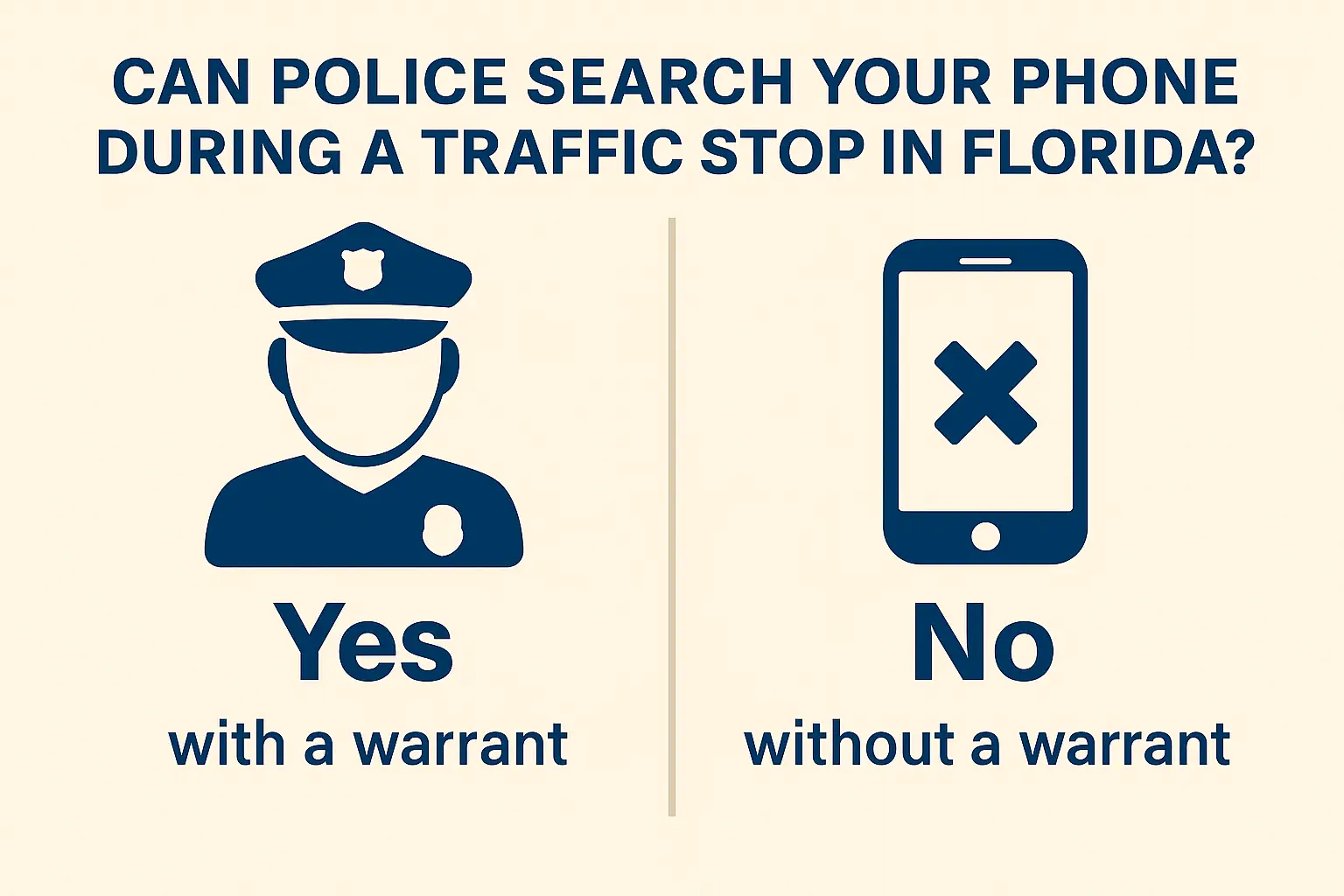
Florida law enforcement cannot search your phone during a traffic stop unless very specific legal requirements are met. Most roadside phone searches violate the Fourth Amendment and Florida’s constitutional right to privacy.
Here’s what you need to know before you hand over your device.
⚖️ When Police Can Search Your Phone
Police may legally search your phone during a traffic stop only under these limited circumstances:
1. You Give Clear, Voluntary Consent
Officers often say:
“Let me see your phone for a second,” or
“Do you mind if I look at something?”
If you agree—even reluctantly—the search becomes lawful.
Never consent unless advised by an attorney.
2. There Is a Valid Search Warrant
Under Riley v. California, the U.S. Supreme Court unanimously held:
Police must obtain a warrant to search a cellphone, even after arrest.
A traffic stop alone is never enough to justify a phone search.
3. Exigent Circumstances Exist
This is extremely rare.
The State must show police had an urgent need to prevent:
imminent danger
destruction of evidence
flight of a suspect
Routine traffic stops almost never meet this standard.
🚫 When Police Cannot Search Your Phone
Officers cannot search your phone when:
You are only pulled over for a traffic violation
They ask “out of curiosity”
They want to see your text messages
They claim they need to “verify your identity”
They try to scroll through your photos
They pressure you into showing them something
Your phone is protected more strongly than almost any other possession under the law.
Read more about digital privacy rights.
🚓 Common Police Tactics to Watch Out For
Officers may attempt:
“Consent by confusion” (“Let me see your phone real quick.”)
Asking you to unlock your phone
Suggesting you’ll “look suspicious” if you refuse
Pretending the search is required for the stop
Claiming it’s to verify a passenger’s ID
Do not unlock your phone unless there is a warrant.
You cannot be punished simply for refusing consent.
For comparison, learn what officers can legally do when dealing with passengers.
🛡️ How We Challenge Illegal Phone Searches
Our office frequently challenges:
Warrantless phone searches
Overbroad digital warrants
Searches based on coerced “consent”
Traffic stops that expanded unlawfully
Detentions not supported by reasonable suspicion
Body-worn camera footage, timestamps, radio traffic, and officer statements often reveal that the search was unlawful from the start.
Even in serious cases like DUI, drug possession, or resisting arrest, unlawfully obtained digital evidence is often suppressible.
For a deeper look at suppression issues, see your Motion to Suppress Guide.
🚨 Get Legal Help Before Things Get Worse
If police searched—or tried to search—your phone during a traffic stop, you may have strong grounds to suppress evidence or challenge the legality of the stop.
Contact Michael White, P.A. today to protect your privacy and your future.
❓ FAQs — Phone Searches During Traffic Stops in Florida
1. Can police search my phone during a traffic stop without consent?
No. Without a warrant or valid exception, officers cannot search your phone.
2. Can police make me unlock my phone?
No. You cannot be compelled to give your passcode or fingerprint during a routine stop.
3. What if I verbally agree under pressure?
Consent must be voluntary. Coerced consent can often be challenged.
4. Can police seize my phone even if they can’t search it?
Sometimes. If police have probable cause to believe the phone contains evidence of a crime, they may temporarily seize it while seeking a warrant.
5. What should I say if an officer asks to look at my phone?
Politely say: “I do not consent to a search of my phone.”
This preserves your rights and prevents accidental waiver.