
Last updated January 2026
When someone is accused of stealing property in Florida, the legal consequences may unfold in two entirely different systems: criminal court and civil court. Although both may arise from the same alleged conduct, civil theft and criminal theft are not the same thing — and the penalties, burden of proof, and long-term impact differ dramatically.
Understanding the distinction is critical, especially because a person can face both cases at the same time, even if one is dismissed.
Allegations involving theft in Florida can trigger serious consequences in both criminal court and civil court, which is why understanding how these cases work — and how they are defended under Florida law — is critical when evaluating your options with an experienced theft and fraud defense lawyer.
What Is Criminal Theft in Florida?
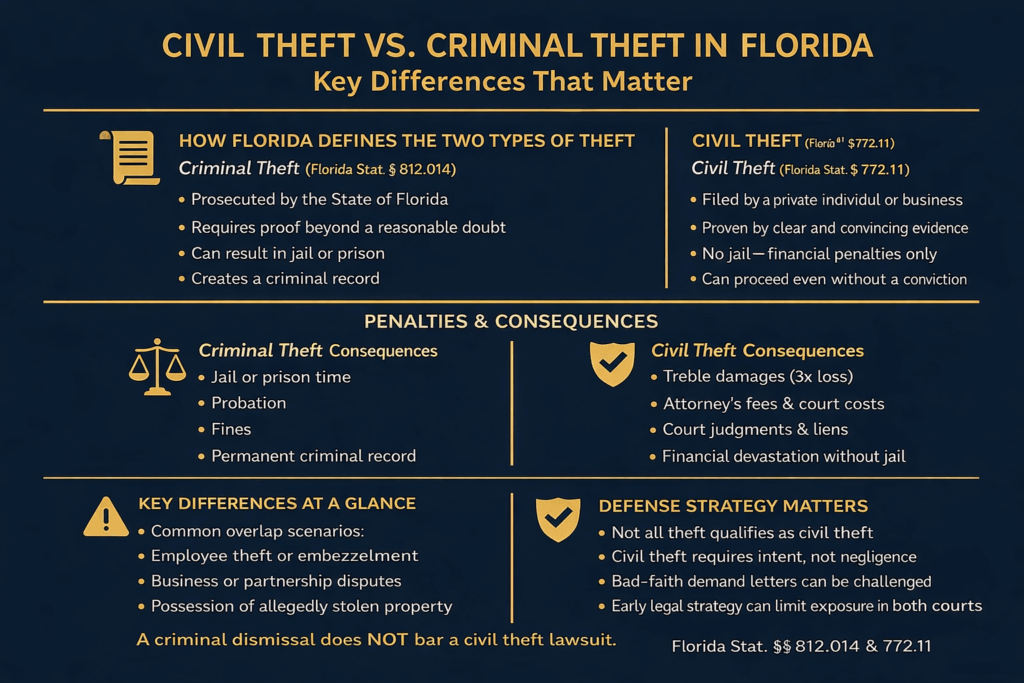
Criminal theft is a state-prosecuted offense governed by Florida law. These cases are brought by the State Attorney’s Office and are intended to punish conduct deemed harmful to the public.
To obtain a conviction, prosecutors must prove the charge beyond a reasonable doubt, the highest legal standard. A criminal theft conviction can result in incarceration, probation, fines, and a permanent criminal record.
Criminal theft charges may arise from allegations involving shoplifting, employee theft, possession of stolen property, or other forms of unlawful taking.
What Is Civil Theft in Florida?
Civil theft is not a criminal charge. It is a private lawsuit brought by an individual or business seeking financial recovery based on alleged theft-related conduct.
Civil theft claims are governed by Florida’s civil theft statute and are proven under a clear and convincing evidence standard — lower than the criminal burden of proof. Unlike criminal cases, civil theft does not involve jail or prison. Instead, it exposes defendants to significant financial liability.
If successful, a civil theft plaintiff may recover:
Three times the value of the alleged loss
Attorney’s fees and court costs
Court-ordered monetary judgments
A civil theft lawsuit may proceed even if no criminal charges are filed.
Key Differences Between Civil Theft and Criminal Theft
The most important distinctions include who files the case, how it is proven, and what is at stake.
Criminal theft cases are filed by the State of Florida and seek punishment, while civil theft cases are filed by private parties seeking financial recovery. Criminal cases require proof beyond a reasonable doubt, whereas civil theft claims require clear and convincing evidence.
Criminal theft can result in incarceration and a criminal record. Civil theft cannot result in jail, but the financial consequences can be severe.
Can Someone Face Both Civil and Criminal Theft Cases?
Yes. Florida law allows parallel proceedings, meaning a person may be charged criminally and sued civilly based on the same alleged conduct.
Importantly, a dismissal or acquittal in a criminal case does not automatically bar a civil theft lawsuit. The two cases operate independently, under different legal standards.
Common Situations Where Civil and Criminal Theft Overlap
Civil and criminal theft cases frequently arise together in situations involving:
Alleged employee theft or embezzlement
Business or partnership disputes
Possession of allegedly stolen property
Theft allegations tied to fraud claims
In these cases, early legal strategy is critical to limiting exposure in both courts.
Why Defense Strategy Matters in Civil Theft Cases
Not every theft allegation qualifies as civil theft. Civil theft requires proof of intent, not negligence or mistake. Overreaching or bad-faith claims can often be challenged, especially when demand letters are improperly used as leverage.
Handling civil and criminal theft matters together — rather than in isolation — helps prevent admissions, inconsistent defenses, and unnecessary financial exposure.
When to Speak With a Lawyer
Whether a theft allegation appears in criminal court, civil court, or both, the stakes are high. Understanding which type of case you are facing — and how they interact — can make the difference between a manageable outcome and long-term consequences.
❓ Frequently Asked Questions About Civil vs. Criminal Theft in Florida
Can someone be charged criminally and sued civilly for the same theft?
Yes. Florida law allows criminal theft charges and civil theft lawsuits to proceed at the same time, even though they involve different courts, standards of proof, and consequences.
Does a criminal dismissal prevent a civil theft lawsuit?
No. A criminal dismissal or acquittal does not automatically bar a civil theft claim. Civil theft cases operate independently and use a lower burden of proof.
Can you go to jail for civil theft in Florida?
No. Civil theft is a financial lawsuit, not a criminal prosecution. However, related criminal charges may still carry jail or prison exposure.
Why are civil theft penalties sometimes worse than criminal penalties?
Civil theft allows for treble damages, attorney’s fees, and court costs. In many cases, the financial consequences exceed any criminal fine and can be devastating.
What should I do if I receive a civil theft demand letter?
Do not pay or respond before speaking with a lawyer. Demand letters are often used strategically, and improper responses can increase liability or be used against you later.
Is civil theft the same as conversion?
No. Conversion and civil theft are related but distinct claims. Civil theft requires proof of criminal intent, while conversion does not. This distinction is often critical to defense strategy.
Facing Theft Allegations in Florida?
Civil theft and criminal theft cases require different strategies — but mistakes in one can affect the other.
If you are under investigation, facing criminal charges, or dealing with a civil theft demand letter or lawsuit, speak with a lawyer before taking action. Early legal guidance can help limit exposure, protect your rights, and prevent costly errors.