
Last updated February 2026
Many drivers believe that calling a tow truck or rideshare is the responsible choice—and legally, it often is. But in Florida, waiting for a tow or Uber does not automatically prevent a DUI arrest.
These cases frequently arise after breakdowns, accidents, or roadside stops, and they often hinge on whether police believe the driver was still in actual physical control of the vehicle.
⚖️ Can You Get a DUI While Waiting for a Tow or Rideshare?
Yes. Florida DUI law does not require proof that a vehicle was moving at the time of arrest.
Officers may claim DUI if they believe:
you were impaired, and
you had the ability to operate the vehicle.
In many of these cases, the strongest defense focuses on challenging and suppressing the DUI evidence, rather than arguing that calling for help alone should prevent an arrest.
🚔 How These Cases Commonly Begin
DUI arrests while waiting for a tow or rideshare often start as:
welfare checks,
roadside breakdown responses,
accident investigations,
or suspicious vehicle calls.
A lawful welfare check does not automatically justify sobriety exercises, prolonged detention, or testing. Whether police had legal grounds to escalate the encounter is often central to the defense.
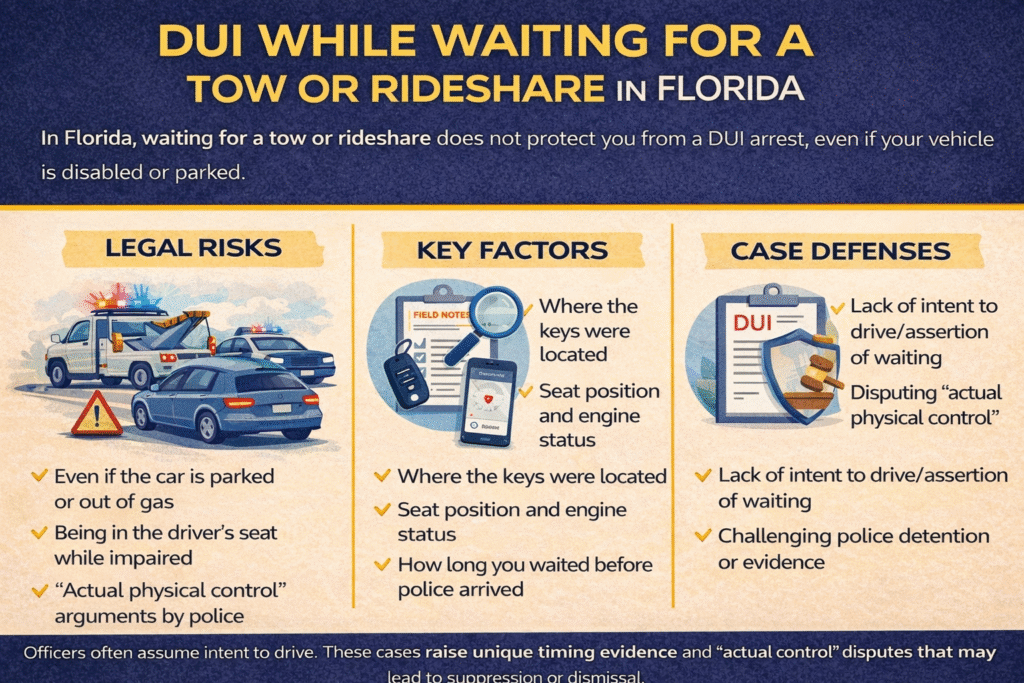
🗝️ Key Location, Seat Position, and Engine Status
Officers frequently rely on circumstantial details, including:
where the keys were located,
whether the engine was running,
where the driver was seated,
whether the vehicle was operable.
These details are often used to argue actual physical control, even when the driver claims they were waiting for help.
🕒 Timing and Intent to Drive
One of the most important issues in tow- and rideshare-related DUI cases is intent.
Courts often examine:
whether a tow or rideshare was actually requested,
how long the driver waited before police arrived,
whether the vehicle was disabled,
whether there was evidence of an attempt to drive.
Evidence showing the driver intended not to drive can significantly weaken the State’s case.
🧪 Testing Problems in Roadside DUI Cases
Because these cases often involve delays, testing issues are common:
delayed breath or blood testing
alcohol absorption after stopping
reliance on subjective observations
stress or environmental factors affecting performance
These issues often implicate Florida DUI testing rules and support suppression arguments.
🚘 Actual Physical Control While Waiting
Even when a vehicle is disabled or parked on the roadside, prosecutors may still argue actual physical control.
They may focus on:
operability,
key access,
proximity to the driver’s seat,
capacity to start the vehicle.
Waiting-for-help facts frequently undermine these claims.
✅ Key Takeaways
Waiting for a tow or rideshare does not automatically prevent a DUI arrest
Police often assume intent to drive
Actual physical control is frequently disputed
Testing delays are common
Suppression is often the strongest defense
❓ FREQUENTLY ASKED QUESTIONS
Can I be arrested for DUI if my car was broken down?
Yes, but vehicle inoperability can be a strong defense depending on the facts.
Does calling a tow truck or Uber help my case?
Often, yes. Proof that you intended not to drive can weaken the State’s argument.
Does sitting in the driver’s seat matter?
It can. Seat position is often used to argue control, even when the driver claims they were waiting.
Are these DUI cases defensible?
Very often. These cases frequently involve weak proof of intent, questionable escalation, or testing issues.