
Last updated January 2026
🚨 Charged With Assault in Florida? The State Has a Heavy Burden.
Florida prosecutors can’t convict you of assault just because someone claims you scared them. They have to prove very specific elements—and that’s where we fight.
While this guide explains Fort Lauderdale assault statewide, enforcement and charging decisions often depend on local agencies and prosecutors.
At Michael White, P.A., we break down what assault charges in Florida really mean, what the State must prove, and how we build strategic defenses that work.
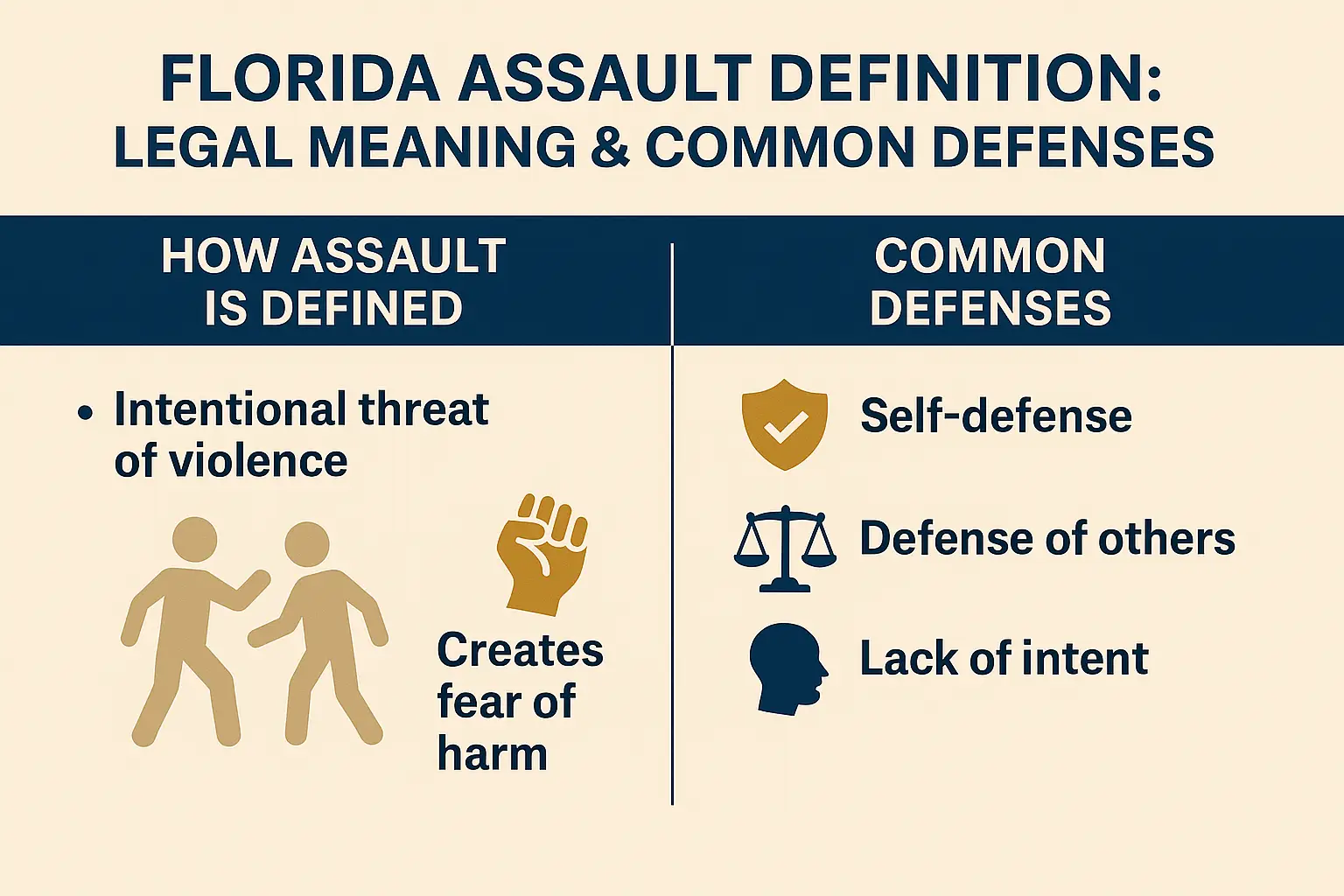
⚖️ Legal Definition of Assault (Fla. Stat. § 784.011)
To convict someone of simple assault, prosecutors must prove:
You made an intentional threat—by word or action
You had the apparent ability to carry out the threat
The alleged victim had a well-founded fear that violence was imminent
🛑 Important: Physical contact is not required for an assault charge.
⚖️ Penalties for Assault in Florida
Not every assault in Florida is a felony. Many are charged as simple assault, a misdemeanor offense
Simple assault is a second-degree misdemeanor punishable by up to 60 days in jail, 6 months of probation, and a $500 fine.
Aggravated assault is a third-degree felony punishable by up to 5 years in prison and a $5,000 fine.
🔺 When Simple Assault Becomes Aggravated Assault
Not every assault charge in Florida is a misdemeanor. A simple assault can be elevated to aggravated assault if certain aggravating factors are present.
Under Florida law, assault becomes aggravated when:
A deadly weapon is used or displayed, even if no one is injured, or
The threat occurs during the commission of another felony
In addition, assault charges are often treated more seriously when the alleged victim is a law enforcement officer, teacher, medical professional, or other protected public employee.
Aggravated assault is charged as a third-degree felony and carries significantly harsher penalties, including potential prison time and long-term consequences.
🧩 How We Beat Assault Charges in Fort Lauderdale
Every assault case turns on whether the State can prove all three required elements: intent, apparent ability, and reasonable fear. In Fort Lauderdale assault cases, our defense strategy focuses on exposing where that proof breaks down.
Disputing Intent
Words spoken in anger, sarcasm, or frustration are often mischaracterized as threats. If there was no genuine intent to cause fear, the assault charge cannot stand.
Challenging the Fear Element
The alleged victim’s fear must be both real and reasonable. We examine body-worn camera footage, witness statements, and post-incident behavior to show when fear is exaggerated, assumed, or fabricated.
Lack of Apparent Ability
Even heated words are not assault unless the accused appeared capable of immediately carrying out the threat. Distance, physical barriers, and surrounding circumstances matter.
Self-Defense and Stand Your Ground
If threats or force were used to prevent imminent harm, Florida law may provide immunity from prosecution under Stand Your Ground or other justifiable use-of-force statutes.
Each of these strategies is designed to stop weak assault cases before they ever reach a jury.
⚖️ Pre-Charge Intervention in Fort Lauderdale Assault Cases
In many Fort Lauderdale assault cases, formal charges are not filed immediately after an arrest. That early window can be critical.
When possible, we intervene before charges are filed by presenting exculpatory evidence directly to prosecutors. This may include video footage, text messages, witness statements, or proof that one or more elements of assault cannot be established.
Early intervention can lead to:
No charges being filed at all
Reduction to a non-violent offense
Referral to pretrial diversion instead of prosecution
Once formal charges are filed, options narrow significantly. Acting early often makes the difference between dismissal and a prolonged criminal case.
🔍 Common Examples of Assault in Florida
Raising your fist during an argument
Stepping aggressively while yelling
Holding a weapon threateningly
Road rage threats
🧾 Assault vs. Battery
Assault and battery are often charged together, but they’re legally distinct.
Assault is a threat — no physical contact required.
Battery involves actual physical contact or harm.
For example, raising your fist and saying, “I’m going to hit you,” may be assault; following through makes it battery.
🔥 Where Assault Cases Commonly Fall Apart
🔹 Intent
Did you mean to threaten violence—or were you simply arguing, reacting, or misunderstood?
🔹 Apparent Ability
Did you actually appear capable of carrying out the threat?
A verbal argument across a parking lot usually won’t meet this threshold.
🔄 Common Defenses to Assault Charges
❌ No intent to threaten
🙄 Victim overreacted or misinterpreted
🔁 Mutual argument with no threat of violence
🎥 Video contradicts claim of fear or threat
🛡️ Self-defense or Stand Your Ground
🚫 No Well-Founded Fear / No True Threat
🔹 Well-Founded Fear
The alleged victim must have genuinely feared imminent harm—and that fear must be reasonable under the circumstances.
🎯 What We Aim to Achieve in Fort Lauderdale Assault Cases
Every case is different, but our objectives remain the same:
Dismissal of charges when the State cannot prove intent, fear, or apparent ability
Pretrial diversion to avoid a conviction and protect your record
Reduction to a lesser, non-violent offense when appropriate
Withhold of adjudication to preserve future sealing or expungement eligibility
Avoidance of jail time whenever legally possible
Our approach is strategic, evidence-driven, and focused on protecting your freedom, reputation, and future.
🚨 What to Do If You’re Arrested for Assault in Florida
If you’ve been arrested or are under investigation for assault, what you do next can directly affect the outcome of your case.
Do not give a statement to police. Even trying to “explain what happened” can be used against you later.
Avoid contacting the alleged victim. This can violate bond conditions or lead to additional charges.
Preserve all evidence immediately. Save text messages, call logs, videos, social media posts, and the names of any witnesses.
Write down what happened while it’s fresh. Small details often matter in assault cases.
Speak with a criminal defense attorney as early as possible. In many cases, early intervention can prevent charges from being filed or significantly weaken the State’s case.
⚠️ What If the Charge Is Aggravated Assault?
Aggravated assault involves:
A deadly weapon, or
Occurs during the commission of another felony
It’s charged as a felony and carries much harsher penalties.
Because no physical contact is required, many assault cases arise from verbal altercations, road-rage incidents, or heated disputes that never became physical.
📌 Related Reading:
What Is Aggravated Assault in Florida?
🛡️ Why Hiring an Attorney Early Matters
Assault cases often come down to conflicting stories and emotional reactions.
Your attorney can:
Gather favorable evidence early
Interview witnesses before memories fade
Build a narrative that keeps prosecutors from filing charges—or gets them dropped later
📞 Facing Assault Charges in Florida? Let’s Get to Work.
Whether you’re facing misdemeanor or felony assault, we fight to protect your record and your reputation.
Call before the State locks in a version of events that works against you.
📲 Call (954) 270-0769 or schedule your consultation now
❓ Frequently Asked Questions
⚖️ What are the elements of assault under Florida law?
Florida prosecutors must prove three elements:
an intentional threat (by word or act),
the apparent ability to carry it out, and
that the victim had a well-founded fear of imminent violence.
❌ Do I have to hit someone to be charged with assault?
No. Assault in Florida doesn’t require physical contact. It’s the threat of violence that matters—not whether the threat was actually carried out.
🔁 What’s the difference between assault and aggravated assault?
Simple assault involves a threat of violence.
Aggravated assault includes a deadly weapon or occurs during the commission of a felony, making it a felony offense with harsher penalties.
🛡️ What defenses are available to assault charges in Florida?
Common defenses include:
Lack of intent to threaten
No reasonable fear by the alleged victim
Mutual argument without escalation
🧑⚖️ Can I get an assault charge dropped or reduced?
Yes. We often negotiate for dismissals, reduced charges, or diversion—especially if there’s no physical injury, the victim overreacted, or evidence is weak.
❓Can words alone be assault?
Not usually. There must be an act showing ability to carry out the threat.
🚫 Can I be charged for yelling during an argument?
Only if the alleged victim reasonably feared immediate harm.