
Last updated January 2026
If you’ve been arrested for DUI in Florida, the State’s case almost always rises or falls on testing evidence. Breath tests. Blood draws. Urine samples. Observation periods. Calibration logs. Chain of custody. Timing after a crash.
The truth is simple: DUI testing is not foolproof. These cases depend on machines, procedures, paperwork, and assumptions — and when any part of that system breaks down, the evidence may be unreliable or inadmissible.
This guide explains how DUI testing works in Florida, where it commonly fails, and how experienced defense attorneys challenge flawed results in real cases.
⚖️ Florida DUI Law and “Proof” of Impairment
Florida prosecutors rely on chemical testing and observations to prove impairment. Those methods are only persuasive if testing was lawfully obtained and scientifically reliable. The State generally attempts to prove impairment in one of two ways:
Per se DUI — chemical testing at or above the legal limit
Impaired “normal faculties” DUI — even with low or no test results
Chemical testing can be used to support either theory — but only if it was lawfully obtained and properly handled. Testing evidence that fails to meet legal or scientific standards may be challenged or excluded.
🧪 Breath Testing in Florida DUI Cases
Breath testing is the most common form of chemical testing in Florida DUI cases because it is fast and heavily relied upon in court. It is also one of the most litigated areas of DUI defense because it depends on strict procedural compliance.
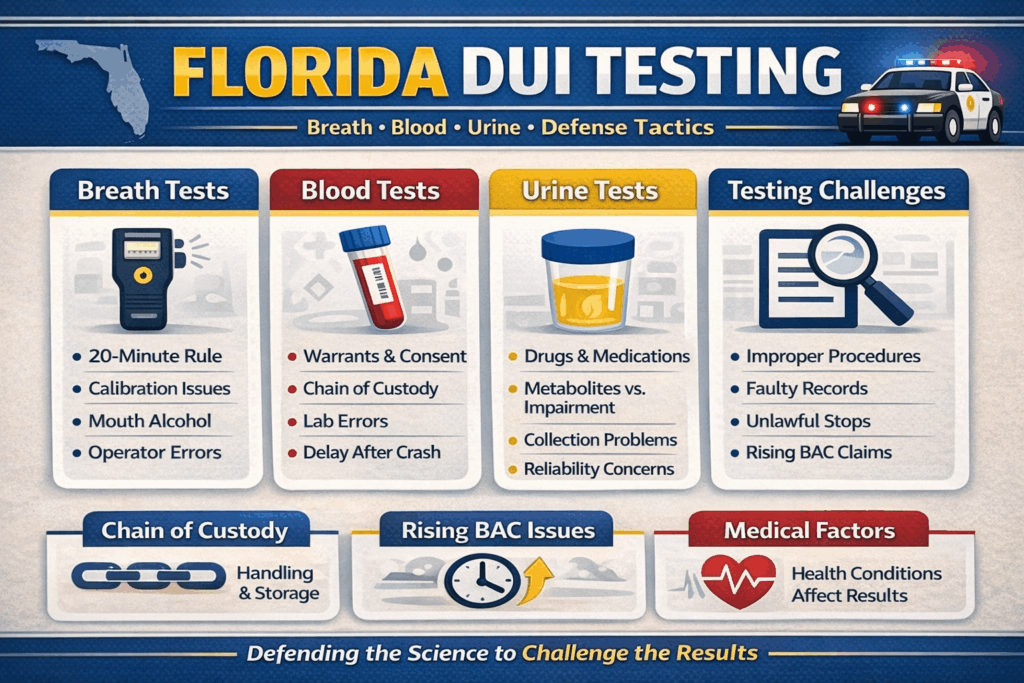
Common breath-test issues include:
Calibration and maintenance problems
Operator error or expired certification
Observation period failures (the “20-minute rule”)
Physiological factors that affect breath samples
- Mouth alcohol contamination (burping, vomiting, reflux, recent mouthwash)
Mouth alcohol contamination occurs when alcohol vapors remain in the oral cavity rather than the lungs. Burping, regurgitation, recent use of mouthwash, chewing tobacco, or dental appliances can all introduce residual alcohol that falsely elevates breath readings — which is why observation period compliance is critical.
Breath test results are not self-validating. Their reliability depends entirely on whether the State can prove that every required step was followed.
⚙️ How Florida Breath Testing Works (and Where It Breaks)
Florida agencies primarily use the Intoxilyzer 8000 to estimate blood-alcohol concentration from breath samples. The instrument relies on infrared spectroscopy and assumes the breath sample accurately reflects deep lung air.
Breath testing also relies on a fixed scientific assumption known as the partition ratio — the idea that 2,100 milliliters of breath equals the alcohol content in 1 milliliter of blood. In reality, partition ratios vary significantly between individuals and even within the same person under different physiological conditions. Factors such as body temperature, lung function, and breathing patterns can cause breath test results to read higher than a person’s true blood-alcohol level.
Breath testing commonly breaks down when:
Required procedures are skipped or rushed
The instrument is out of compliance or poorly documented
The operator lacks current certification
The observation period is incomplete or undocumented
The breath sample is contaminated
Even when a breath test appears valid on paper, underlying documentation problems often create powerful defense opportunities.
🔒 Refusing a Breath Test in Florida: Implied Consent and the Real Issue
Florida’s implied consent law allows administrative penalties when a driver refuses a breath test after a lawful DUI arrest. Refusal cases often turn on whether:
The arrest itself was lawful
The implied consent warning was read correctly
The refusal was clear, voluntary, and unambiguous
Refusal is frequently portrayed as “consciousness of guilt,” but many refusals occur due to confusion, fear of the machine, medical limitations, or unclear instructions. From a defense standpoint, refusal cases often create early opportunities to litigate stop legality, arrest legality, and procedure.
❗ Failed a DUI Breath Test? It’s Evidence — Not Automatic Proof
A breath test result over 0.08 is powerful evidence, but it is not an automatic conviction. A “failed” breath test can still be challenged through:
Calibration and maintenance documentation
Operator certification and administration
Observation period compliance
Mouth alcohol contamination
Medical or physiological explanations
In many cases, the strongest defense is not disputing alcohol consumption — it is demonstrating that the test result itself is unreliable under the specific facts.
🩸 Blood Testing in Florida DUI Cases
Blood testing is typically used when breath testing is unavailable, impractical, or legally insufficient. Common scenarios include:
DUI arrests involving crashes or injuries
Suspected drug impairment
Breath-test refusals with a warrant
Hospitalized drivers
Although blood evidence is often described as the “gold standard,” its reliability depends entirely on how the sample was collected, handled, documented, and analyzed.
⚖️ Common Problems With DUI Blood Tests
Blood test evidence is frequently vulnerable to challenge due to:
Chain-of-custody gaps
Improper storage or preservatives
Labeling or documentation errors
Hospital blood versus legal blood issues
Delays between driving and testing
Even small procedural errors can undermine the integrity of blood evidence and create reasonable doubt.
🧾 Legal Challenges to DUI Blood Draws
Blood draws raise significant Fourth Amendment concerns because they involve a physical intrusion into the body. In most cases, law enforcement must obtain either valid consent or a properly issued warrant.
Blood evidence may be challenged when:
A warrant lacked sufficient probable cause
A non-consensual draw occurred outside legal limits
Hospital blood was used without proper authorization
Statutory procedures were not followed
When blood evidence is excluded, the State often loses its strongest proof of impairment.
🚨 Warrantless Blood Draws and Exigent Circumstances
Florida courts evaluate warrantless blood draws case by case. There is no automatic exception for crashes, injuries, or suspected DUI manslaughter.
Courts examine whether a real emergency existed that made obtaining a warrant impractical, considering:
Scene conditions and medical priorities
Availability of a judge
Timing and delay concerns
If officers had time to obtain a warrant, a warrantless draw may violate constitutional protections.
⏱️ Trauma, Delayed Testing, and BAC Interpretation
In many Florida DUI cases, chemical testing does not occur immediately after driving. Breath or blood tests may be administered one or more hours later — particularly in cases involving crashes, injuries, medical treatment, or prolonged investigations.
These delays matter because chemical test results reflect the time of testing, not necessarily the time of driving.
Delayed testing can result in:
A BAC that had not yet peaked while the person was driving
Altered alcohol absorption caused by shock, stress, or injury
Effects of medical treatment, including IV fluids or medications
Changes in breathing patterns that affect breath testing
When testing is delayed, the State’s burden becomes more complex — and more vulnerable to challenge.
⚖️ Retrograde Extrapolation in Florida DUI Cases
To bridge the gap between delayed testing and the time of driving, prosecutors sometimes rely on a scientific method known as retrograde extrapolation. This method attempts to estimate a person’s earlier BAC by working backward from a later test result.
Retrograde extrapolation is not direct evidence. It is an estimate that depends on assumptions about:
When alcohol absorption began and ended
Whether the person was still absorbing alcohol at the time of driving
Elimination rates, which vary widely between individuals
Food intake, body composition, and drinking pattern
Because these variables are often unknown or disputed, retrograde extrapolation is highly case-specific and frequently contested.
⚠️ Factors That Undermine Retrograde Analysis
Florida courts scrutinize retrograde extrapolation closely because no two people metabolize alcohol in the same way. Common factors that weaken or invalidate retrograde analysis include:
Unknown timing of the last drink
Food intake that delayed absorption
Medical conditions or medications affecting metabolism
Stress or trauma altering physiological responses
Delays caused by transport, triage, or emergency care
Testing or storage irregularities
If alcohol absorption was still occurring, a driver’s BAC may have been lower at the time of driving than at the time of testing, directly contradicting the prosecution’s theory.
🛡️ Why Delayed Testing and Retrograde Evidence Matter
Delayed testing cases often signal that the State’s evidence is not straightforward. When prosecutors must reconstruct BAC instead of relying on timely testing, the defense may gain substantial leverage.
Successful challenges to delayed testing or retrograde extrapolation can result in:
Exclusion or suppression of BAC estimates
Reduction of charges
Dismissal when proof of impairment collapses
Increased negotiation leverage
In some cases, alcohol absorption may still be occurring at the time of driving, particularly when drinking occurred shortly before a stop. When testing is delayed, breath results may reflect a higher post-driving BAC rather than impairment while the vehicle was actually being operated. This distinction is especially important in borderline cases near the legal limit.
For this reason, trauma-related and delayed-testing cases require careful scientific and legal review early in the defense process.
🧪 Urine Testing and Drug DUI Cases in Florida
Urine testing appears most often in drug DUI cases, including allegations involving THC (marijuana), prescription medications, or multiple substances.
Unlike breath or blood testing, urine testing does not measure what is currently active in a driver’s system. Instead, it detects metabolites — chemical byproducts that remain in the body long after any impairing effects have passed.
This distinction is critical.
⚠️ Why Urine Tests Often Fail to Prove Impairment
Urine tests can show past exposure, but they often say nothing about impairment at the time of driving.
Common limitations include:
Metabolites may remain detectable days or weeks after use
The test does not show when the substance was consumed
The test does not establish how much active substance was present while driving
Concentration levels do not correlate reliably with impairment
As a result, urine testing frequently creates a gap between what the test shows and what the State must prove.
⚖️ Legal Challenges to Urine-Based DUI Cases
In urine-based DUI prosecutions, the defense often focuses on:
Whether the test proves impairment at the time of driving
Whether the substance detected was active or merely residual
Whether alternative explanations exist for the result
Whether the testing method meets admissibility standards
When the State cannot bridge the gap between metabolites and impairment, urine evidence may be given little weight — or excluded entirely.
🧠 Medical Factors That Can Affect DUI Testing
Testing is not performed in a vacuum. Real people have real conditions that can affect:
Apparent impairment
Breath test reliability
Field sobriety performance
Blood-alcohol readings after injury
Certain medical conditions an directly interfere with breath testing accuracy by introducing non-alcohol compounds or altering how breath samples are delivered to the instrument:
Gastroesophageal reflux disease (GERD) or acid reflux, which can introduce alcohol vapors from the stomach
Diabetes, where acetone may be misidentified as ethanol
Asthma or chronic respiratory conditions that alter breath flow and volume
Recent dental work or oral appliances that can trap residual alcohol
Fatigue and anxiety
Injury and trauma after a crash
🧾 The Paper Trail: Records That Win DUI Testing Challenges
Testing challenges often succeed because of documentation issues.
Depending on the type of test, important records may include:
Maintenance and calibration logs
Operator certification records
Observation period compliance notes
Breath card or instrument printouts
Lab submission forms
Chain of custody documents
Video evidence showing what actually happened during testing
When the paperwork doesn’t match the State’s story — that’s often where leverage is created.
🛡️ How DUI Testing Issues Create Leverage
Many DUI cases never go to trial — they resolve based on evidence strength.
When the defense identifies real testing problems, outcomes can include:
Suppression of test results
Reduction to a lesser offense (like reckless driving)
Dismissal when the State loses key proof
Stronger negotiation position early in the case
Testing issues also interact with constitutional issues, especially where the stop, detention, or search is challenged.
When testing evidence is unreliable or unlawfully obtained, defense attorneys may seek to suppress DUI evidence entirely.
🚗 What to Do If You’re Facing a DUI Testing Issue
If your DUI case involves breath, blood, or urine testing:
Act quickly — deadlines matter
Preserve evidence (video, receipts, witnesses, medical records)
Avoid making statements about drinking patterns without legal advice
Understand that testing is defendable — but only if it’s investigated early
For the license side of the case, the 10-day administrative window matters too.
For a broader overview of DUI defense strategies in Fort Lauderdale and South Florida — including how testing issues fit into the larger defense picture — see our Fort Lauderdale DUI defense guide.
❓ DUI Testing FAQs
Do DUI breath tests have to follow strict rules?
Yes. Breath tests are highly procedural, and deviations can create attack points in court.
Can blood tests be challenged in Florida DUI cases?
Yes. Chain of custody, preservation, and legal authority for the draw are common issues.
Does urine testing prove impairment?
Not always. Urine often shows metabolites and may not prove impairment at the time of driving.
What is the 20-minute observation rule?
It’s a pre-test requirement often used to prevent mouth alcohol contamination and ensure reliable results.
What if my test happened hours after a crash?
Timing issues can matter and may create defenses depending on the facts.