
Last updated January 2026
A client I’m currently representing in a DUI case called me recently. Now, he’s being investigated for a possible hit-and-run. The police reached out and asked him to provide a statement. His question was simple:
“Should I talk to them?”
My answer: Absolutely not—at least not without a lawyer present.
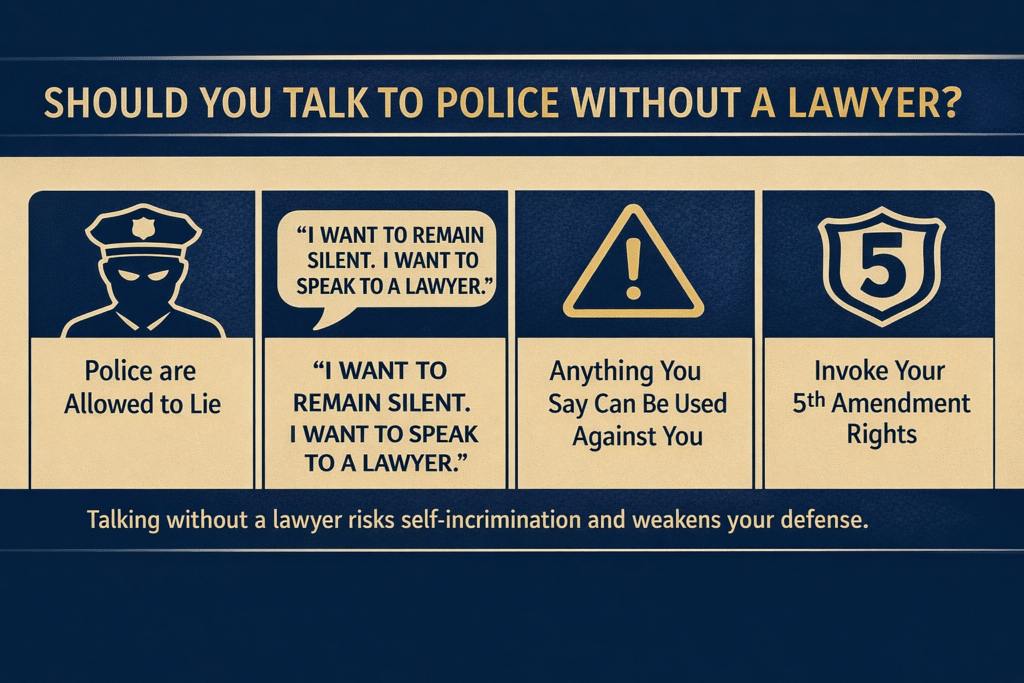
That advice is grounded in your Miranda rights, which protect you from self-incrimination during police questioning.
⚠️ Police Questions Are Rarely Harmless
Law enforcement officers are trained to ask questions that build a case against you. Even if you think you’re helping yourself—or think you’re innocent—you may say something that incriminates you or limits your defense.
Statements made without a lawyer are often the strongest evidence prosecutors rely on. When police obtain statements in violation of Miranda rules or after a coerced waiver, a defense attorney may be able to exclude them through suppression.
👨⚖️ Why You Need a Lawyer by Your Side
Here’s what an experienced defense attorney can do before you speak to police:
- ✅ Advise you on what to say—and what not to
- ✅ Protect your Fifth Amendment rights
- ✅ Prevent you from accidentally confessing or contradicting yourself
- ✅ Communicate with law enforcement on your behalf
Invoking your right to counsel is one of the strongest protections the Constitution gives you. Once you clearly ask for a lawyer, police must stop questioning you. Continued interrogation after a request for counsel can violate your rights and make any statements suppressible.
Saying “I want a lawyer” is not a sign of guilt — it is a constitutional safeguard designed to protect you during police questioning.
📞 Facing a Criminal Investigation? Call Me First.
If the police are calling you about a DUI, hit-and-run, or any other charge, do not respond without speaking to a lawyer. You may think cooperating will help your case—but in reality, it could make it worse.
📲 Call (954) 270-0769 today to schedule a free consultation with Michael White, P.A. I’ll protect your rights and help you avoid critical missteps.
Risks of Talking to the Police Without a Lawyer Present
In the video below, Michael White explains how police questioning works in real cases and why having a lawyer involved before you speak can protect your rights and your defense.
💬 Frequently Asked Questions: Talking to Police Without a Lawyer
Q1: Do I have to talk to the police if they call me about an investigation?
A: No. You have the right to remain silent and should exercise it. Politely decline and tell them you’ll speak through your lawyer. Talking without legal counsel can seriously harm your case.
Q2: What if I didn’t do anything wrong—shouldn’t I clear things up?
A: Even innocent people can say things that get misinterpreted or twisted into evidence. Police are trained to extract statements that support their case—not yours.
Q3: Can anything I say to the police be used against me later?
A: Yes. Anything you say can be used in court—even offhand comments or things said before an arrest. That’s why having a lawyer present is essential.
Q4: Will it look bad if I refuse to talk to the police?
A: No. Asserting your right to an attorney is protected by the Constitution and cannot be held against you in court. It shows you’re serious about protecting your legal rights.
Q5: When should I contact a lawyer during a criminal investigation?
A: Immediately. The earlier you involve an attorney, the more they can do to protect your rights, gather favorable evidence, and guide your next moves strategically.