
Last updated January 2026
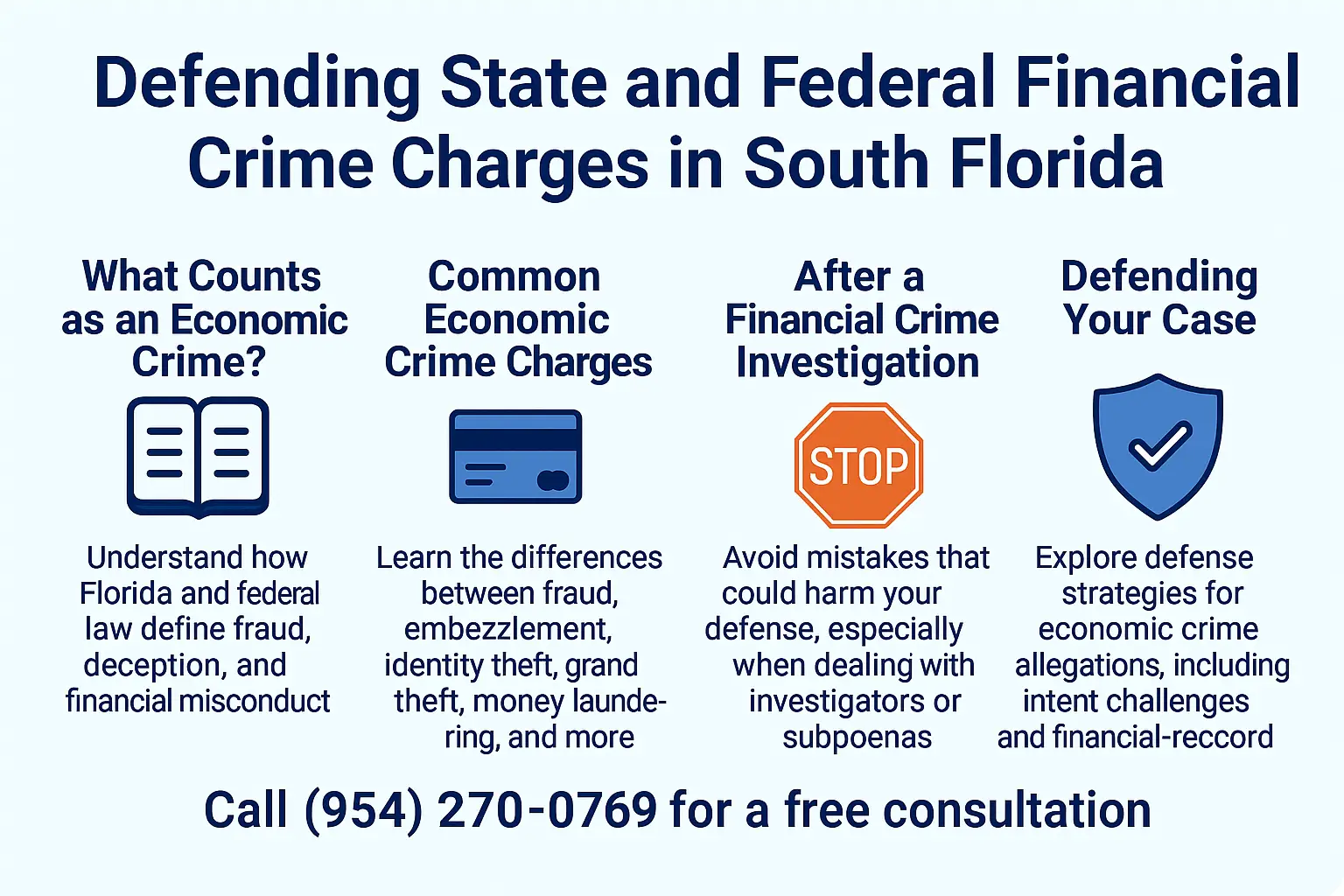
Defending State and Federal Financial Crime Charges in South Florida
If you are accused of fraud, embezzlement, or any other financial crime, you need an experienced economic crimes lawyer immediately. These cases move fast, involve multiple agencies, and often carry life-altering penalties — especially when federal prosecutors are involved.
At Michael White, P.A., we defend individuals and businesses facing economic crime investigations and charges in Fort Lauderdale, Broward County, Miami-Dade, Palm Beach County, and federal court. Whether you’ve received a subpoena, target letter, or formal charges, we act early to protect your rights, your reputation, and your future.
📞 Call (954) 270-0769 or schedule a confidential consultation today.
What Are Economic Crimes?
Economic crimes are non-violent offenses committed for financial gain. They are typically document-heavy, evidence-intensive, and aggressively prosecuted — particularly when banks, government funds, or interstate transactions are involved.
While often referred to as white-collar crimes, economic crimes encompass a broader category of financial and business-related offenses prosecuted under both Florida and federal law.
Common economic crime allegations include:
Fraud (bank, wire, mail, insurance, mortgage, tax)
Embezzlement and misappropriation of funds
Racketeering (RICO)
Money laundering (state and federal)
Healthcare and Medicare/Medicaid fraud
PPP loan fraud and SBA violations
Securities and corporate fraud
Bribery and public corruption
Forgery, check fraud, and financial falsification
These cases frequently involve forensic accounting, digital records, subpoenas, and multi-agency investigations.
State vs. Federal Economic Crime Charges
Economic crimes may be prosecuted in Florida state court or federal court, depending on how the conduct occurred and who was affected.
State cases are typically handled by local law enforcement and the State Attorney’s Office. Federal cases are investigated by agencies such as the FBI, IRS, DOJ, or U.S. Secret Service and prosecuted by the U.S. Attorney’s Office.
Federal charges often arise when allegations involve:
Interstate transactions
Banks or federally insured institutions
Government funds (PPP, Medicare, SBA)
Large loss amounts or multiple alleged victims
Federal prosecutions carry higher sentencing exposure, mandatory restitution, and asset forfeiture risks — making early legal strategy critical.
👉 Learn more about the differences between state and federal criminal charges in Florida.
Types of Economic Crime Cases We Defend
Our firm represents clients who are charged with — or under investigation for — a wide range of financial and business-related crimes, including:
Fraud and false statements
Federal wire fraud and mail fraud
Money laundering investigations
Racketeering and enterprise-based prosecutions
Tax-related offenses and IRS criminal cases
Healthcare billing and insurance fraud
Business and corporate crime allegations
If your case involves professional licensing risk, executive exposure, or federal prosecution, learn more about our focused white-collar crime defense services.
Penalties and Consequences of Economic Crimes
Penalties depend on the alleged conduct, loss amount, and whether the case is prosecuted at the state or federal level. Potential consequences include:
Felony convictions
Lengthy prison or federal sentencing exposure
Restitution orders in the tens or hundreds of thousands
Asset seizure and forfeiture
Loss of professional licenses or business interests
Long-term damage to reputation and employability
Even an investigation — before charges are filed — can jeopardize careers and businesses.
Our Defense Approach to Economic Crime Cases
Economic crime cases are not won by reacting late. They are won by early intervention, detailed analysis, and strategic pressure.
We routinely handle cases involving:
Grand jury subpoenas
Multi-agency investigations
Financial record analysis
Alleged intent or knowledge disputes
Our defense strategy focuses on:
Challenging intent, knowledge, and attribution
Attacking the government’s financial narrative
Identifying overreach, assumption-based charging, or flawed accounting
Negotiating pre-filing resolutions, diversion, or charge reductions
Aggressively litigating when prosecutors refuse to act reasonably
👉 Read how early legal intervention can change the outcome of a criminal case.
Speak With an Economic Crimes Defense Lawyer Today
Michael White is a former prosecutor who understands how financial crime cases are built — and how they fall apart. We provide discreet, strategic representation for clients facing serious economic crime allegations.
We defend clients throughout:
📍 Fort Lauderdale, Broward County, Miami-Dade, Palm Beach County, and federal courts in South Florida
📞 Call (954) 270-0769 or schedule your confidential consultation today.