
Last updated March 2026
Racketeering charges are among the most serious allegations a prosecutor can file in Florida. Often charged under Florida’s RICO statute, these cases can expose defendants to decades in prison, asset forfeiture, and reputational collapse.
If you’ve been accused of racketeering, it’s natural to ask:
Can these charges be dropped or reduced?
The answer is yes — but only under specific circumstances, and only when the defense applies early, strategic pressure to the State’s case. Below, we explain when racketeering charges can be dismissed or reduced, and why prosecutors frequently overreach when filing RICO cases.
For a broader of overview of racketeering charges in Florida, see our comprehensive guide on How Racketeering (RICO) Charges are Prosecuted and Defended in Florida.
🎥 Watch: How Racketeering (RICO) Charges Get Reduced or Dropped
In this short video, Fort Lauderdale defense attorney Michael White explains how prosecutors build racketeering cases, where those cases commonly break down, and why RICO charges are often reduced when the State cannot prove a true criminal enterprise.
⚖️ Real-World Example: From Racketeering to a Lesser Charge
In a recent Florida case, a client was charged with racketeering, a first-degree felony punishable by up to 30 years in prison. The State alleged an ongoing criminal enterprise based on financial transactions and related conduct.
After a detailed review of the evidence and sustained legal pressure, the defense exposed weaknesses in how the State defined the alleged enterprise and linked the predicate acts. As a result, prosecutors reduced the racketeering charge to a lesser offense, eliminating prison exposure and resolving the case through probation.
This outcome was not automatic — it required a focused challenge to the RICO framework itself.
🔍 When Racketeering Charges Can Be Dropped or Reduced
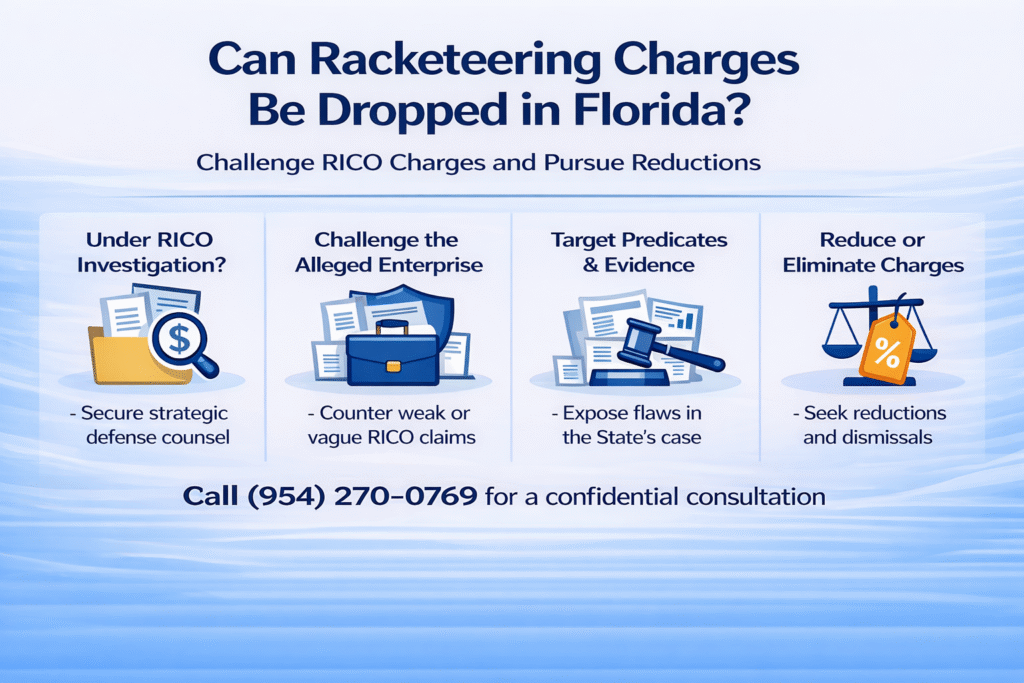
Racketeering cases are powerful tools for prosecutors, but they are also legally fragile. Charges may be dismissed or reduced when the defense can show problems such as:
📉 No true pattern of criminal activity
Isolated acts do not qualify as racketeering without a demonstrable pattern.🏢 Failure to establish an “enterprise”
The State must prove a real, ongoing organization — not just loosely connected conduct.🗂️ Weak or improperly linked predicate acts
RICO charges depend on underlying crimes; if those acts fail, the RICO case collapses.🧾 Overreliance on vague financial or business records
Complex transactions are often mischaracterized as criminal activity.💬 Unreliable or inconsistent witness testimony
Cooperating witnesses and insiders frequently undermine the State’s narrative.
In many cases, successful defense strategies involve challenging the RICO predicates, filing targeted motions, and negotiating from a position of legal leverage rather than fear.
🛡️ Why Early Legal Strategy Matters in RICO Cases
Racketeering charges are often filed as a pressure tactic — designed to force pleas, cooperation, or concessions. Once prosecutors commit to a RICO theory, they may resist backing down unless the defense exposes fundamental flaws in the case.
Early legal intervention allows a defense attorney to:
Challenge enterprise allegations before trial
Limit or exclude predicate acts
Prevent escalation into federal court
Position the case for reduction or dismissal
Because racketeering charges hinge on how prosecutors define an alleged enterprise and pattern of activity, it’s critical to understand the broader RICO framework before evaluating dismissal or reduction options.
In some cases, early defense pressure does not lead to a full dismissal, but instead creates leverage for a negotiated resolution that significantly reduces exposure. To better understand how plea negotiations work in Florida racketeering cases, see our post that discusses Negotiating Plea Deals in Florida RICO Cases.
⚖️ Facing Racketeering Charges in Fort Lauderdale or South Florida?
If you are under investigation or charged with racketeering, time matters. These cases move quickly, and delay often strengthens the prosecution’s position.
At Michael White, P.A., we defend clients throughout South Florida facing racketeering and related white-collar allegations, including fraud-based and enterprise-driven prosecutions.
📞 Call (954) 270-0769 or request a confidential consultation to protect your rights before the stakes escalate further.