
Last updated March 2026
Facing racketeering (RICO) charges in Florida is a life-altering situation. As a first-degree felony, a conviction can expose you to up to 30 years in prison, significant fines, asset forfeiture, and long-term damage to your reputation and career.
Because of that risk, many defendants ask an urgent question:
Can a racketeering case be resolved through a plea deal?
The answer is yes — sometimes. But whether a plea deal is offered, and whether it’s worth accepting, depends heavily on the strength of the State’s evidence, the structure of the alleged enterprise, and your defense strategy.
Learn more about how Racketeering (RICO) Charges are Prosecuted and Defended in Florida.
🎥 Watch: Negotiating Plea Deals in Florida Racketeering (RICO) Cases
In this short video, Fort Lauderdale defense attorney Michael White explains when prosecutors are willing to negotiate plea deals in racketeering cases, how RICO charges are often leveraged for pressure, and what defendants should consider before accepting or rejecting a plea offer.
⚖️ What Is a Plea Deal in a Racketeering Case?
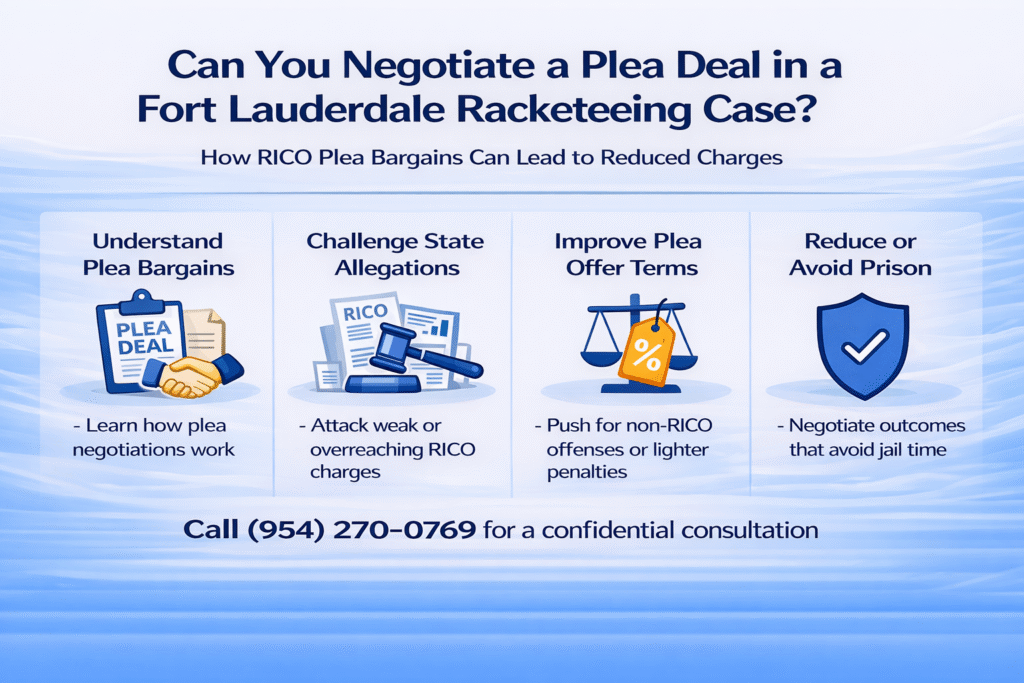
A plea deal (or plea bargain) is an agreement between the defense and the prosecution in which the defendant agrees to plead guilty or no contest in exchange for some form of concession.
In racketeering cases, that concession may include:
Reduction or dismissal of the RICO charge
Pleading to a lesser, non-RICO offense
Avoiding mandatory prison exposure
Limiting forfeiture or restitution claims
Accepting a plea deal usually means giving up the right to trial and, in most cases, the right to appeal. That tradeoff must be evaluated carefully.
🤔 Do Prosecutors Offer Plea Deals in Florida RICO Cases?
Yes — but not automatically.
Racketeering cases are complex, document-heavy, and risky for prosecutors. Even strong-looking RICO cases can unravel if the State struggles to prove a true criminal enterprise or a qualifying pattern of predicate acts.
Prosecutors may be motivated to negotiate in order to:
Avoid complicated, expert-driven trials
Manage limited resources
Reduce exposure if evidence is weak or circumstantial
Resolve cases involving multiple defendants
Whether a plea deal is offered often depends on:
🔍 The strength of the enterprise and pattern allegations
📑 The quality of financial and documentary evidence
👥 The number of defendants and alleged roles
⚖️ Defense pressure applied through motions and negotiation
🧠 Should You Accept a Plea Deal in a Racketeering Case?
Not every plea deal is a good deal.
Before accepting any offer, your defense attorney should help you evaluate:
✅ Strength of the Evidence
Can the State actually prove an enterprise and qualifying predicate acts? Are witnesses credible? Are financial records being misinterpreted?
✅ Terms of the Offer
Does the deal eliminate the RICO charge entirely? Does it avoid prison? What collateral consequences remain?
✅ Long-Term Consequences
Even reduced charges can impact:
Employment and professional licenses
Housing and credit
Immigration status
Future sentencing exposure
A plea offer must be weighed against realistic trial outcomes, not fear-driven assumptions.
🛡️ How a Defense Lawyer Negotiates Better RICO Outcomes
Effective plea negotiations in racketeering cases usually come after the defense exposes weaknesses in the State’s case.
A skilled RICO defense strategy may include:
Challenging the existence of an enterprise
Attacking weak or unrelated predicate acts
Filing motions that limit admissible evidence
Highlighting overcharging or misapplication of the RICO statute
Demonstrating why a jury trial presents risk to the prosecution
Because plea negotiations in racketeering cases depend heavily on how the State’s RICO theory is structured, it’s important to understand the broader racketeering framework before making any decisions.
For more information see our post on How Racketeering Charges Can be Dropped in Florida.
⚖️ Facing a Racketeering Case in South Florida?
If you’re under investigation or charged with racketeering in Fort Lauderdale, Broward County, Palm Beach, or Miami-Dade, the decisions you make early can shape the outcome of your case.
At Michael White, P.A., we help clients:
Evaluate plea offers realistically
Negotiate for reduced or non-RICO resolutions
Prepare for trial when negotiation is not in your best interest
📞 Call (954) 270-0769 or request a confidential consultation to discuss your options before critical decisions are made.